English
 Español
 Français
 Deutsch
 Italiano
 Português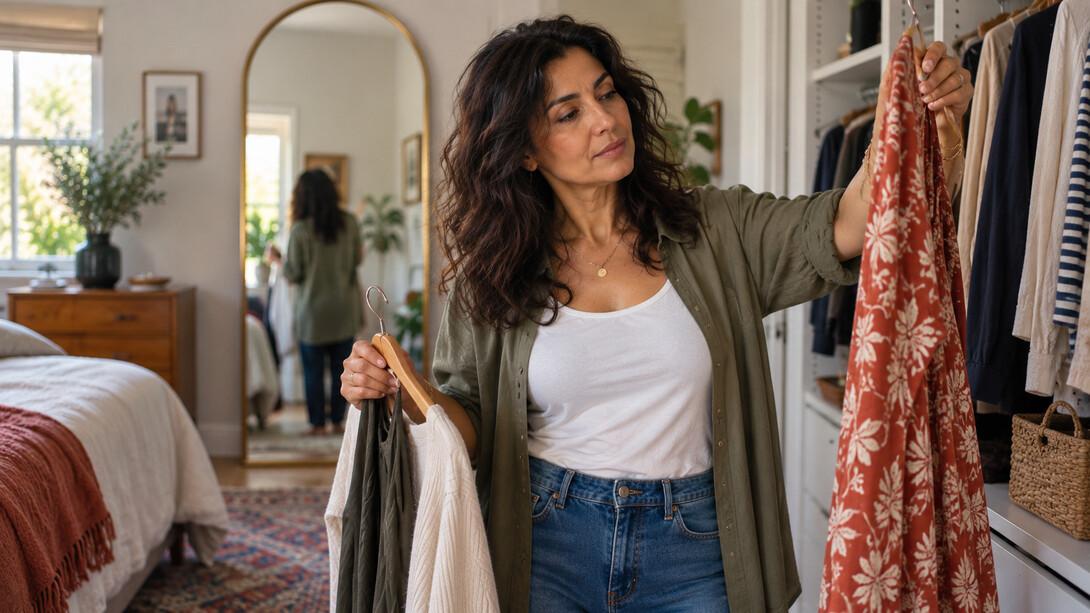
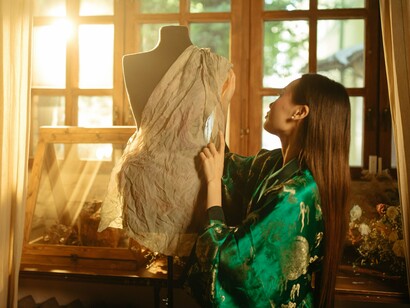
I have been designing clothes for almost twenty years, and lately I have found myself standing in front of my own closet thinking something that is slightly embarrassing for a fashion designer: I have no idea what to wear.
I know silhouettes. I know proportions. I know how a garment can emphasize one part of the body and soften another. I know what a few centimetres added here or removed there can do to the way a woman looks. I am not a stylist, but I understand the female body.
Or at least, I thought I did. Because for most of my career, without really thinking about it, I was designing for a relatively young body. And for most of my life, I was dressing one too.
When weight gain was just weight gain
In my twenties, I gained weight sometimes. I was a fashion student, after all. Stress, long nights, irregular meals—we've all been there. But when I gained weight then, my body still felt like my body, just slightly bigger. The proportions remained familiar. My waist was still my waist. My legs were still shaped the same way. If my jeans became too small, I simply needed a larger pair of jeans.
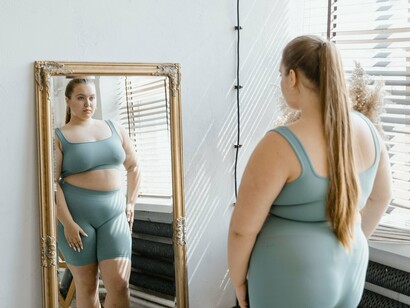
At 46, after five pregnancies and now going through perimenopause, it doesn't work like that anymore. My body hasn't simply become "bigger." It has changed its architecture.
The menopause transition is associated with changes in where women tend to store fat, particularly an increase around the abdomen. Aging, hormones, muscle mass, genetics, and lifestyle all play a role. I have developed what I can only describe as a permanent little pillow attached to my stomach, and apparently it is convincing enough that people still occasionally ask me if I am pregnant. At 46. Yes. Really.
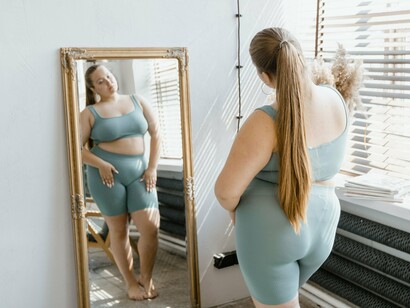
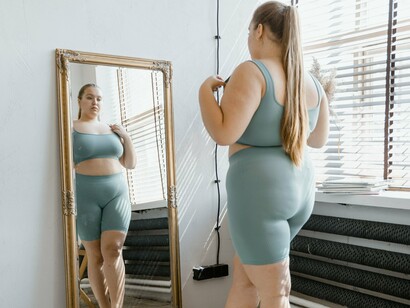
My inner thighs now touch each other when my entire life there was an O-shaped gap between my legs. My arms are thicker. My stomach changes throughout the day. Things sit differently around my hips and crotch. This isn't the body I learned to dress.
And suddenly, all those years of fashion experience haven't made getting dressed easier. In some ways, they've made it more frustrating.
Just buy a bigger size, except that doesn't work
The obvious answer would be, "Your body changed, so buy bigger clothes." Believe me, I've tried. The problem is that size and proportion are not the same thing. I can go up a size and still find trousers pulling unflatteringly around my stomach or crotch. Something can fit my hips and be completely wrong around my waist. A top can technically be my size but cling exactly where I don't want it to. Go another size up and suddenly the shoulders are too wide, the garment hangs everywhere else, and I look bigger rather than better.
The clothes fit. But they don't fit me. And that's when the designer in me started paying attention. Perhaps there isn't something wrong with my body.
Fashion hasn't quite caught up with us
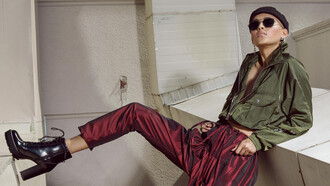
Women over 40 today occupy an interesting place culturally. We're not old. Many of us are raising children, running businesses, building careers, exercising, dating, traveling, starting new projects, and reinventing ourselves. We follow fashion. We wear sneakers. We want great jeans. We want beautiful dresses. Sometimes we want something sexy. Sometimes oversized. Sometimes elegant. Sometimes ridiculously comfortable. We don't suddenly wake up on our 40th birthday wanting to dress twenty years older.
Yet shopping can make it feel as though women have two choices. There are fashionable clothes largely designed around younger proportions and presented on young bodies. And then there is what is often politely called "mature fashion." Why do clothes designed to accommodate a changing body frequently seem determined to erase that body completely?
Loose tunics. Strange prints. Long tops designed primarily to hide the stomach. Elastic everywhere. Silhouettes that seem to say, Don't worry, nobody will know there's a woman under here. I don't want to hide. I want clothes that understand me.
We don't need to look thinner; we need better clothes
Fashion advice for women with changing bodies often revolves around disguise. How to hide your belly. How to make your arms look thinner. How to minimize your hips. At some point, you start wondering whether getting dressed is supposed to be enjoyable or an elaborate magic trick. I don't want every garment I wear to have the objective of making me look smaller. I want it to make me look good. Those aren't necessarily the same thing.
A beautiful silhouette can work with a fuller stomach. Trousers can be constructed differently around the rise and waist. Fabric can skim rather than cling. Stretch can provide comfort without turning everything into shapewear. A sleeve can flatter a fuller arm without hiding it. These aren't impossible design problems. They're design problems.
Maybe I'm embarrassed for the wrong reason
For a while, I felt embarrassed by how difficult I suddenly found dressing myself. I'm the fashion designer. Surely I should know what to do.
But lately I've started looking at it differently. Maybe the fact that I'm struggling doesn't mean I've forgotten how to design. Maybe I'm finally learning about a woman I wasn't designing for before. Me.
For twenty years, I've understood garments professionally. Now I'm experiencing, personally, what happens when the body a garment was designed around no longer resembles the body wearing it. And I suspect millions of women are standing in fitting rooms experiencing exactly the same thing. Looking sideways in the mirror. Trying the next size. And the next. Then walking out thinking, "Something is wrong with my body." Maybe nothing is.
The next generation
This experience is also changing the way I think about my own brand, Gingerit. I'm working on its next generation, and increasingly I know exactly which woman I want to design for. She's over 40 or maybe younger, because bodies don't follow birthdays. Her body has changed. Perhaps she's had children. Perhaps she's going through perimenopause. Perhaps she simply doesn't have the proportions fashion has decided are "standard." But she is not done with fashion. She wants clothes that feel current without making her feel like she's borrowing her daughter's wardrobe. She wants fabrics that feel wonderful against her skin. Waistbands that don't punish her after lunch. She wants to put something on and stop thinking about her body every five minutes.
Designing for the woman I am now
There is something almost funny about reaching this point after twenty years in fashion. I spent years designing clothes and imagining the woman who would wear them. Now I am becoming the woman I need to design for. Maybe that's not a professional embarrassment.
Maybe it's an advantage. Because I don't need a focus group to explain what it feels like when trousers fit everywhere except where your body has changed. I don't need a trend report to tell me that a 46-year-old woman can still want to look cool, modern, feminine, and sexy. I live it.
My body is different from the one I had at 25. Of course it is. It has carried five children. It has lived another twenty years. It is moving through another hormonal chapter. Expecting it to maintain exactly the same figure forever would be absurd. Perhaps fashion needs to change its expectations too.
So yes, getting dressed has become more complicated. But strangely, that complication may be giving me something valuable. After twenty years of designing for women, I'm beginning to understand a completely different woman. And I think she deserves much better clothes.