English
 Español
 Français
 Deutsch
 Italiano
 Português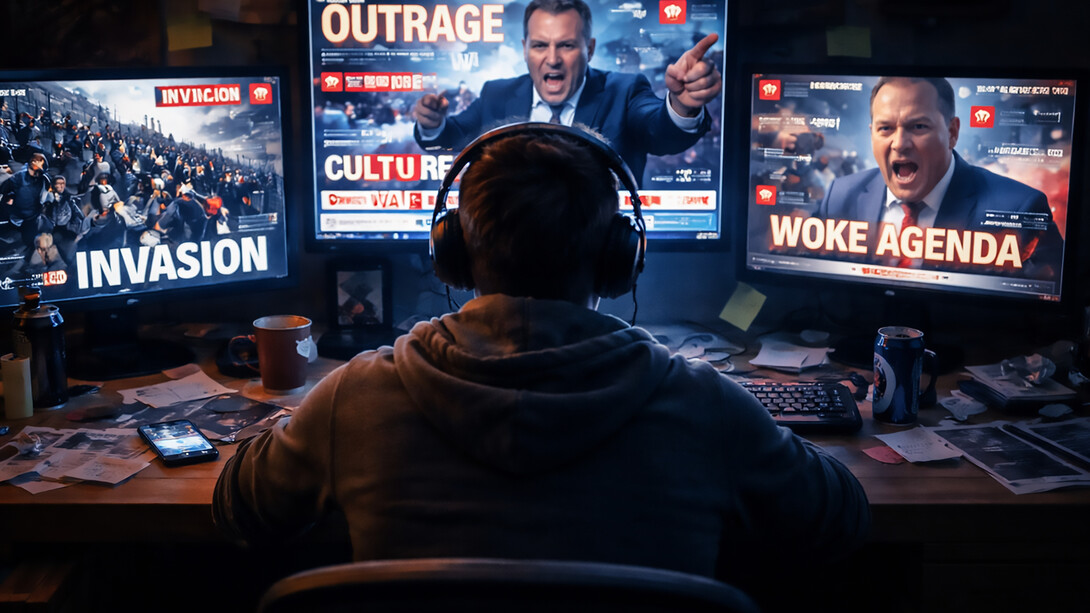
This is the second one in a series of articles which discuss how the Internet became such a toxic, draining place.
As I’m using a lot of terminology from Jean Baudrillard, the first article was a bit more technical in elaborating that terminology, so I encourage anyone to check it to see how I’m using it here too. The position of experts as knowledge or opinion producers was where we left off, and here we’ll focus on the knowledge these experts disseminate. Specifically, we’ll focus on political ideologies.
Being political is profitable
Simply put, digital media (social media, news outlets, podcasts, etc.) thrives on toxicity. It craves polarisation, just as it needs drama. Digital media need to be creative in enraging the audience just enough to keep them engaged and not to turn them away completely. This is what generates clicks, reach, and visibility. Political topics are of special value here – they can be applied to any theme of content and any form of content and always generate extra visibility for any commodity that circulates in our digital ecosystem.
On the other hand, because these issues are at times closely related to our identities, we feel them personally. Everything is at least a bit political, just to keep you engaged. I’m stating that to highlight that behind statistical, operative, and business-orientated terminology there is always, ultimately, a human being that is feeling enraged, entitled, drained, threatened, or treated unjustly. This is a feature of digital media – not their unintended effect.
Because it generates extra attention, there’s a lot of incentive to produce content on any issue through “political” lenses. But even more so, the influencers and/or politicians that are “political” in their content can find new content material on a daily basis. They regularly use the same rhetoric, same keywords, and same overarching narrative to extrapolate the most negative aspects of their opponents in search of vindication and victimhood. Be it Shapiro, Kimmel, or Nick Fuentes, the template is the same; I’m confident you’d be able to find this type of influencer/politician in your national or local setting too.
It is the combination of engagement-through-enragement elements of the digital media with the consistent “hot take” narratives made by the influencers that occupied the spaces of our once-pure Internet. Influencers, who eventually represent themselves as “the experts”, do it not just for their ideological convictions, but also because influencing is a solid or a great-paying job.
For the digital media, any kind of engagement is great, because it’s profitable, even if it’s provenly harmful to the wider population. And ultimately, the right to be toxic for profit is the freedom of speech they’re protecting or trying to deregulate by influencing European regulations like GDPR or DSA.
Simulated politics
Digital media, because of the described structure they operate upon, should definitely not be a place to discuss political ideas. Precisely because our attention span can’t tolerate anything longer than 20 seconds, an obnoxious piece out of context, the most radical and vocal representatives of an ideological stance are what get the spotlight as it piques our interest. The complexity of political and social issues is flattened down to enraging content.
For the most part, and that is my position, most of this toxicity is generated by the far-right groups, and that will be my focus here. Not just because so much of internet discussions come down to promoting illiberal political views, but mostly because far-right ideologues are in the crucial positions of power with the ability to change their platform's policies (Musk, Zuckerberg; not to mention people like Peter Thiel and Murdoch) or governmental positions – in the U.S.A. or most of European countries.
At this point, people who can do something and are doing something are the ones deserving criticism, not a random neo-Nazi or an incel that’s excluded from the market and real-life society. That is also the reason why understanding these illiberal positions as “reactive” to all the (alleged) wrongdoings of “woke propaganda” is always falsely apologetic: you can disagree with something – you don’t have to become racist as a reaction to it.
To be a bit more specific with an extremely plastic example: popular short videos of “feminism destroying men and women”, followed up with a clip of, for example, a woman saying how cheating on men is empowering (I think the podcast name is “Whatever”). This is the content that fits the bill: it’s enraging, it’s vindicating, it literally shows how opposing ideology is dangerous to a regular guy, and you are a regular guy living in a crazy society.
This is how a term like “feminism” gets occupied by chauvinists – and how misogynistic views become normalised. Feminism becomes “truthful” in the way they represent it, no matter how distorted, unfair, or dishonest it is. The same applies with (“illegal”) migrants’ representations, or basically any other minority. We do have real social-economic issues – and these distorted frameworks offer the explanations for them.
I have to say, this logic at times applies for addressing the regular right-wing positions automatically as “far-right” positions. But, as far as I can tell, in far less frequency and in far less harmful ways, for the reasons mentioned above. I am saying this precisely because this sort of “doing politics” is not actually politics – it’s not discussing, it’s not disagreeing, it’s just an exclusionist spectacle. For my own position representatives, I do expect more than digital media-reactionary content. Otherwise, it just contributes to the problem. And again, in practice, this happens far less often and in far less harmful ways.
The issue with this revisionism, reframing and distorting is not just that it’s lying, harmful or self-righteous. Consumers of these ideologies are harmed by being convinced they’re the victims and they’re treated unjustly just because they’re white or male or patriotic, which is normal, as opposed to what’s not normal (feminazis, the deep state, Jews, migrants, globalists, leftards, etc.).
The bigger issue is that people who are minorities or representatives of egalitarian ideologies have to defend their own positions from the ideas that are not attributable to them, e.g., “cheating on men is empowering”. Or, just because I don’t believe that Brussels wants to subjugate my country, it doesn’t mean I don’t want my country to thrive. Or, just because I took a COVID vaccine, it doesn’t mean I’m a Satanist with a Devil’s mark; etc, etc.
In the sentence,, etc., we’re forced to be represented by ideas we do not believe in by the people who supposedly represent everyone else with their own bizarre ideas of the world. We respond to these simulacrums with even more simulacrums. Those “Cursed A.I. videos” might be the best metaphor for this exchange – where once was something genuine, now is a replacement of reality residuals. Yet we treat it as reality, because it does relate to us on an intimate level.
The political struggle – discussing what’s best for a society – is what’s lost in this sort of environment. The issues remain unaddressed and unresolved – but the animosity, hate and blame are transferred to the actual, real human beings these ideologies purposely misrepresent, while the frustration is left with the consumers of this content. These are the effects of the described hyperreal ideologies.
Hyperreal ideology: a case study example
An article by Knüpfer, Yang, and Cowburn demonstrates how these kinds of ideologies function in real time. In this study they analysed how the term “Critical Race Theory” is used in right-wing digital networks.
Firstly, from Wikipedia: “Critical Race Theory is a conceptual framework developed to understand the relationships between social conceptions of race and ethnicity, social and political laws, and mass media. CRT also considers racism to be systemic in various laws and rules, not based only on individuals' prejudices.” In other words, it was a framework to address the issues of systemic racism in the U.S.A.
For these right-wing influencers, CRT became a perceived "woke" indoctrination that induces white guilt or prioritises race over merit, framing these as divisive, anti-American threats to traditional values and white identity.
This faction, which are primarily digitally networked elites (e.g., legislators, activists), promotes this CRT rhetoric to build visibility and influence, co-producing agendas with alternative media outlets that amplify it beyond party structures. This part is especially troublesome if we know that visibility and interaction can be artificially boosted by bots, paid accounts, and marketing. It not only misrepresents an idea, butis it also poses as if this is what the majority of the population thinks, but something beyond is controlling the agenda.
I believe consistency is also a key part of this. Consistency not only gives the opportunity to create a pattern out of individual cases and an overarching bigger narrative that all these topics indicate, but it also creates something the authors call “informational ping”. "Informational ping" is defined as a discursive trigger (in this example it is mentioning "CRT", but also think of news when a transgender woman wins a competition, a migrant commits a felony, etc.) that surfaces or reinforces connections in a communicative network. Simply put, if a topic emerges, these groups reinforce and support each other to generate larger visibility, reach and “importance” to the public.
Please, for a much more elaborated and convincing discussion, refer to the article “The Logic of Connective Faction: How Digitally Networked Elites and Hyper-Partisan Media Radicalise Politics” by Knüpfer, Yang, and Cowburn.
At this point, I’d also like to emphasise that this is how these influencers function and that you probably can recognise the same patterns with different terminology in your own digital media surroundings: how certain terminology is being taken over by certain factions; how Nazism gets portrayed as cool; and how genocide is Palestinian propaganda. Think about how topics of "sovereignty" are framed when discussing Greenland or Venezuela or Ukraine; how migrant crimes are framed with a gleeful joy of "I told you so" sentiment; and who was dismissive of the Epstein files' importance but has used them as confirmation that there indeed is a satanistic cabal running the show.
Final thoughts
We spend the majority of our awake time connected to the digital media, and in many ways it has become an inseparable part of our existence. No matter how much we’re able to distance ourselves from the digital media negativity, the truth of the matter is that at some point, the Internet will come to get us, even if we shut off the screen and close the laptop. That is what constitutes the hyperrealness of these ideologies – they may be referencing a non-existent lost original, a copy of a copy, but ultimately, they do trickle down and influence real people. That is the bad part.
The good part is that reality is far more complex and in many ways a lot better (albeit harder) than the digital media consistently try to convince us. Instead of arguing in rage with a bot for some likes, try to communicate with an ideological opponent in real life. Or just read a book, exercise, cook, exist – anything but the Internet. I’m not saying we should stop resisting the tide of authoritarian governments and ideologies; we definitively must continue resisting them.
But I want to emphasise and empathise that our enemies are not random human beings believing in those ideologies, but organisations, corporations, lobbyists, and the system with financial and data capital that is utilised for their own political agenda. In that way, I believe, a part of the struggle must be articulated.