English
 Español
 Français
 Deutsch
 Italiano
 Português
In Orthodox Christian thought, the Komboskini is viewed as a “spiritual sword,” a symbol of strength and resistance in the face of temptation. Just as soldiers bear weapons for physical battle, the Komboskini represents the weapon Orthodox Christians wield in their spiritual battle against negative thoughts, distractions, and temptations. By using the Komboskini, the believer calls upon Christ’s mercy, fortifying themselves against worldly temptations and reminding themselves of God’s constant presence.
Orthodox Christians carry the Komboskini throughout their daily lives, often tucked in a pocket or around the wrist, as a constant reminder to pray. Anytime the believer feels the need for connection with God, they can take hold of their Komboskini, moving their fingers along the knots and saying the Jesus Prayer silently or aloud. This practice of “praying without ceasing” creates an ongoing awareness of God’s presence, helping the believer live in a state of prayerfulness.
The Komboskini, or the Prayer Rope, is a central tool in the spiritual life of Eastern Orthodox and Eastern Catholic Christians. It serves as an aid in the continuous repetition of the Jesus Prayer: “Lord Jesus Christ, Son of God, have mercy on me, a sinner.”
The Jesus prayer and the practice of the Komboskini
The primary prayer associated with the Komboskini is the Jesus Prayer: “Lord Jesus Christ, Son of God, have mercy on me, a sinner.” This short, repetitive prayer holds profound significance in Orthodox spirituality:
“Lord Jesus Christ” acknowledges the lordship and divinity of Jesus.
“Son of God” affirms His divine sonship.
“Have mercy on me” is a plea for grace, compassion, and forgiveness.
“A sinner” expresses the humility and repentance of the one praying.
The Komboskini is a deeply meaningful tool in the Orthodox Christian life, representing a profound connection to faith, humility, and the tradition of continuous prayer. Inspired by a divine dream, it serves as a tangible reminder of God’s protection and guidance. Each knot and cross in the Komboskini reminds the wearer of the angelic hosts, Christ’s sacrifice, and the commitment to repentance and spiritual growth.
Origins in a divine dream
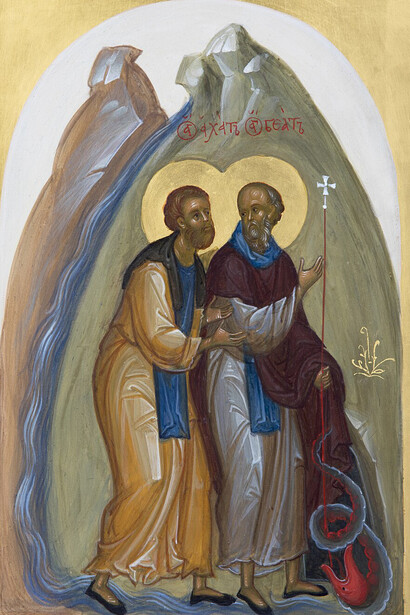
The origin of the Komboskini is traditionally traced back to a miraculous event in the early 4th century, within the Egyptian deserts where monasticism first blossomed. The story begins with Saint Pachomius, an early Christian monk who, with guidance from Saint Anthony, sought to help his fellow monks remain focused in prayer.
At that time, the monks would use a simple string, tying a knot each time they completed a prayer. However, they faced a peculiar challenge: as they prayed, their knots would mysteriously unravel, a phenomenon attributed to demonic interference designed to break their concentration. Frustrated by these interruptions, Saint Pachomius turned to prayer, seeking divine guidance.
One night, Archangel Gabriel appeared to Saint Pachomius in a dream, bringing a solution. The archangel showed him a new way to weave the knots, making each one nearly impossible to untie. These knots were not ordinary—they were intricately woven with nine interlocking crosses, symbolizing the nine ranks of angels. This new method created a prayer rope that no demonic force could disturb, allowing the monks to pray without distractions. Saint Pachomius shared this technique with his fellow monks, and from that day on, the Komboskini became a revered tool for prayer in the Orthodox monastic tradition.
Symbolism and structure
The Komboskini is far more than a simple string of knots. Each element of its design carries deep symbolic meaning, connecting the believer to the mysteries of faith and the presence of God.
Material and color
The traditional Komboskini is often made of black wool or silk. The color black symbolizes humility, mourning, and repentance, reminding the believer of the need for a spirit of contrition. Wool represents Christ’s flock, reminding the wearer that they are part of His fold, under the care of the Good Shepherd.
The knots
Each knot in the Komboskini is meticulously woven with nine crosses, making it sturdy and difficult to unravel. These nine crosses represent the nine orders of angels, emphasizing divine protection over the one praying and serving as a reminder of heavenly guidance and support.
The cross
Many komboskini also feature a small cross within the design. This cross represents the crucifixion of Christ, symbolizing His ultimate sacrifice, love, and victory over sin and death.
The tassel (or mass)
At the end of the Komboskini, there is often a tassel. This tassel has practical and spiritual purposes. It represents the tears of repentance and sorrow for one’s sins and serves as a reminder of the humility and sincerity that should accompany prayer. Some believe it can be used to wipe away tears during moments of deep prayer.
Using the Komboskini, one moves from knot to knot, repeating the Jesus Prayer with each touch. This practice is meant to be more than mechanical repetition; it serves as a means of focusing the heart and mind on God, quieting internal distractions, and fostering a deep sense of divine presence. With each prayer, the believer strives to achieve hesychia—a state of inner stillness and peace.
Through the use of the Komboskini and the recitation of the Jesus Prayer, Orthodox Christians strive to deepen their relationship with Christ and embody a life centered on divine mercy and love. It’s not just a tool—it’s a companion in their journey toward holiness and unity with God.