English
 Español
 Français
 Deutsch
 Italiano
 Português
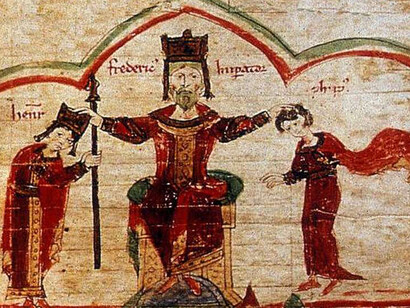
The story of Frederick II of Swabia and his linguistic experiment is one of the most fascinating and unsettling episodes of the Middle Ages. Emperor of the Holy Roman Empire from 1220 to 1250, Frederick was known for his extraordinary intellect, rational thinking, and interest in science.
A man of his time, yet surprisingly modern in certain aspects, he promoted studies in various fields, from philosophy to medicine, zoology to linguistics.
Born in 1194 to Henry VI and Constance of Hauteville, he was raised in the Kingdom of Sicily, a cultural crossroads where Latins, Greeks, Arabs, and Jews coexisted. He spoke multiple languages and was a passionate promoter of culture, founding the University of Naples in 1224, the first secular university in Europe.
Nicknamed Stupor Mundi for his vast knowledge and critical spirit, Frederick did not hesitate to challenge dogmas and beliefs. However, his rationalism was accompanied by an authoritarian streak: he believed that knowledge should serve the reason of state, and at times, his scientific curiosity crossed into cruelty, as exemplified by his infamous linguistic experiment.
The idea of a "natural" language of humanity was widespread in the Middle Ages and linked to biblical beliefs. According to some interpretations of Genesis, Adam and Eve spoke a primordial language, lost after the confusion of tongues during the construction of the Tower of Babel.
From a linguistic perspective, the story of the Tower of Babel represents the loss of a single universal language and the subsequent incomprehension among men. According to the biblical narrative (Genesis 11:1-9), humanity initially spoke a single language and shared a common form of communication. This enabled people to collaborate effectively, even to the point of building a tower meant to reach the heavens.
However, God intervened to punish human arrogance, confounding their languages and causing their dispersion. The core issue was not the construction of the tower itself but rather mankind’s presumption of reaching the divine through their own ingenuity.
Linguistically speaking, the consequence was the fragmentation of communication: humanity shifted from a unified code to a multiplicity of languages, making cooperation and mutual understanding more difficult, thus generating hostility.
In the Middle Ages, this myth was interpreted as a theological explanation for linguistic diversity and the challenges of transmitting knowledge universally. Throughout history, lingua francas—such as Latin in Europe, Arabic in the Islamic world, or Chinese among Asian cultures—have attempted to mitigate the effects of Babel’s fragmentation, serving as bridges of communication between different peoples.
Frederick II may have sought to discover this original language, hypothesizing that it could be Hebrew, Latin, Greek, or Arabic. To verify this, he conceived an extreme experiment: raising children without any linguistic exposure and observing which language they would spontaneously speak.
He was not the first ruler to attempt such an experiment:
Psamtik I (7th century BCE, Egypt): According to the historian Herodotus, the pharaoh had two infants raised without verbal contact to determine humanity’s original language. When the children uttered "bekos," it was mistakenly concluded that Phrygian was the primordial language.
James IV of Scotland (15th century): It is said that he had two children raised by a mute nurse on an isolated island to see which language they would develop. Some sources claim they spoke no language at all; others suggest they uttered words in Hebrew.
To carry out his experiment, Frederick II took several newborns and ordered that they be raised in complete isolation. He entrusted the infants to wet nurses with a strict directive: they could feed, bathe, and care for them, but they were never to speak to them, caress them, or show them affection. The children were to grow up without hearing a single human word so that, upon reaching an appropriate age, it could be observed which language they would begin to speak spontaneously, free from external influences.
The experiment, however, had a tragic outcome. The children did not develop any language and died prematurely. Moreover, the experiment inadvertently highlighted the fundamental role of learning and environment in language development.
Today, we know that without affectionate interactions and verbal stimuli, child development is severely impaired. This phenomenon, known as "affective deprivation syndrome," was studied in the 20th century by psychologists like René Spitz, who observed similar effects in orphans raised in emotionally deprived institutions.
The story of Frederick II was primarily recorded by Salimbene de Adam, who harbored little sympathy for the emperor and depicted him as an impious and megalomaniacal ruler. For this reason, some modern historians question the veracity of the episode, considering it perhaps an exaggeration or a black legend spread by his opponents. However, the fact that similar experiments were hypothesized or attempted in different eras suggests that human curiosity about the origins of language has always existed.
If Frederick II’s experiment was indeed carried out, its outcome demonstrated that language does not emerge spontaneously but develops only through social interaction. Without affection and stimuli, children not only fail to learn to speak but may not survive at all.
This principle underpins many studies in developmental psychology and confirms that human language is not merely a matter of sounds and grammatical rules but a phenomenon deeply rooted in relationships and human contact.
Modern linguistic theories, such as those of Noam Chomsky, emphasize the existence of an innate predisposition for language acquisition, known as "universal grammar"—the human brain’s inherent capacity to structure language. However, more recent research in psycholinguistics and neuroscience has shown that this predisposition alone is not sufficient: without social interaction, language exposure, and adequate stimuli, language cannot develop.
Frederick II, despite being a man of extraordinary intellect, was also a ruler capable of extreme acts. His experiment, with its cruel determination, reminds us that language—and life itself—cannot exist in silence and isolation.
His linguistic experiment reflects both his thirst for knowledge and his rational vision of the world, but also his tendency to treat science in a cold and inhumane manner. Frederick II sought an absolute truth, but his experiment demonstrated that, although language distinguishes humans from other animals, our essence is not merely reducible to words alone.