English
 Español
 Français
 Deutsch
 Italiano
 Português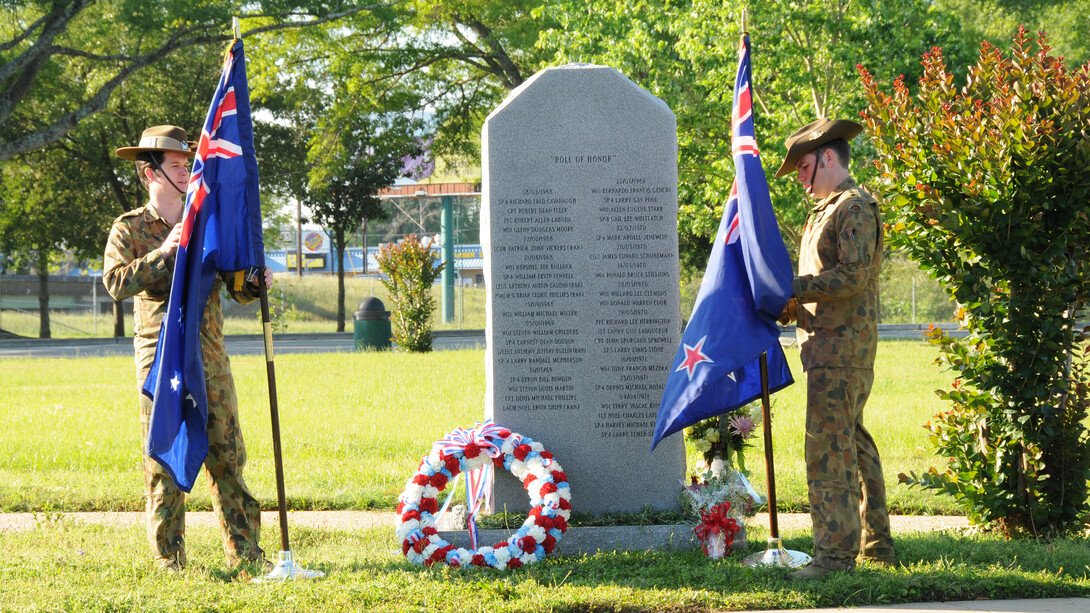
Ali Jan was unremarkable. A farmer and father of seven in Afghanistan's Uruzgan province, on September 11, 2012, he would meet his death. Handcuffed and kicked off a cliff by an Australian special forces soldier nicknamed 'Leonidas,' Jan lay in agony with a broken back until the operator ordered another soldier to finish him with a rifle shot.
That ‘Leonidas’ was Ben Roberts-Smith: Australia's most decorated living soldier, a Victoria Cross recipient and former "Father of the Year," was a grim irony. At two meters tall, heavily muscled, and with flesh adorned with Spartan and Templar tattoos, Roberts-Smith embodied the warrior ideal Australians believed defined their military heritage. He was the modern Anzac—that sacred figure who had supposedly forged Australian identity through sacrifice at Gallipoli in 1915.
But in 2020, a landmark inquiry revealed something that challenged everything Australians thought they knew. Members of the elite Special Air Service Regiment (SASR) had engaged in systematic murder, executing at least 39 Afghan civilians and prisoners between 2009 and 2013. In 2023, a civil court found Roberts-Smith himself had murdered four Afghans, ruling he "broke the moral and legal rules of military engagement and is therefore a criminal."
These revelations should have shattered the Anzac mythology, the secular religion or Culte Militaire that defines Australian identity more than any other cultural force. Instead, something stranger happened: Australians simply looked away. Anzac Day 2023, months after Roberts-Smith's court defeat, saw record crowds. Sporting events bearing the Anzac name drew record attendance and gambling revenue. Politicians continued praising "our heroes" without acknowledging Afghanistan. Indeed, it seemed as though the nation was blinkered to the uncomfortable realities of Australia’s participation in the murky war that was Afghanistan.
The creation myth
Anzac stands for Australian and New Zealand Army Corps, the force that landed at Gallipoli on April 25, 1915. Over eight months, more than 8,000 Australians died in a strategically pointless operation at the behest of the British Imperial Forces, who themselves were acting to assist their ally in Tsarist Russia by forcing open the Dardanelles. The campaign failed catastrophically, achieving nothing except massive casualties.
Yet from this disaster, official war historian C.E.W. Bean crafted something extraordinary in a creation myth. Writing in 1933, Bean declared, "The consciousness of Australian nationhood was born at Gallipoli." For those soldiers, "Life was very dear, but life was not worth living unless they could be true to their idea of Australian manhood."
This was an exercise in national convenience. Australia desperately needed a founding story. It became a nation in 1901 without revolution, without civil war, and, as some would feel (though this is contested by the history of Australia’s Frontier Wars), without dramatic struggle. Worse, it carried what historian Manning Clark called "the convict stain" in the shame of being founded as a British penal colony. Anzac conferred a baptism by fire that could wash away that original sin and prove Australians worthy of nationhood.
The timing mattered. Australia had sent 331,000 soldiers from a population of barely 5 million to fight in a European war. They suffered 60,000 dead and 155,000 wounded. Such staggering sacrifice demanded meaning. Anzac provided it, transforming senseless slaughter into the moment Australia "came of age."
But the early Anzac story was much more contested than we realize today. Returned soldiers often refused to march. One veteran wrote in his novel My Brother Jack: "They had had their years in the trenches, but the world of mufti to which they had returned had hardly become a fit place for heroes. Life, in their own words, was a 'fair cow.'" Peace movements spread rapidly. Australia gathered one of the world's largest petition drives for disarmament in 1931—118,000 signatures from a country of 6 million. It made sense that a country that had suffered such extreme losses in the Great War would also develop, in part, antipathetic tendencies towards military adventurism.
For decades, Anzac remained primarily about mourning and commemoration. That changed in the 1990s when conservative Prime Minister John Howard seized Anzac Day and transformed it into a festival of national celebration. As the War on Terror provided new conflicts, Howard praised the "great tradition of honorable service" and encouraged Australians to "enrich ourselves" through Anzac commemoration.
By the 2000s, Anzac had become Australia's dominant civil religion. It was no longer about mourning sacrifice but celebrating an imagined tradition of freedom-loving citizen-soldiers regardless of actual strategic objectives or political realities.
This was the cultural context when Australian special forces deployed to Afghanistan.
The 'Spartans' of Uruzgan
Afghanistan represented what military historian John Blaxland calls "niche wars"—conflicts involving tiny military factions with unclear objectives. Only 1,550 ADF personnel were deployed, roughly 1,200 in Uruzgan. Over 2001-2015, just 30,000 served, barely 3% of the force.
This created a unique dynamic in a small elite force bearing nearly all the combat burden while the rest of Australian society remained completely insulated. No conscription, no national mobilization, no economic sacrifice. Most Australians only encountered Afghanistan through feel-good stories about brave operators and humanitarian operations.
The burden of combat, however, fell overwhelmingly on the Special Air Service Regiment, conducting high-intensity operations repeatedly, ignoring customary rotation schedules. The SASR became what the later Brereton Report called a "warrior culture," emphasizing "warrior heroes" rather than professional soldiers bound by laws and treaties.
They adopted the iconography to match. Operators took nicknames like 'Leonidas,' the Spartan king who fought at Thermopylae, itself the ancient world's Gallipoli. The parallel was conscious in that they saw themselves as heirs to Anzac's warrior tradition.
In all this, a darker militarized pathology was developing. As one SASR member testified, "It's just do what I want, bash who I want, shoot at whoever." Another described the escalation: "Shoot a kid, shoot some fucking grandparents." New operators underwent "bloodings"—ritualistic killings where captives were executed to initiate them.
Rumors circulated by 2015. A 2016 sociological study documented testimonies about sanctioned massacres, kill competitions, and systematic cover-ups. Interviewed SASR members stressed extreme violence wasn't aberrant but was rather baked into the DNA of the outfit in Afghanistan: "It happened all the time."
In 2017, a confidential report leaked. Military lawyer David McBride provided documents forming the basis for ABC's "Afghan Files" investigation. Roberts-Smith launched an aggressive defamation lawsuit. The Australian Federal Police raided ABC headquarters. McBride was eventually sentenced to five years' imprisonment.
But the evidence kept mounting. And in 2020, the Brereton Report was released.
The reckoning that wasn't
The Brereton Report was damning. Four years of investigation found credible evidence of 39 unlawful killings by 25 personnel, recommending 19 for prosecution. It detailed systematic murder, prisoners and civilians executed, followed by "throwdowns" where weapons were planted on bodies.
The report rejected the "few bad apples" argument, pointing instead to systemic failures: "Ego, entitlement, and exceptionalism" had fused with "military excellence," creating a culture where rules didn't apply. The SASR had been overdeployed in unclear circumstances, leading to "a wavering moral compass and declining psychological health." It was a simple matter of fact that operators were deployed on tours many more times than initially expected, and this, in part, played a key role in the development of such a morbid culture of killing and violence.
One might expect this to force a reckoning with Anzac mythology. How could citizen-soldiers defending freedom be committing war crimes? How could warriors embodying "mateship" be executing prisoners?
The answer: Australian leaders chose not to ask.
In 2023, when Roberts-Smith lost his defamation case, it barely registered in Anzac commemorations. Former prime ministers delivered speeches making no reference to war crimes, instead praising soldiers for embodying "the highest standard for the Australian character."
Record crowds attended services. Sporting matches drew record ratings. Only one SASR member has been criminally charged, and he certainly didn't act alone.
Some unit members showed more awareness. One SASR soldier who was asked to guard the Anzac cross at their Afghan base in 2012 later couldn't recognize himself in photographs, unable to process the person he'd been. Another rejected the mythology entirely: "People say, 'You're the sons of Anzac.' No, we're fucking not... we were a superior force... and we did the wrong thing."
Russian anthropologist Alexei Yurchak coined the term "hypernormalization" to describe how societies retreat into counterfactual mythology when confronted with realities challenging core identities. In Australia, Anzac mythology has become so fundamental that citizens cannot process contradicting information.
But there are tentative signs that this might be changing.
The first trial in 30 years
Five years after Brereton, Australia is finally seeing its first war crimes prosecution, but the glacial pace and singular nature reveal how incomplete accountability remains.
In October 2025, former SAS soldier Oliver Schulz pleaded not guilty to war crime murder, becoming the first Australian soldier ever charged. Despite Brereton recommending 19 prosecutions, only Schulz has been charged.
The alleged crime is unusually well-documented. Footage from a 2012 raid allegedly shows Schulz aiming at Dad Mohammad, a father of two lying on the ground. Three times Schulz asks, "Do you want me to drop this c***?" before firing three shots.
Yet the trial won't begin until 2027, seven years after Brereton and fifteen after the killing. This reflects enormous challenges. The Taliban takeover made evidence gathering nearly impossible. The SASR's "code of silence" remains intact. At a public barbeque, one soldier reportedly boasted that investigators "haven't got shit."
The case carries unprecedented legal weight. Australian courts will need to define crucial aspects of international criminal law never properly tested, particularly "proportionality." Under Australian law, wartime killing can be dismissed as a war crime if the death was unexpected and proportional to a genuine military objective.
This enables basic operations, as bombing a munitions factory with limited civilian casualties wouldn't be a war crime. But how does proportionality apply to allegedly purposeful close-range killing? The Schulz trial will force courts to grapple with questions that have bedeviled international criminal law for decades.
The stakes extend beyond one prosecution too. As legal scholars note, the trial "provides the government a chance to apply war crimes law consistently and fairly." But there's a darker possibility. If Schulz is acquitted, as occurred in Australia's last major war crimes case in 1993, it could effectively end the entire program.
The International Criminal Court is watching. If Australian authorities prove "unwilling or unable" to prosecute, the ICC can step in, which would serve as a humiliation undermining Australia's claim to principled international action.
Meanwhile, the disconnect persists. David McBride, the whistleblower whose leaks exposed the crimes, sits in prison. Ben Roberts-Smith, found by a civil court to have murdered four people, remains free. No senior officers have faced accountability for command failures enabling this culture.
What comes next
When Schulz's trial finally begins in 2027, it will mark 15 years since Dad Mohammad was killed, seven since Brereton, and 112 years since Gallipoli birthed the Anzac legend. Whether that trial leads to conviction or acquittal, genuine reckoning or further denial, will reveal whether Australia remains prisoner of its mythologized past.
Anzac mythology has always been constructed rather than organic. In 1915, Australians fought for British imperial interests, which was hardly the freedom-loving narrative now taught. The myth evolved to serve different political purposes: justifying war dead, anchoring British ties, pivoting toward Asia, and celebrating the War on Terror.
Now it faces perhaps its greatest challenge, as it acknowledges that Australia's most elite soldiers, operating under the Anzac banner, committed war crimes, and that those crimes weren't aberrations but stemmed from a culture that internalized warrior mythology at the expense of professional ethics and legal constraints.
A more honest Anzac mythology would acknowledge that placing small elite forces in grinding, strategically incoherent wars while telling them they're warrior heroes creates predictable pathologies. It would recognize that Anzac values can be corrupted when divorced from democratic accountability.
The Australian government's response has been to investigate quietly, charge minimally, and prosecute slowly while allowing Anzac celebrations to continue unchanged. This satisfies no one. It fails to deliver justice to Afghan victims. It fails to hold accountable the command structures enabling the crimes. It fails to force Australians to reckon with what was done in their name abroad to those whose crimes were little more than just existing in the face of a foreign war machine.
Historian Manning Clark warned Howard's triumphalist Anzac would make Australia "a prisoner of her past." He was right. Australia isn't trapped by honest reckoning with historical tragedy. It's trapped by mythology too precious to examine.
The families of 39 murdered Afghans, be they Ali Jan's seven children, Dad Mohammad's two daughters, or others, all deserve better. So do SASR members who resisted the culture and tried to speak out. So do Australians themselves, who deserve a national mythology accommodating complex realities rather than retreating into comforting fantasy.
Some SASR who spoke to investigators understood. "We did the wrong thing," one said simply, rejecting the warrior mythology entirely. That clarity, a very basic moral one, is what Anzac mythology must recover if it's to have meaning beyond nationalist performance.
Sources
Brereton, Paul. "Inspector-General of the Australian Defence Force Afghanistan Inquiry Report." Australian Defence Force, 2020.
Willacy, Mark. Rogue Forces: An Explosive Insiders' Account of Australian SAS War Crimes in Afghanistan. Simon & Schuster, 2021.
Damousi, Joy, et al. What's Wrong with Anzac?: The Militarisation of Australian History. University of New South Wales Press, 2010.
Clark, Manning. A History of Australia. Melbourne University, 1999.
Yurchak, Alexei. Everything Was Forever, until It Was No More: The Last Soviet Generation. Princeton University Press, 2006.
Knapton-Lonsdale, Rhys, and Paul Taucher. "The first Australian war crimes case in 30 years is going to trial. It raises big questions." The Conversation, October 14, 2025.
Federal Court of Australia. "Roberts-Smith v Fairfax Media Publications Pty Limited (No 41) [2023] FCA 555."
Shanahan, Maxim. "A First (Civil) Ruling Confirms Australia's War Crimes in Afghanistan." JusticeInfo.net, June 9, 2023.
Gellerfy, Thea, Marcus Fielding, and John Blaxland. Niche Wars. Australian National University, 2020.
Scheipers, Sibylle. Heroism and the Changing Character of War: Toward Post-Heroic Warfare? Palgrave Macmillan, 2014.