English
 Español
 Français
 Deutsch
 Italiano
 Português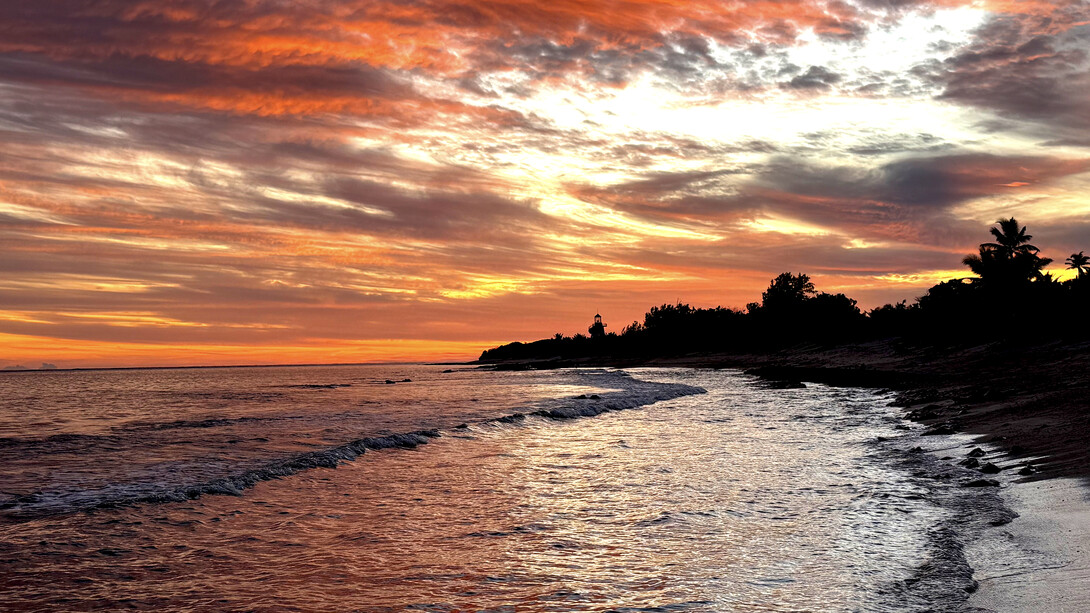
If the Seychelles already feels remote, Desroches takes that feeling and stretches it until it almost aches.
From Mahé, there is just one flight a day. You board, you lift off, and very quickly there is nothing but ocean in every direction. Just water.
Then, without much warning, a thin runway appears. You land, the engine cuts, and the silence feels different. There is no sense that anything exists beyond the edge of what you can see. You do not think about remoteness here. You feel it.
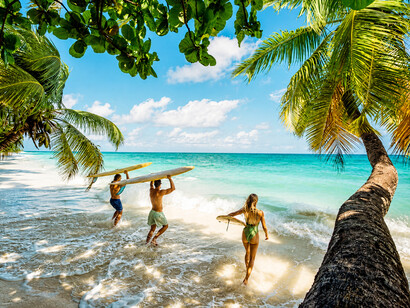
Desroches is a coral island, ringed entirely by reef. The effect is immediate. The sea stays shallow, calm and impossibly clear along much of the shoreline so that swimming feels like stepping into a vast natural lagoon. You walk in and the water holds you there.
The island still carries the imprint of its past as a coconut plantation. Long lines of mature palms stretch across the landscape, their spacing too deliberate to be accidental. They shape the movement of light, casting shifting patterns of shade while the air moves differently beneath them.
At the northern end, the plantation gives way to something denser. A thick, enclosed jungle where narrow paths cut through deep shade and the temperature drops as soon as you enter. Cycling through it, the change is immediate and physical.
The only land animals moving freely here are giant tortoises, around a hundred of them, encountered without warning. They move slowly, entirely unbothered by your presence, some approaching with quiet curiosity while others remain still, watching. They feel anchored to the island in a way that suggests a much longer sense of time.
We cycled everywhere. To breakfast, to the beach, and often to nowhere in particular. The island reveals itself gradually that way. Certain bends in the path become familiar, as do particular stretches of sand that draw you back more than once.
The rides are easy and shaded for long stretches by the canopy of mature palms. Light flickers constantly as you move, shifting by the minute from bright openness to something softer and filtered.
Along the paths, overhanging coconuts have been cleared, a practical decision that makes movement around the island noticeably easier. It is a small detail, but one that reveals the degree to which the landscape has been managed and organised for visitors.
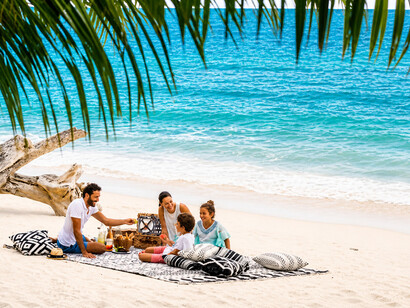
The beaches are what stay with you most. There are many of them, long and perfectly formed, some close to the main areas of the resort and others further out, reached by bike along sandy paths that gradually become empty of people.
Even the more isolated stretches are prepared in advance, with towels, water, and seating already arranged. The experience of solitude here is therefore carefully constructed rather than entirely natural, though this does little to diminish its effect.
On several days, we chose a stretch of beach and realised we were completely alone. The only other people on the island are the guests and the staff, and distance does the rest. You arrive, you swim, and you stay as long as you like.
The reef sits just offshore, close enough that slipping on a mask and moving into it feels effortless. The water shifts from pale sand to a deeper colour, and suddenly you are inside it, surrounded by fish moving in constant, quiet patterns.
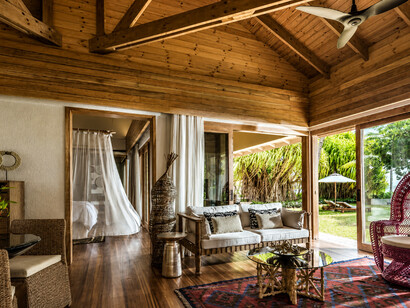
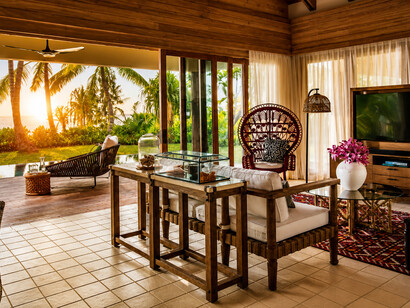
The beach villas set the tone. From the outside they remain relatively concealed behind palms and vegetation, revealing little of their scale.
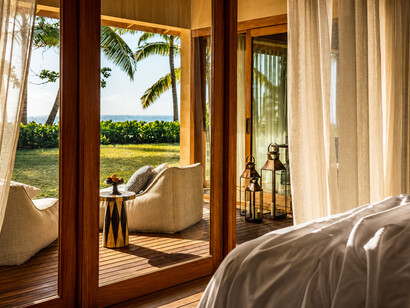
Inside, the spaces are open and restrained. Pale wood, clean lines, and natural light dominate the interiors. Large glass doors slide away so that indoor and outdoor space merge almost completely.
The bathrooms are expansive, with deep tubs and outdoor showers that quickly become integrated into the rhythm of the day rather than functioning simply as design features.
Outside, terraces and small pools sit only a short distance from the shoreline, reinforcing the sense that the sea is always close.
That water becomes a constant. The colour is the kind of turquoise that rarely translates in photographs, warm, clear and quietly repetitive in its pull. Over the course of a week, you find yourself returning to it repeatedly without much conscious decision.
Days settle into a rhythm that feels both repetitive and strangely absorbing. Long mornings extend into late breakfasts, sand finds its way into everything, and afternoons pass without structure as the light shifts continuously across the island.
Food on Desroches is varied enough to sustain longer stays without becoming monotonous.
The main restaurant operates through rotating themed menus that shift between cuisines each evening. The scale remains controlled enough that it avoids the impersonal atmosphere common to larger resort buffets.
The lighthouse restaurant sits at the far edge of the island above the water, where waves break below as evening approaches. The setting inevitably shapes the experience as much as the food itself.
Ahi, the Japanese restaurant, offers carefully composed dishes and a quieter atmosphere, though during our visit the pacing of service became noticeably slow. Long gaps between courses disrupted the flow of the evening and occasionally made the experience feel overly extended.
The wood-fired pizza restaurant provides a more relaxed alternative, with simple food that suits the informality of the island’s pace.
What defines the experience most clearly, however, is the strange self-containment of the island itself.
Because there is little beyond the resort infrastructure, daily life becomes highly concentrated within a single managed environment. Over time, this creates both comfort and a subtle sense of enclosure. The atmosphere depends heavily on the interactions between guests and staff, and on the ability of the island to sustain the illusion of effortlessness.
What remains after leaving Desroches is less a collection of dramatic moments than a gradual accumulation of sensory impressions. Cycling without purpose, swimming repeatedly in the same clear water, beaches that briefly feel unoccupied, and a growing detachment from ordinary schedules and routines.
Leaving also restores a sense of logistical reality.
There is only one flight a day back to Mahé, and ours departed early, leaving a long gap before the onward journey to the United Kingdom via Dubai.
We spent those hours at another resort on Mahé arranged through the hotel, along a dramatic stretch of coastline that immediately felt busier and more connected to the wider world.
The contrast clarified something about Desroches itself.
On Mahé, you remain aware of the surrounding island and its movement. On Desroches, distance becomes the defining condition. The experience is shaped as much by isolation, controlled space, and repetition as by the landscape itself.
The resort operates within that isolation carefully, balancing preservation, infrastructure, and exclusivity in ways that are difficult to maintain on a remote coral island.
That tension between remoteness and management ultimately defines the experience of Desroches.