English
 Español
 Français
 Deutsch
 Italiano
 Português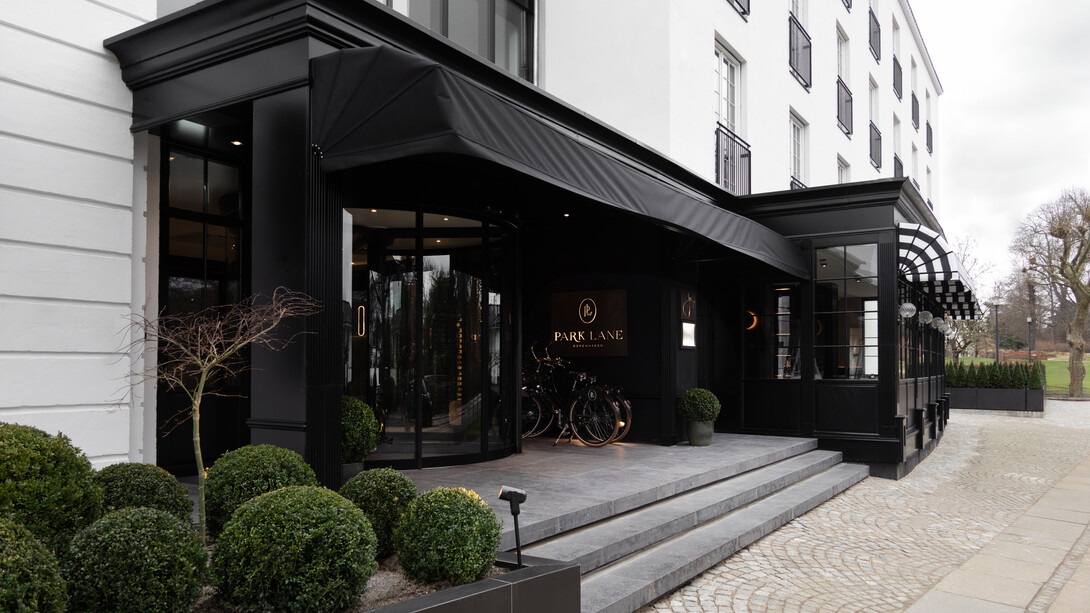
I was in Copenhagen to lead the opening of the Danish Film School’s new mini MBA program and needed a base that was calm, grown-up, and slightly outside the center. Park Lane Copenhagen, newly reopened after a careful restoration, turned out to be exactly that: a hotel with history in its structure and clarity in its design.
A former cinema on the Gold Coast
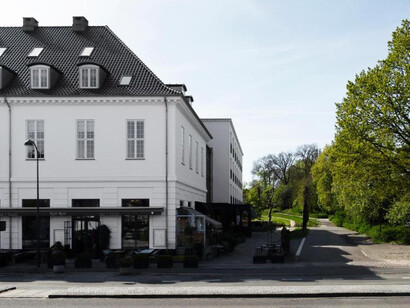
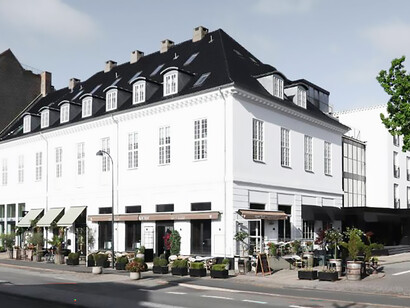
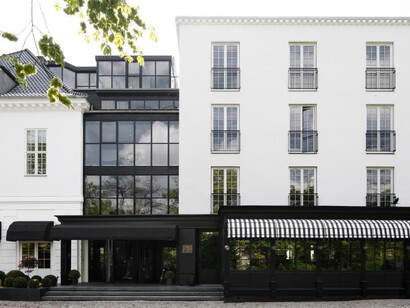
The building opened in 1926 as Strand Teatret, a cinema where silent films were accompanied by a live orchestra, before later becoming a private members’ club. Its latest incarnation is a 5-star boutique hotel, and the bones of its earlier lives are still visible in the grand chandeliers, the high stucco ceilings, and the original herringbone floors.
Park Lane stands on Strandvejen, the stretch known as Copenhagen’s Gold Coast, lined with extravagant standalone villas. One looks faintly Versailles, another nods to Buckingham Palace, and together they form a surprisingly dense run of architectural one-offs. We arrived to a light dusting of snow, and the neighborhood looked like a restrained Scandinavian take on Beverly Hills.
Directly across the road is Øregårdspark, a formal green space that contributes to the sense of being both in the city and slightly away from it.
A hotel for people who love Wallpaper magazine (and a touch of Boogie Nights)
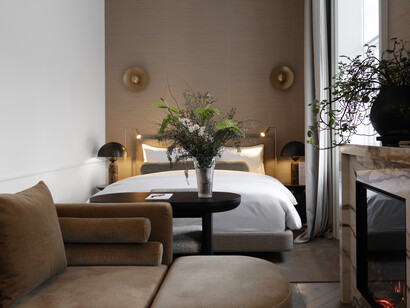
There are only a few hotels I’ve stayed in that feel as quietly, naturally chic as this one. Park Lane isn’t a family hotel, and it isn’t a resort. It’s for people who enjoy proportion, materials, and mood—the kind of guest who notices a 1930s line, reads Wallpaper magazine, and appreciates an interior with a subtle 1970s undertone: warm browns, soft upholstery, natural textures, and a palette that never tries too hard.
Interiors: 1930s geometry, nature-led palette, 1970s material warmth
The public spaces keep the architectural drama of the 1930s cinema—height, plasterwork, chandeliers—but the palette is gentler: soft creams, earthy browns, and natural materials inspired by the park outside. French balconies open many of the rooms to the trees, and the design as a whole feels edited rather than decorated.
Nothing is showy. It’s the kind of luxury you feel more than you see.
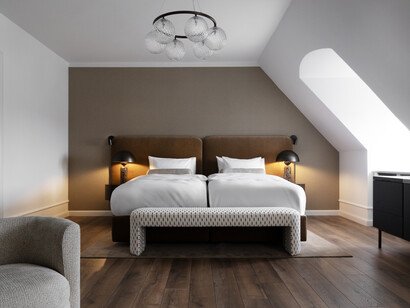
Our junior suite: small footprint, generous height
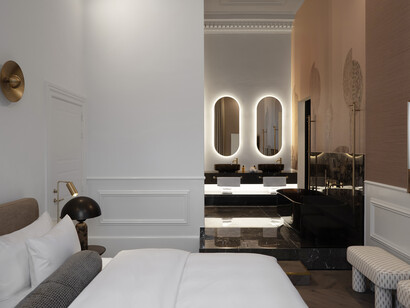
We stayed in a junior suite overlooking Øregårdspark. You enter through the bathroom—unconventional but surprisingly effective. For two people, it works well, and it gives the bedroom a sense of calm.
The sleeping area itself is compact: a bed, a small sofa, and a deliberately tiny desk. In a room with normal ceilings it would feel tight, but here the height gives it air. Light from the French balcony windows softens the warm tones of the furnishings.
The bathroom follows the same quiet aesthetic. Both the bathtub and the sink were alabaster in color—very much in keeping with the building’s 1930s origins—but made from a warm, matte resin rather than stone, which is far more pleasant in practice. No one wants water cooling against cold marble in winter, and the resin solves the problem elegantly.
Eating in: 2900 at Park Lane, and an unexpectedly excellent breakfast
We ate one night at 2900 at Park Lane, the hotel’s own dining room. It blends Nordic produce with French technique, and the room has that same edited quality found throughout the hotel. I began with a Bellini topped with Baltic caviar and followed it with steak; my partner ordered a foie gras salad and baked cod. Everything was straightforward and assured.
Breakfast, however, was the real surprise
Served entirely at the table rather than as a buffet, it felt calm and deliberate. Omelettes appeared perfectly folded, poached eggs arrived exactly as ordered, and there was a choice of salmon, ham, and other cold items presented with the same care as the evening meal. Nothing was excessive; it was simply beautifully cooked food, brought without fuss and paced in a way that makes the first hour of the day feel unusually civilized.
Out of town: Louisiana Museum of Modern Art
One of the pleasures of staying in Hellerup is how easy it is to slip out of the city. We took the train north to the Louisiana Museum of Modern Art, where the architecture and landscape are inseparable. The low buildings stretch along the slope facing the sea, and the sculpture park is placed so that you glimpse water through and around the works: Henry Moore, Jean Arp, and others framed against the horizon.
With snow on the grass and a pale sky, the whole setting felt slowed and contemplative.
Back in the city: Balanchine’s Nutcracker
We returned to Copenhagen for the Balanchine Nutcracker at the Royal Danish Ballet. Surprisingly few children; almost entirely adults. The performance was crisp and musical, and the design—both set and costume—felt distinctly Danish: clean lines, confident color, and nothing over-ornamented.
The neighborhood
Between work, dinner, and performances, we kept returning to the streets around the hotel. Hellerup has the calm of a residential district with the convenience of a small town: cafés, wine bars, the sea, and the park. It’s a very easy place to be.
The stay
Park Lane is the kind of hotel that doesn’t need to announce itself. The design is thoughtful, the history is present without being overplayed, and the service is quiet and steady. For my purposes—teaching, working, and dipping in and out of Copenhagen’s culture—it was the right backdrop: considered, calm, and rooted in its own past.