English
 Español
 Français
 Deutsch
 Italiano
 Português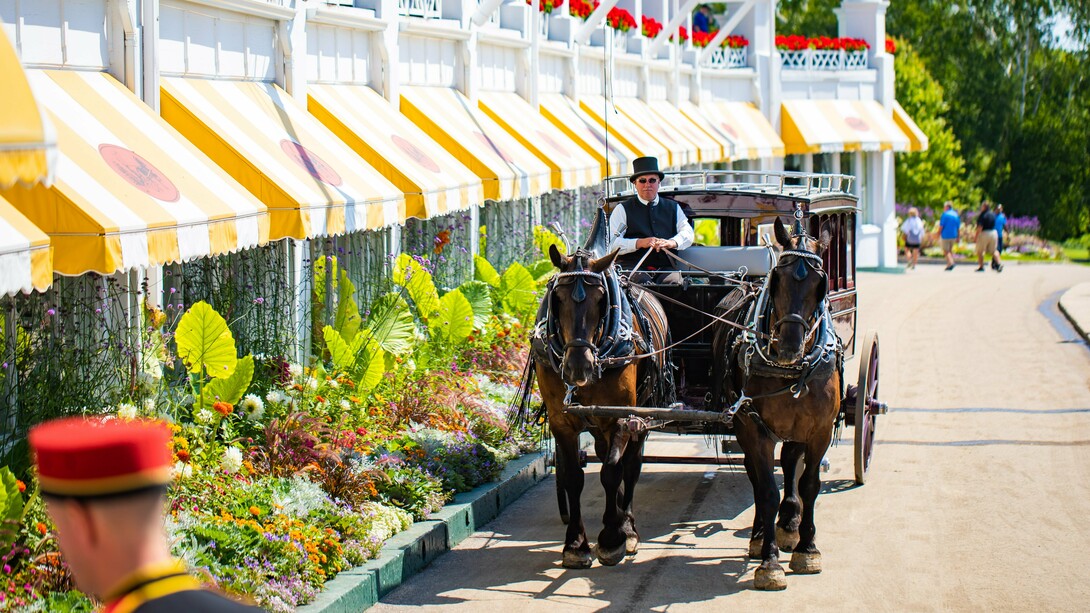
In a world where nothing seems to stay the same, Mackinac Island, located where two great lakes, Michigan and Huron, converge, remains much as it was in 1897 when the island’s leaders banned automobiles. For more than a century, the sounds here have been the clip-clopping of horses’ hooves on brick roads, the jingling of harnesses and the forlorn horns of the ferries as they make their way from the mainland across the Straits of Mackinac.
The 19th-century Queen Anne and Victorian-style houses still stand, in pristine condition, along the cliff road as it winds along the western edge of the island, and the downtown still boasts buildings that were here when the British invaded during the War of 1812 and even earlier when John Jacob Astor ran a successful fur-trading company that opened in 1808.
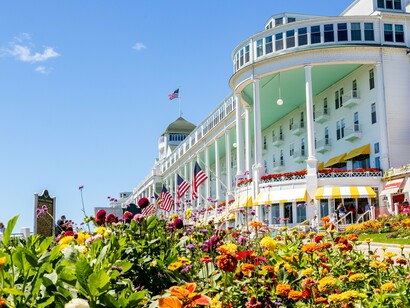
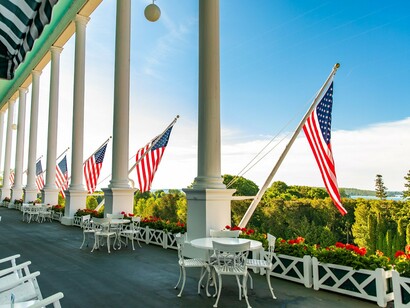
But perhaps what best personifies the timeless quality of Mackinac Island is the Grand Hotel, an elaborate confection of ornate cupolas, gables, balconies, and classic columns perched on a bluff overlooking the water. When the Grand first opened its doors in 1887, it was one of about 1000 summer resort hotels that were operating in the United States. Now, it is one of only 12 or so remaining.
Its luxury is based on old-fashioned style. White wood rocking chairs line the three-story tall porch, which at 660 feet is considered one of the longest in the world. Beyond are the majestic gardens where each year groundskeepers plant 105,000 annuals, 24,000 tulips, 3,000 daffodils, and 4,200 geraniums. Located among the vast green lawn with its statuary and fountains is the hotel’s swimming pool, where movie star Esther Williams shot several scenes for the 1947 movie, This Time for Keeps. Both that movie and a newer one, also made on the island and starring Christopher Reeve and Jane Seymour, Somewhere in Time, are available for free viewing at the hotel.
Glossy maroon coaches, pulled by strong hackneys and Percherons (those big, beautiful horses whose colors start off black, transforming first to gray and white and then all white as they age), transport the Grand’s clientele from the ferry wharves located in the charming downtown. These coaches aren’t reproductions but instead have been lovingly—and expensively—restored and are the original coaches from when the hotel was first built.
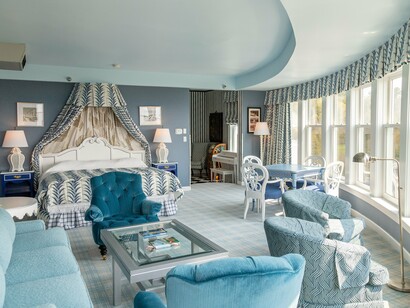
Inside this old-fashioned attention to detail endures as well—though for those who like modernity, after a long debate, televisions were added to the rooms and there is also a business center, and, of course, internet.
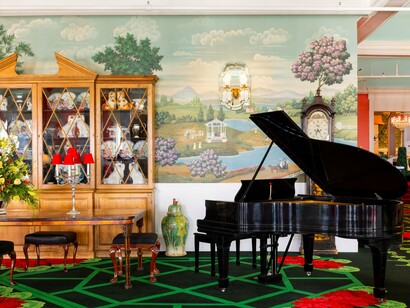
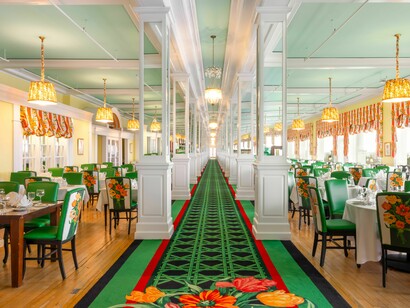
The Grand Hotel, decorated by Carlton Varney, once a disciple of the famous mid-1900s decorator diva Dorothy Draper, showcases his penchant for the grand detail—wallpaper in broad strips, bold colors, and antiques filling every public space.
Waiters dressed in black tuxedos serve sumptuous five-course dinners in the Grand’s large dining room with windows overlooking the lawn and straits as a harpist and pianist, dressed in formal wear, play soft dinner music. A cavernous kitchen turns out 5000 meals a day with such haute cuisine as veal stuffed with figs and island regional as whitefish sautéed in herb butter as well as the Grand’s famous dessert—ice cream served with a pecan fudge sauce.
Within a short time of arriving on Mackinac, the leisurely pace of another century sets in. Plodding along in a carriage up the steep slopes, one becomes accustomed to smiling and nodding towards others as they pass by. Imagine two strangers in separate cabs in a big city bothering to greet each other. Wouldn’t happen. Another curious effect of the island culture soon sets in. Words such as "dray," "buggy," "hackney," and "lorry," all long-ago terms, soon start to become part of the normal conversation. Drays, filled with toilet paper, roofing supplies, or whatever, are how commercial goods are moved about on Mackinac.
The island’s 600 horses do pose a slight problem, consuming more than 500 tons of hay and food supplements along with 6000 bushels of crimped oats each summer season. That translates into over 8500 cubic yards of manure per season that is quickly collected and composted for landscaping. Horses, buggies, and more are available through rentals from liveries like Mackinac Island Carriage Tours, a company whose origins date back to shortly after the Civil War.
A typical tour might go along the twisting island roads, past elegant summer “cottages,” thoroughly restored and built in such ornate styles as Colonial Revival, Stick or Shingle Style and Neo-Classical Revival. Phil Porter, Director Emeritus of Mackinac State Historic Parks, summered on the island as a child and wrote a book on island architecture called “The View from the Verandah,” which is available at the Ft. Mackinac Museum Store and is a good guide for those interested in the local architecture.
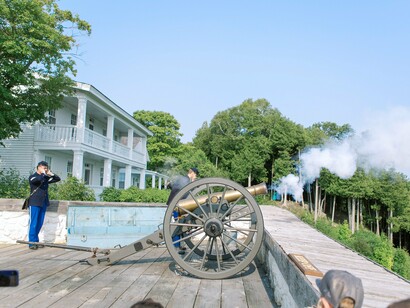
The fort, which rises up on the east bluff, surrounded by ramparts designed to withstand attack—though that design failed in 1812 when the English captured the island, is open to visitors and showcases island life more than a century or so ago. Guides dressed in 19th-century garb fire cannons over the ramparts, shoot muskets on the green, and host visitors in the bar, billiards room, and infirmary. Located on the grounds is a colonial-style restaurant with low ceilings, planked floors, and a verandah overlooking the bay.
Other stopping points include the 50-foot-wide limestone Arch Rock as well as Skull Cave, where Wawatam, a Native American, hid English trader Alexander Henry during the Fort Michilimackinac uprising in 1763. Bike riding or hiking around the perimeter of the island is another way to get a sense of its natural beauty.
The three island cemeteries offer another view of early island life, one of hardship and sometimes early death. Soldiers are buried at the post cemetery, while Saint Anne's Cemetery shelters the oldest grave on the island—that of young Mary Biddle, whose family were fur traders.
The Biddle House, located downtown, is now a museum. Related to the Biddles of Pennsylvania, who first migrated to the Colonies in 1681, the family fought on the wrong side of the Revolutionary War, a choice that resulted in their property being confiscated.
In 1816, one of the Biddle sons decided to settle on Mackinac Island, which was at that time the western center of the fur trade. Biddle worked for John Jacob Astor, who founded the American Fur Company—a thriving business that employed 500 people to keep track of the furs bought in by over 2000 traders. Members of the Biddle family lived in their home until the youngest daughter of the original settler died in 1929. The home languished until undergoing renovation that started in 1958. Now completed, the house, circa 1780 and located near the old headquarters of Astor’s fur company, is an example of the French Colonial Quebec Rural style.
Just down the street is the Beaumont Memorial, once a trading post, where surgeon William Beaumont made medical history in 1821 when one of his patients, Alexis St. Martin, was accidentally shot. St. Martin’s stomach wound didn’t close properly, allowing Beaumont a two-year view of how our digestive systems work.
Visitors to Mackinac are frequently referred to as “fudgies” because the island, which has specialized in fudge since the 1880s, sells approximately 10,000 pounds of the sweet (using 100 tons of sugar that is ferried from the mainland) a year.
The first visitors to Mackinac were the Ojibwa and Chippewa tribes, who used the island as a burial ground, considering it the birthplace of Michibou, the God of Waters. They named the island Michilimackinac, meaning “Great Turtle,” because from a distance that’s what it looked like. Though the name ends with an “ac,” the French missionaries who came to the island in the late 1600s pronounced it “aw.”
It was these missionaries who planted the lilacs that still burst forth into bloom every June and whose beauty and history have been celebrated since 1949 with the annual Mackinac Island Lilac Festival, held each June. Some of the lilac bushes are reputed to be 300 years old and are considered to be the oldest living lilacs in the country. The festival activities include garden tours, the world's longest horse hitch parade, a fireworks display, and free outdoor concerts. The Mackinac Island Lilac Festival was voted one of the top 100 festivals in the country by Bus Tours of America.
It’s all part of Mackinac’s history and a connection to a past that remains part of the present.