English
 Español
 Français
 Deutsch
 Italiano
 Português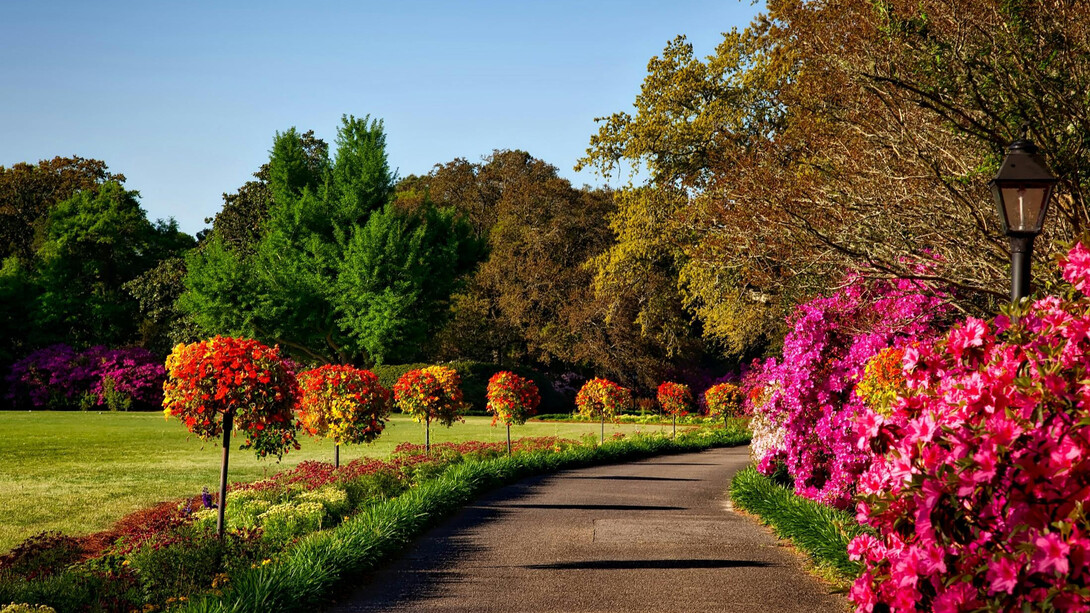
The garden of the world has no limits, except in your mind. Its presence is more beautiful than the stars, with more clarity than the polished mirror of your heart.
(Rumi)
Eight years ago, after recovering from major heart surgery, I started having long walks around my neighborhood. My mind and spirit were still in a sort of twilight zone. In one of these walks, I was musing about the state of the world, about the New Humanity that had been foretold. I was thinking about the pitiful state of fragmentation that our world was, just when we were physically and informationally, more connected than ever before.
I was disconcerted by the reach of global social networks, which, instead of helping us connect as one humanity, were becoming instruments to promote partisanship, superstition, and conspiracy theories. My walk then led me to turn a corner, just as I was deep in my gloom about the state of humanity.
I came across a large patch of empty land, a desolate lot, with stirred-up soil. A man was sitting on a bench, admiring the area. As I approached and passed by him, he greeted me cheerfully. With sparkling eyes, he pointed to the barren lot and asked me if I liked his garden. Both because of my state of mind, and the fact that the piece of land was an eyesore, I blurted frankly that I thought it was not a nice sight. He replied in a suave and assertive tone:
“Look, my dear friend, you will walk again through here. You might have been distracted or forgotten about it, but you have walked by this garden many times before. At other times, what you might have seen was different; maybe it was green, landscaped, or maybe wild, pruned, tilled, renovated, or torn. But never unkempt, no, never unkempt, because this garden is always being taken care of. You are passing by, so your mind is fixated on how things look now as you are passing by, but if you could just integrate all your prior and future walks, you would see a beautiful garden in different stages of growth and realization.”
He ended by winking an eye and started walking toward the raw grounds, whistling a morning song.
His words were resounding in my memory today as I walked again, pondering how long we humans have been walking around this garden of Earth. How we unfolded from pre-human forms, acquired self-awareness, and for two million years or so (nobody really knows) we were in close communion with nature, developing our capacities to communicate and interact with the surroundings, to survive. Equipped with instinct, a developing mind and a sense of Being that went beyond instincts and mind.
After that long tribal phase of hunting and gathering food, learning and being in awe, and relating to nature, just about fifteen thousand years ago, we developed agriculture. We learned to plant and harvest, and to do animal husbandry.
And our running around as hunters and gatherers was replaced by human settlements. With it came a closeness of many, a concentration of people, and time to use our awareness to develop written languages, culture, commerce, and the discovery of nature’s codes, as well as the design of our hierarchical organizations or politics, and intensify the differential expressions of selfishness and power-mongering.
As I pondered about this, walking the streets of my neighborhood, I felt humanity in me, and somehow saw myself walking for a long time on this Earth, as that intriguing gardener had said to me. And felt the unfoldment of my form, like evolving shapes in a slow-motion film, and the gradual ripening of an unknown inner fragrance, that seemed to be the raison d être of the Earth garden.
The encounter with that intriguing Gardener came back to my heart, His final words echoing in my mind: “If you would remember your previous walks, you would see this place, like a resident gardener does, in all its moments of potential and actual beauty, because it is in the whole cycle that its immense beauty lies.”
Further developments of our long human walk in this garden of the Universe came to mind (as by now I had realized that the whole universe was the garden, not just that small patch of land where I had met the beautiful gardener eight years ago).
The Renaissance, the coming together of the Hemispheres, the Industrial Revolution, followed the agricultural revolution. At that point, a thought came to mind with a smile. Marco Polo was once a legend, but today, you can have breakfast in China and dinner in Europe.
I pondered about the sociological, spiritual, and civilizational changes accompanying these accelerated capacities to communicate. The fast travel, media, Internet, cellular, and social networks, and AI. What is their impact on the human psyche?
I thought about the fateful humor of it all, and the tragedy at the same time. For example, Caligula was not a problem for India, nor a point of conversation for the Mayans, but now people like Trump can be of concern for everyone on the planet. No doubt work on the garden is now going through an intense phase. The gardener seems to be doing some particularly intense work on the overall lot.
My mind was captivated by the idea of a garden. That mythical Garden. Raised as a catholic, my first memories of the Garden came back, as it was described by the priests and nuns in my school, and how my child’s imaginative mind tried to conceive and understand what they were telling me.
God created Adam from the dust of the ground and then planted the Garden of Eden with the “tree of life” and the forbidden “tree of the knowledge of good and evil” at its center. God tasked Adam with tending the garden and naming the animals therein and gave him the single command to not eat the fruit of the tree of the knowledge of good and evil. (which happened to be an apple, and of course, growing in Puerto Rico, it did not resonate, mango trees, yes, guava trees, but not apple trees)
Anyhow, the story went on; it happened that Adam lacked a helper for his work, so he was put into a deep sleep while God took from him a rib and created a companion, Eve. The two were people of innocence and lived unashamedly without clothes like husband and wife. However, an evil serpent in the garden deceived Eve, who ate an apple and gave some to Adam.They recognized their nakedness and wore fig leaves as garments. Immediately God saw their transgression and proclaimed their punishments—for the woman, pain in childbirth and subordination to man and, for the man, relegation to an accursed ground with which he must toil and sweat for his subsistence. God clothed them with animal skins and then cast them out of the paradise garden, posting an angel armed with a sword of fire there to prevent their return.
At my tender age of six or seven, this story terrified me! I immediately became panicked about God, snakes, apples, and whatever it was (innocent then) that happens when people of both sexes become aware that they are naked.
I wonder now, if all the fear, guilt, the capacity to understand what life all is about, our relationships with each other would have been different, if at that age I had been told something like what follows, by those educating me:
There is only one Being that we all are. We think we are many, but it is just God who is like one Ocean of fragrance playing a hide and seek game with himself, and he starts a Garden where he is lost, like asleep without being aware of anything, and starts grouping little by little through evolution, remembering gradually, and waking up, first as tiny particles, then these come together, and make stars, and these stars develop the seeds, like pieces of puzzles, that start to come back together, and organisms with identity, begin and play, and they change form, and grow in knowing where they are, and become plants and birds and animals and puppies and all that, and out of that line of evolving relationships full knowledge comes, associated with one of those forms, and humans like you and me appear, and they have the capacity to know themselves to be fully aware that they are and bloom like flowers in a Garden…
I am not a good storyteller for children. Yet I wonder, what if the story told to them, about the universe and life, was about the intimacy of everything, evolution, inner growth, and love, and the eventual realization by everyone, that all is just one Being.
Instead of the fearful tale of an angry God, and heaven and hell. Maybe a different understanding and attitude would develop in adult humans, as they would not grow under the context of an annoyed God, a devil, of hell and heaven, apples that cannot be eaten, and reproductive organs meant to perpetuate the garden and not to be ashamed of.
Looking into the Internet, after I finished my walk, I found out that besides that Garden of Eden, which terrified me in my childhood, there are different varieties of the Garden myth, some more ancient and much less panicky than the biblical one. The oldest conception, perhaps being Pairidaeza from ancient Persia, a cultivated space amid chaos or desert, is about conscious cultivation. Ordered, irrigated, harmonious — not wild nature, but nature transformed by care.
But back to the present garden we are living in now. I am amazed at the simultaneity of connectivity, the scientific understanding of nature, and the concurrent blooming of fear and selfishness that pervades today. Narcissism, cruelty, fear, tribalism, trauma, love, compassion, genius, and longing for meaning. All surging at once. This is perhaps why the moment feels unbearable and sacred.
Yet I feel somehow that the Garden is not being destroyed, but like my Gardener friend would have said, the soil is being prepared, for a deep blooming of empathy and love.
All seems to me like a Mayavic theatre. The myths of Adam and Eve, Ganesh, Quetzalcoatl, and so many others. And then the personal myths and opinions of all people, like me. We are so many billions passing by, with wonder about what life is all about, pounding our minds, when we engage at times, or suppressing it, and or passing on to others (priests, ideological or political leaders), to avoid the personal paralyzing perplexity of tackling it.
And then there is this selfishness that we express in all intensities, that makes us so focused on getting whatever we want, at all costs, even if we are not satisfied, even if it hurts others. Then we all die. And all the hubris from each point of view dissolves.
But how many people can one hurt with this attachment to our egos? Millions, if you are a political or a corporate leader, satisfying your whims and wants, feeling so cocky about yourself, that you ignore the whole universal dance. And how about the enablers, the ones who support and applaud these leaders, backing their madness, with their gullibility, ignoring the harm being done to others. Either in the ovens of Germany or in the pogroms of ICE. And all those personal little moves we all make in our lives, ignoring the feelings of others, hurting others, so we can stand in front, or get what we want.
But has it not always been like this? One might say. Whether in the times of Hitler, Caligula, Attila the Hun, the witch hunters, the inquisitors, the lynching mobs in the Southern US, and on and on and on. We seem to be better today: violence per capita is dramatically lower than in medieval or early modern times, slavery, while not eradicated, is illegal and morally condemned nearly everywhere, human rights are recognized and globally referenced, extreme poverty has fallen in the last 50–70 years, life expectancy, education, literacy, and health have improved across continents. Women’s legal status has advanced more in 100 years than in the previous 5,000.
The MAGA hatred (and their equivalents in Europe and elsewhere) towards immigrants is just a present manifestation of the worst of human instincts, which have always been with us. But we are better today in terms of cruelty, recognition of human rights, and showing compassion.The moral baseline has shifted upward, albeit unevenly. But yes, a lynching today is a crime; and 150 years ago, it was a picnic.
I believe that MAGA and other tribal nationalistic movements are evidence of something subtler: that when moral norms advance, backlash appears. This is not new. The end of slavery produced violent white supremacist backlash, women’s suffrage produced hysterical anti-feminism, decolonization produced authoritarian nationalism, and civil rights produced reactionary politics. But the fact that these go to the past movements, shout, exaggerate, lie about, and mythologize the past is evidence that the past is no longer viable.
What is creating the present intense and seemingly worst scenario is that our access to knowledge about cruelty is wider than ever. It used to be local. Now it is globally broadcast. Because of this, we have become more empathetic in proportion to past times, for the recognition of rights, legal protections, and the norms for equality. However, there is still no global emotional integration or a surge of spontaneous compassion and planetary identity. The legal, rational, and spiritual context is saying -we “all are created equal”, but nationalistic instincts whisper, “each one to his own” or “my tribe is first.”
More people are realizing we are globally interdependent, and are becoming more compassionate to each other, and are in harmony with nature. But many are afraid to lose their perceived ego standing, their tribal identity, and the traditions that they are attached to.
But today, human civilization, in terms of understanding natural systems, communications, and creating corporate networks to have a more prosperous business, has already moved towards a planetary structure.
Structurally, we are more capable today than at any time before of acknowledging and addressing widespread cruelty and violation of rights and acting compassionately. But our dark instincts have not disappeared; they are being exposed, redistributed, and amplified in new ways. Thinking about the above, with every step I took in my walk, brought back my own mistakes.
There is a natural tension between ego and awareness, between the intoxication of selfishness and the quiet gravity of compassion. Human history, if assessed by numbers, seems to have favoured at times the loud, the brutal, the self-certain leaders. Because they simplify, they relieve people—temporarily—of the burden of doubt, complexity, and responsibility. They offer a shortcut: follow me, and you can blame others for your pain.
The enablers, the ordinary people who empower these figures of authority, aren’t anomalies; they are the majority in history. Even followers of religions, whose original teachings point to a life of compassion, forgiveness, and love, contract out to authoritative institutions of faith and adhere like a tribe, rather than try to understand and feel the oneness in all.
The present corporate and political selfishness prevailing in the power structure of society, particularly in the United States, is weakening our discovery through science of the intimate interdependence of human society with nature, and is now negating climate change. Because it affects their corporate interests.
This could lead to a human-provoked catastrophe, which perhaps will make us reflect and move towards cohesion and cooperation, rather than to pursue the “each one to his own” mentality. Perhaps somehow, built into our expanded consciousness journey, this is just another step for the garden to bloom. A tragic beauty.