English
 Español
 Français
 Deutsch
 Italiano
 Português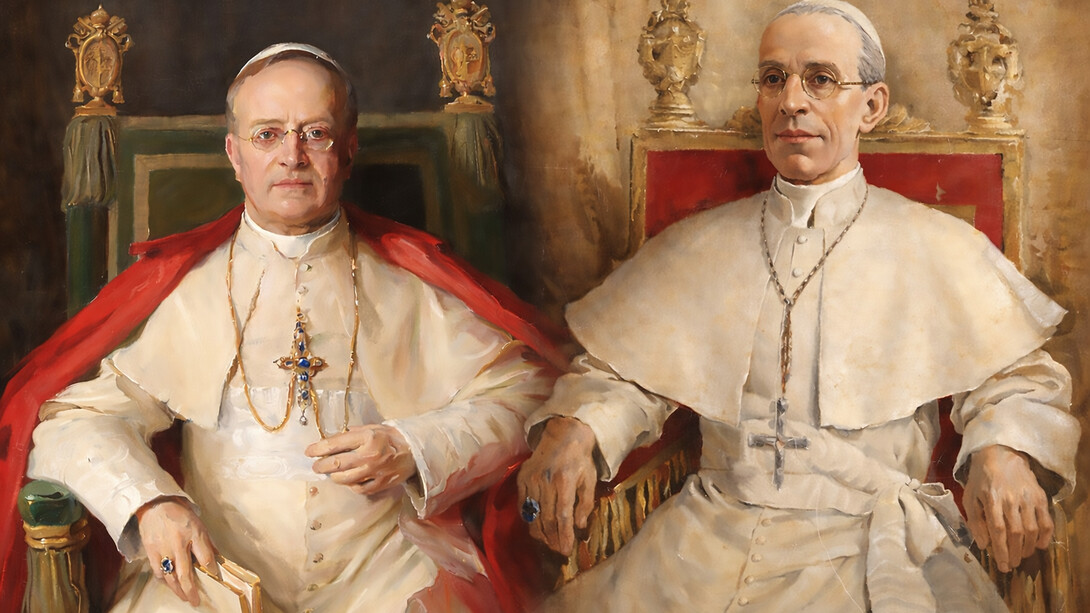
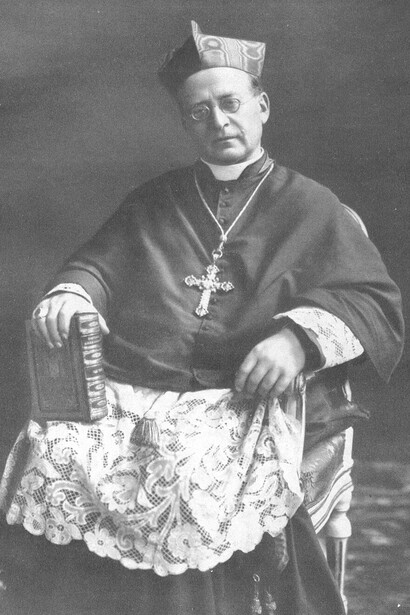
Prior to 1939, the Catholic Church under Pope Pius XI (Achilles Ambrose Damian Ratti, 1929-1939) was unalterably opposed to the Nazis' openly racist ideology. It is important to say a few words about this Pope XI and his character. A question often arises asking, “If Pope XI were alive on October 16, 1943, I wonder what actions he would have taken to stop the raid on the Jews of Rome that day?” Pius XI was not afraid to publicly denounce Nazi racism. He was a forceful and resolute individual who knew the threat that Nazi ideology posed and was willing to say so.
The silence, or as it has been suggested to say, “the silences,” of Pope Pius XII, according to many, illustrated that he was not willing to act boldly. Instead, he was a cautious pragmatist or, worse, an incrementalist bureaucrat. Social commentator and humorist Ron Placone (formerly a communications college professor) noted, “[t]here is nothing pragmatic about an incremental solution to a catastrophic problem.” The impending Holocaust was a catastrophic problem.
Pope Pius XII, as leader of the Roman Catholic Church, offered a self-preserving, incremental, and defensive response only when necessary to a relentless adversary and did not lead his flock with a clear message of resistance. Romans 6:14 says, “For sin shall not have dominion over you: for ye are not under the law, but under grace.” Grace is God’s presence. Pius XII did not transmit this grace by allowing the Nazis dominion over his flock and therefore sinning.
Pius XI issued the first papal encyclical written in German, not Latin, on March 10, 1937, titled “Mit brennender Sorge” (“With burning concern”). So what is an encyclical, and why is it important? The word “encyclical” means “circular letter.” It is a letter written by a pope to his clergy and laity in which he discusses his personal views on the church's teachings and doctrine in a particular area. Encyclicals do not set down new rules for the Roman Catholic Church’s core beliefs (church doctrine); instead, they are official statements and are considered authoritative teachings of the church.
Pope Pius XI’s encyclical is significant not only for what it said but also for how it was said—it was purposely written in a language all Germans could understand and was a direct response to current events with a message to his flock. The core message of the encyclical was ‘we are all children of God.’ Catholics do not respond to race baiting. Period. This particular letter was smuggled into Germany and read out loud from the pulpits of all German Catholic churches on March 21, 1937, on Palm Sunday. It also condemned breaches of the 1933 Reichskonkonkordat (a treaty negotiated between the Vatican and the emergent Nazi Germany and signed on July 20, 1933, by Cardinal Secretary of State Eugenio Pacelli, who later became Pope Pius XII on March 2, 1939).
The contents of this encyclical are extremely important because it condemned “pantheistic confusion” (the belief that nature is divinity), “neopaganism,” “the so-called myth of race and blood,” and the idolizing of the State. It noted the importance of Jewish influence on Christianity, such as the Old Testament, because it prepared the way for the New Testament. It condemned the exaltation of race, or the people, or the state. Furthermore, this encyclical declared “that man as a person possesses rights he holds from God, and which any collective must protect against denial, suppression, or neglect.”
The encyclical also defended baptized Jews. Even though some Jews had converted to Catholicism, they were considered to be intrinsically Jewish by the Nazis because of unfounded racial theories that the church could not and would not accept. The stain of racial Judaism was always in the blood and could not be removed.
On April 2, 1937, the Vatican’s Secretary of State, Cardinal Pacelli (later Pius XII), wrote a letter to Germany’s Cardinal Faulhaber on April 2, 1937, condemning the Nazi atrocities, explaining that the encyclical titled “Mit Brennender Sorge” (“With Burning Concern”) was to be a public denunciation against Nazism, purposely written in German.
Pacelli went on to elaborate that the encyclical states that there are no real racial differences. It argues that the human race forms a unity because “one ancestor from God made all nations to inhabit the whole earth.” From Mit brennender Sorge: “What a wonderful vision, which makes us contemplate the human race in the unity of its origin in God...in the unity of its nature, composed equally in all men of a material body and a spiritual soul; in the unity of its immediate end and its mission in the world; in the unity of its dwelling, the earth, whose benefits all men, by right of nature, may use to sustain and develop life; in the unity of its supernatural end: God himself, to whom all ought to tend; in the unity of the means for attaining this end...in the unity of the redemption wrought by Christ for all.” From this and other sources, it should be emphasized that Pius XII was unalterably opposed to Nazi ideology.
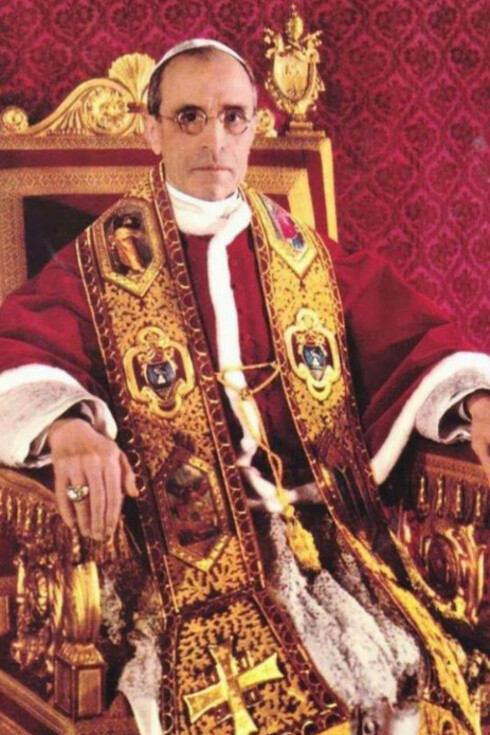
Pope Pius XI died on February 10, 1939. On March 2, 1939, Eugenio Pacelli was elected pope and took the name Pius XII. Pius XII’s first encyclical, Summi Pontificatus (On the Supreme Pontificate, October 12, 1939), echoed his predecessor’s viewpoint that Christianity is opposed to every form of racial hostility and every claim of racial superiority.
However, what Pius XII safely kept to himself (scholars call this the Hidden Encyclical) was a draft originally planned for Pope Pius XI before his death in February 1939. The Humani Generis Unitas (On the Unity of the Human Race) condemned racism, anti-Semitism, and especially the persecution of the Jews. It is called the “Hidden Encyclical” because it was never issued until its publication in 1995. It has been argued that Pius XII did not promulgate the draft as an encyclical. His critics point to this particular action of Pius XII as evidence of his alleged silence toward anti-Semitism and the Holocaust. Being a pragmatist, Pius XII did not publish it, and his decision violated the three tenets of the church: faith, hope, and charity. The last of these makes it incumbent upon Christians to act in a charitable manner towards other human beings. However, Pius XII’s actions towards the Jews were less than charitable.