English
 Español
 Français
 Deutsch
 Italiano
 Português
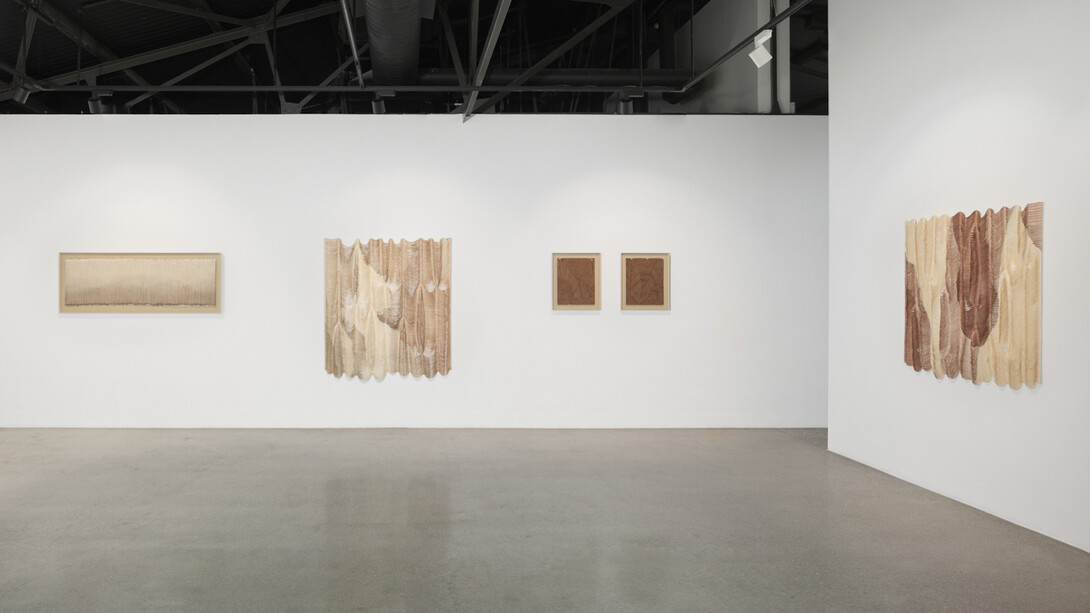
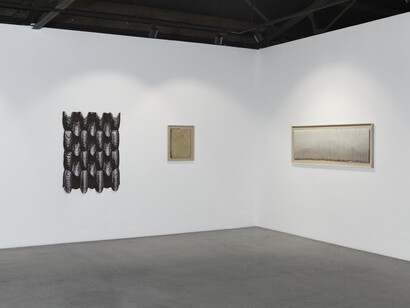
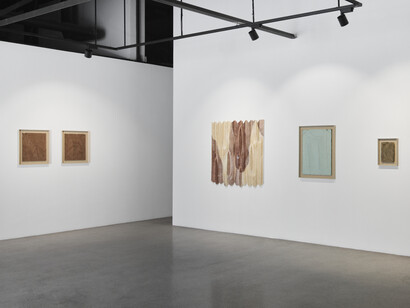
Whatiftheworld is proud to announce the opening of Range of motion, a debut solo exhibition by Michelle Czarnecki.
In her previous life, Michelle Czarnecki worked as a physiotherapist. She spent 12 years in close proximity to the bodies of her patients; flexing and extending joints into mobility, pressuring pain to run its course through tendons and commandeering fine needles into flesh. By virtue of her occupation, the physiotherapist herself absorbs the pain and discomfort of others. To have worked so closely with human corporeality and to have moved bodies into mended states must surely be an act of alchemy; much like the artist who animates material into form.
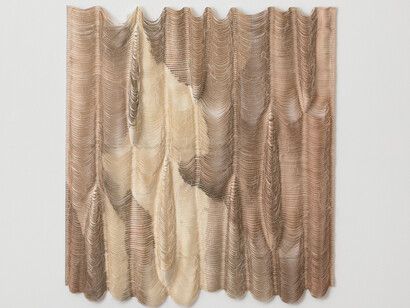
What appears most striking about Czarnecki’s work is her unique negotiation of her chosen materials, calico and ink, into such unexpected forms that one might hesitate to detail the process, so as not to spoil the intrigue. However, there is something to be studied in her learnt mechanisms, which seem to call on navigation informed by touch. Likewise, she applies this same method to her recollections of landscape and geological formations. In particular referencing the Groot Winterhoek mountains in a series of ink landscape paintings on fabric made during a residency in Tulbagh, which were then cut by hand and reconstituted into a single work titled Twenty-eight.
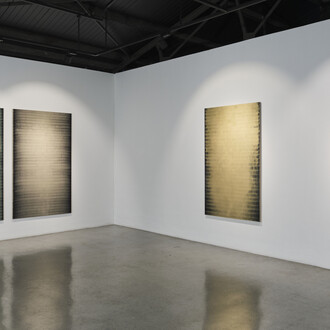
Czarnecki is a self-taught artist, who by drawing on her life experience and the bodily nature of her former practice, demonstrates an original, enquiring approach to the traditional canvas as a sculptural medium. Czarnecki’s layered working process is limited to a strict colour palette of brown, green and blue ink. It is through the mixing of these pigments onto calico that the sumptuous tonal range of her work is realised. Slick browns spread into swamp greens from what appears to be a deep black, perhaps emerging from blue. Her approach to her colour palette involves an intuitive and unpredictable method; too much or too little in a formula can yield an entirely new colourspace, as can be seen in the deadly shade of aubergine in Smokescreen. The initial impression of stained calico is reminiscent of a bruise, which is expressed in the blushing transformation of flesh after trauma.
A colour gradient, ranging from Czarnecki’s aubergine, emerges in subtle hues of dusty pink in the work, Castaway. Czarnecki’s choice of such a colour offers an intriguing reference to a pink-washed Saldanha Bay, the industrial port town in which she was raised. The arid, West Coast terrain of Saldanha is synonymous with an infrastructure coated in pink dust (since the establishment of an iron ore terminal in 1976). Windswept with industrial pollution from an excess of tiny, corrosive iron ore particles; residual dust has relentlessly coated cars, buildings, plants and animals alike in a soft pink hue of infective rust. The ongoing pollution from iron ore transport to the Port of Saldanha Bay marks an environmental crisis, which precedes the artist’s birth. Czarnecki has subsequently re-approached her hometown terrain as a landscape to be fleshed out and mended through the oscillating mechanisms, which define her methodology.
While a bruise is a refrain of trauma, which gradually fades with repair; rust actively corrodes; it is as though the colourspace of each traverses the timeline of the other.
The mechanisms of Czarnecki’s practice thus undulate between repair and corrosion. After painting and drying her canvas, she hand cuts it into 1cm strips along the warp of the material. For works, such as Collateral I and II, her process involves the act of dissecting the canvas into perfectly measured equal strips, she then lays down acrylic medium glued spines at intervals and flips the canvas upright. Un-stained calico slits are dragged into view and a thousand possibilities are conjured at once: a body slouched over, a drapery, a scoliotic spine, a breast, a protrusion, a tumor, an artefact, an archive, a ghost...
Conversely, her other favoured technique, which can be seen in the series, All together now I, II, III, is to squeeze the dissected canvas strips very tightly into box moulds, which makes the works appear to be bent, as opposed to slouched, into form. A distinction between the two outcomes could be chalked down to a difference in range of motion; each work embodies an oscillation between modes of stiffening and of slacking. In All together now I, II, III, the stained ink impression of the canvas from its former life, stripped and flipped into a new dimension, lends a patina effect to the tightly compressed work. A patina is the exact opposite of corrosion; one holds form together while the latter dismantles it. This impression appears as oxidised copper, or tarnished silver, which lends to it an uncanny feeling of decades of wear and yet … her work has just begun.
(Text by Georgia Munnik)