English
 Español
 Français
 Deutsch
 Italiano
 Português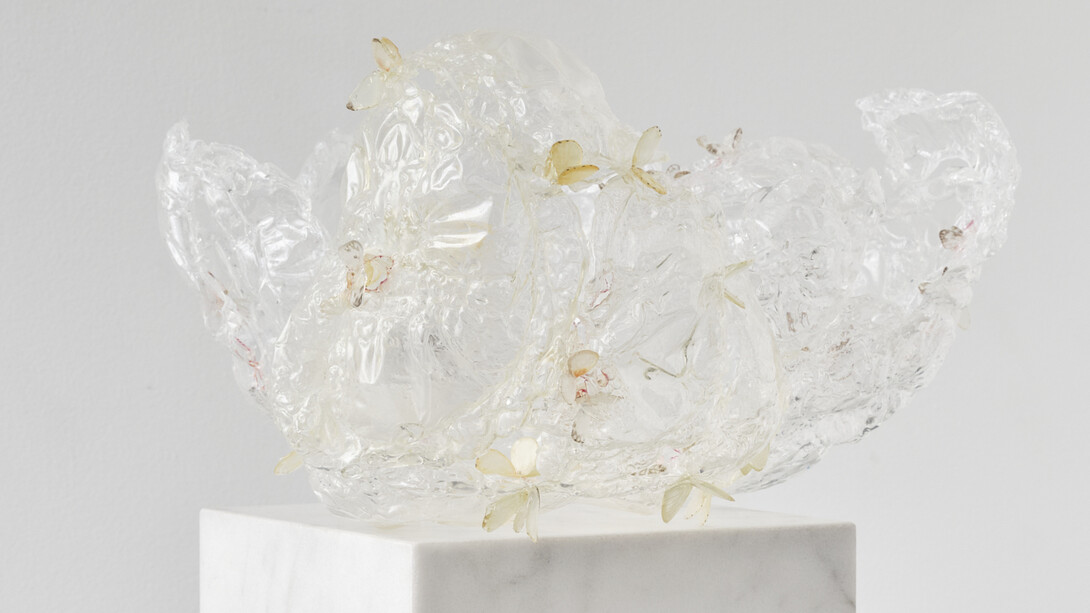
Whatiftheworld is proud to present Strangling fruit, a solo exhibition by Georgia Munnik.
“I make work from literature. Writing was my first talent and so naturally, my artist practice is an ode to translating the seductive affect of a written story into something tactile. My practice always begins with the word.
Strangling fruit, the title of this body of work, is derived from a mycelial phenomenon in one of my favourite books, Annihilation (VanDerMeer, J. 2014), the first book in a four-part climate-fiction literary series, Southern reach (2014-24). The series is based in and around the pristine, edenic landscape of Area X, previously a territory in Florida, USA, in which nature appears to have mutated, co-evolved and proliferated beyond human comprehension. Area X is believed to be uninhabitable to humankind. Yet, on an official excursion into the terrain, one of the series’ protagonists, ‘the biologist’, discovers a fungal expression of fruiting bodies (mushrooms), which have taken the form of clusters of fleshy and outwardly yearning human hands, the fingertips of which are capped with golden nodules that burst with spores at intervals. Together, they form the cursive script for a curious religious sermon, the opening statement of which reads, “Where lies the Strangling Fruit that came from the hand of the sinner I shall bring forth the seeds of the dead to share with the worms . . .” (2014:23).
On her first encounter with the alien orthography, the biologist leans into the fleshy script as a golden nodule bursts open; its spores travel into her nose, which she identifies by the smell of rotting honey. The ingested spores that the biologist inadvertently consumes germinate her lungs and ignite a glow within her chest, which she comes to identify as a feeling she calls ‘the brightness’. Over the course of the series, the brightness alters her physiology at a cellular level, operating as a kind of affective psychic and corporeal link between herself and her uncanny natural environment. This process is reflected in the biologist’s slow metamorphosis into an insatiable roving marine ecosystem. The religious sermon, which the strangling fruit spells out, could be interpreted as a self-referential expression of fungal reproduction, orchestrated at the site of the spore-releasing fruiting bodies, which serve to further proliferate mycelial presence in Area X.
The concept image of an orthography becoming something tangible, even respiratory and olfactive, is deeply alluring to my own artistic and olfactory sensibilities. My sculptural work operates in much the same way: each material constellation, scene or cluster is a conjuring of the affect of the brightness to pull the DNA of the external world into the object itself. The Strangling fruit as a constellation of works offers a speculative, ecological narrative of animal, mineral, plant and plastic co-mutations, in which human corporeality is absolutely enmeshed. This constellation of works therefore serves as a speculative gaze into a world in which organic and plastic mutations are possible, and even productive.
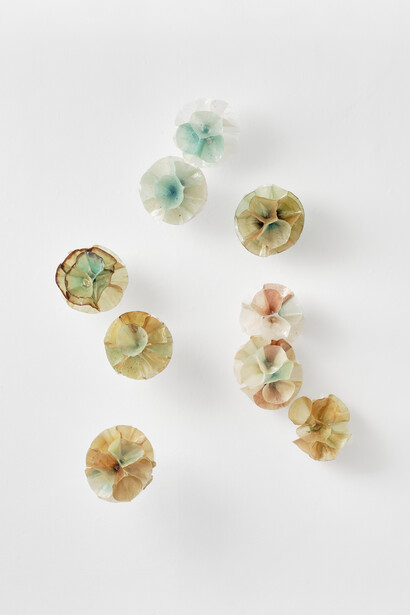
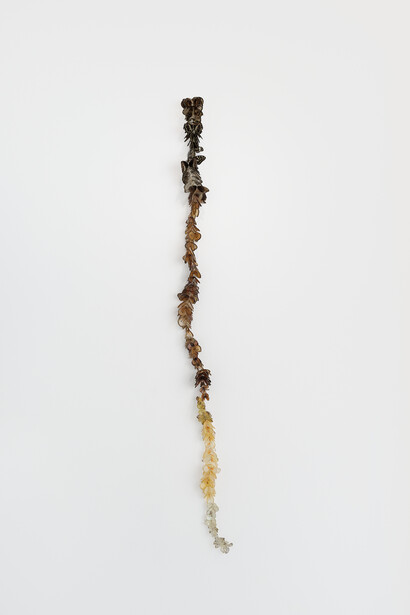
The logic of the speculative ecology of the The Strangling fruit is based on expressions of mycelial reproductivity: the snaking, spine-like formation of resin-coated butterfly wings replicate themselves ad-infinitum in an act of auto-procreation (selfing). ‘Selfing’ is synonymous with certain mushroom species that can release asexual spores via mitosis, which effectively replicate the parent fungus. I imagine the clone butterflies to clip themselves off, vertebra by vertebra, and to flutter into the blood-lined crevices of the bulbous, crystalline bodies, whose transparent flesh hinges open for the insects to gather as they puddle (feed).The resin flowerhead clusters of the *Strangling fruit ecology are arranged in an ’S’ formation and serve as its fruiting bodies: fleshy, outwardly yearning hands. During production, each part of a flowerhead cluster is treated as a porous body, fed with pigments, perfumes and minerals, the ingestion of which is reflected in the colourspace of its individual parts. While the flowerhead clusters appear to lend themselves to the performance of floral pollination, they are also sealed shut with an epoxy resin, and thus sterilised in their encapsulation for permanent display. This gesture in itself is an arc within my work, which considers the introduction of synthetic, non-soluble materials into the natural environment through human industrial activity on earth from the late 18th Century onwards. The speculative material and sculptural forms of the clustering constellations of the Strangling Fruit make reference to a world in which “collaborative survival” (Tsing, A. 2015:20) extends beyond nature, simply on the basis that micro-plastics now exist within human bloodstreams.
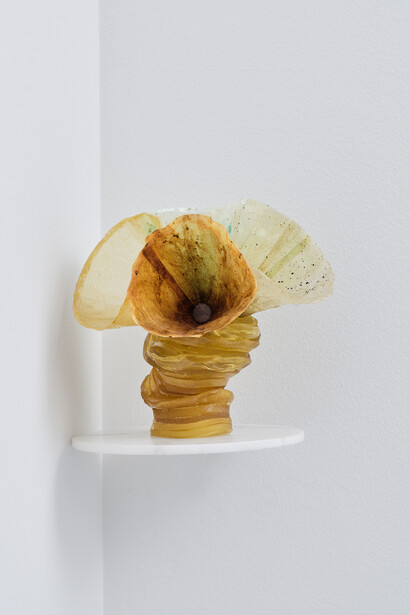
The sculptural forms within The strangling fruit offers insight into a fantastical and queer reproductive cycle in which death is a gaping mouth of many and, in which human corporeality has seeped from its former perceived finitude to the world and utterly surrendered to it. Burial is made from the small Hario coffee filters through which I poured my morning coffee over months. The filters are stained with the residue of soaked coffee grains, they are then dried and set in resin, which results in a honey-like, skin-textured translucency. The resin-cast individual filters are stacked and sculpted into an organic formation. To me, their final collective expression reads as a decomposing body, stretched out and embalmed with fungal life. This image makes me think of a kind of chrysalis: an intimate cocoon whose inner world is utterly unknowable but from which new, fantastical life forms ultimately emerge. Finally, this type of sculptural expression further serves as a material meditation on the theme of human memorialisation, particularly within the realm of my PhD research, which offers the provenance of a body – in all of its decompositional wonder – as the most earnest archive of life.”
(Text by Georgia Munnik)