English
 Español
 Français
 Deutsch
 Italiano
 Português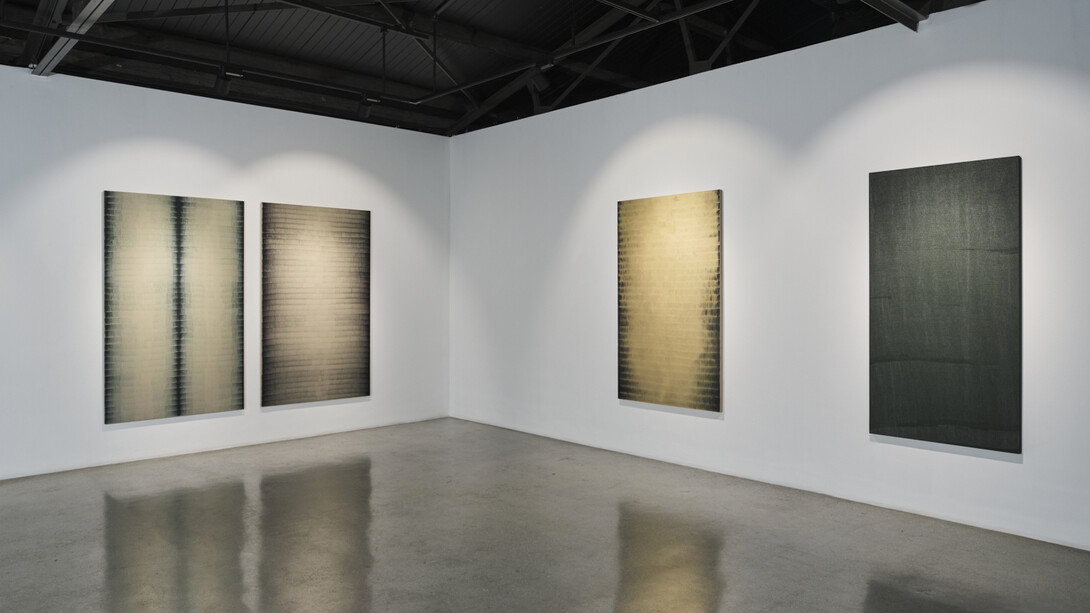
Whatiftheworld is proud to present Remains of a never world, a solo exhibition by Cathy Abraham.
Cathy Abraham’s practice centres on a simple but profound proposition: that time can be measured through acts of attention. Across her surfaces, marks accumulate, gestures repeat, and breath disperses pigment – each work a register of moments passed, of material processes and metaphysical measures. In these engagements with duration, the artist is guided by gematria, an alphanumeric system in the Jewish mystical tradition of Kabbalah, in which numbers serve as vessels of meaning.
Within these teachings, the world is sustained by Thirteen Attributes of Divine Mercy, a structure of patience, restraint and compassion through which existence endures. Mercy, in this sense, is not a sentiment but a cosmological principle: the condition that allows life to persist, however fractured. Abraham’s work unfolds within a related logic. In attending to counting and repetition, her paintings and drawings give form to formlessness as temporal instruments of perception rather than representations of time’s passage. The artist’s mind turns to forgiveness as she works, a salve for our splintered humanity in the urgent unrest of the present.
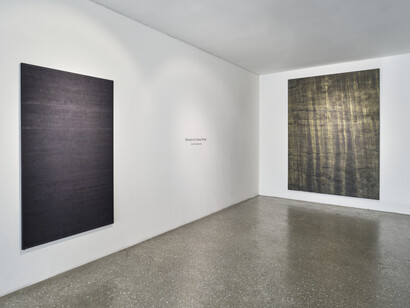
The exhibition takes its title from the monumental drawing Remains of a never world, a vast indigo field across which fine arcs of gold accumulate in succession. Appearing as a recitation, the repeated marks invoke the number eighteen – chai, the numerical value of life in Kabbalah – a structure that recurs throughout Abraham’s practice. To the artist, the phrase ‘never world’ suggests a condition of unmet potential: a world that began to gather coherence, but was never realised. What remains are not ruins, rather residues of possibility. At three metres in height, the titular work draws the viewer into its undulating rhythm, where each mark records an instant of contemplation.
A related gesture appears in the diptych The weight of truth is 9. Here, gold pigment is dispersed by breath across a chromatic ground, allowing particles of light to hover briefly between air and earth before settling onto the substrate. The weight of dust exhaled – nine grams – corresponds in Kabbalistic thought to truth and completion, and carries a sense of inner coherence, a structure that holds even as it scatters. What is measured here is not certainty, but a sustained proximity to what resists resolution. Truth, like breath, is not declared but suggested and released. The surface becomes a plane where weight and immateriality coexist, where the act of measuring approaches the immeasurable. The title of another painting, in which a luminous centre is held within surrounding darkness, recalls a phrase from the Zohar, a foundational work of Kabbalistic literature: A trace of light remains hidden in all things. Illumination does not arrive as revelation; instead, the light of truth is contained within the surface itself.
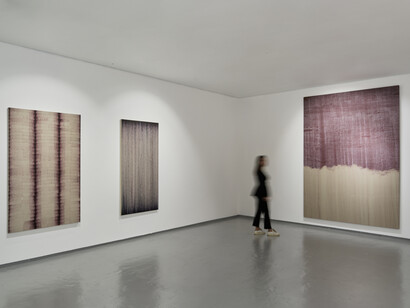
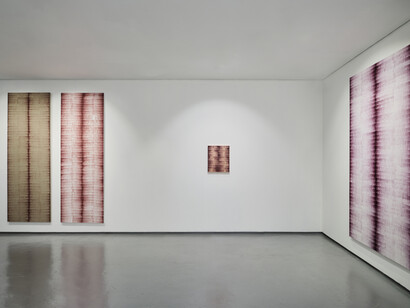
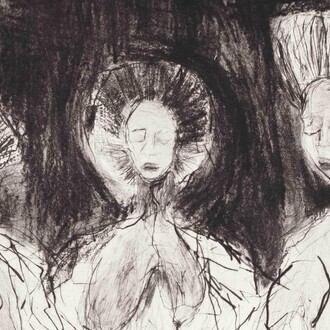
Other works measure time through endurance. In the paired paintings Before the flame I and Before the flame II, marks are assembled on tall vertical planes. To Abraham, these two works resonate with the divine attribute erech apayim – slow to anger – in which mercy manifests as restraint, the capacity to withhold reaction. A larger work, I went closer, I did not die, at once expands on these reflections and echoes the veil-like quality of Remains of a never world. Time finds a further form in the artist’s oil pastel drawings. Made over eight minutes, the twinned works titled 8 minutes continuous line drawing retain the trace of both hands moving in mirrored motion. The duration is significant. In Jewish mystical thought, the number eight signifies that which exceeds the natural order, an interval through which transformation becomes possible.
From the multiple temporal systems that intersect within the exhibition, a numerical cosmology emerges, refracted through the thirteen attributes of mercy and the repeated invocations of eighteen, nine and eight. Returning to these numbers in mark, gesture and breath, Abraham traces a philosophical movement from the sustaining forces of clemency to the renewal of life, and finally to those moments when time opens outwards, transcending our human limits to touch the divine.