English
 Español
 Français
 Deutsch
 Italiano
 Português
What remains of a life when its objects are no longer needed? What stories can an empty bottle, a worn- out shoe or a collection of discarded containers tell about the people who once owned them? In Song Dong. Soul out, the Chinese artist invites visitors to reconsider the relationship between memory, materiality and the passage of time, transforming ordinary objects into witnesses of individual and collective histories.
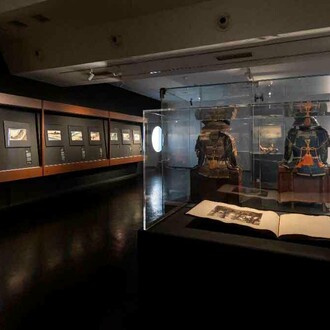
Presented at the MAO – Museum of Oriental Art in Turin, the exhibition marks Song Dong’s first solo presentation in Italy. Curated by Li Zhenhua and Davide Quadrio, with Francesca Filisetti and Rebecca Ricci, the project extends throughout the museum, bringing together installations, photographs and videos that span more than three decades of artistic practice. Rather than treating the museum as a neutral container, the exhibition engages with its architecture and permanent collections, creating an encounter between contemporary artistic languages and the historical objects housed within Palazzo Mazzonis.
At the heart of Song Dong’s practice lies an apparently simple gesture: paying attention to things that are ordinarily overlooked. His work emerges from the conviction that the everyday possesses an extraordinary capacity to preserve experience. Objects become repositories of affection, loss, habit and social transformation, while their physical deterioration reflects the instability of human existence.
This sensibility draws upon Taoist thought, particularly the philosophies of Laozi and Zhuangzi, as well as Buddhist ideas of impermanence and the fluidity of being. Yet Song Dong’s artistic language is neither exclusively contemplative nor detached from the world. His work also engages with the histories of Arte Povera, Dada, Minimalism and Conceptual Art, exploring how the ordinary can become a powerful instrument of critical reflection.
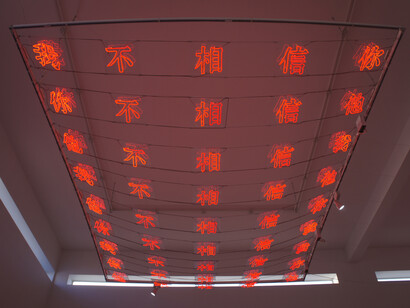
The exhibition opens with Believe, a luminous installation adapted to the museum’s spaces. Its cascade of red light establishes an immediate sensory encounter, inviting visitors into a world where perception and interpretation remain uncertain. The work’s play on the meaning of trust introduces a subtle tension between belief and suspicion, between the desire to connect and the difficulty of fully understanding oneself or others.
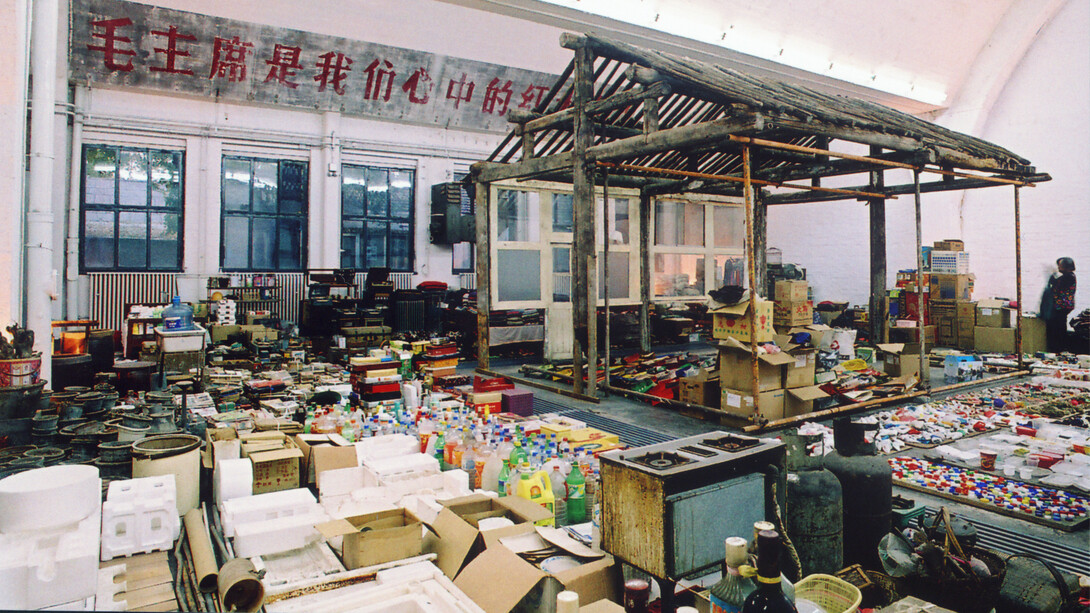
The central work, however, is Waste not, the monumental installation that gives the exhibition its emotional and conceptual foundation. Presented in Italy for the first time following its appearances at institutions including the Barbican Centre in London and the Museum of Modern Art in New York, the work consists of more than 10,000 domestic objects accumulated by the artist’s mother, Zhao Xiangyuan.
Following the death of her husband in 2002, Zhao’s attachment to saving things became increasingly compulsive. What might initially appear to be an overwhelming accumulation of household refuse gradually reveals itself as something far more complex: an intimate archive of a family’s history and of the social conditions that shaped it.
Buttons, plastic containers, old clothes, toys, newspapers, medicine boxes, bottles and countless other objects are arranged alongside the wooden structure of the family home. Their presence evokes a life organised around scarcity, thrift and the fear of waste. Yet the installation also challenges contemporary assumptions about consumption, value and the relationship between material possessions and emotional security.
The objects are not merely remnants of the past. They embody the memory of a mother, the experience of a generation and the transformations of Chinese society. Through their accumulation, Song Dong gives visible form to the intimate connection between private memory and collective history.
The title Waste not consequently carries an ethical dimension. It asks us to reconsider what we discard, but also what we preserve and why. In a culture increasingly defined by rapid consumption and planned obsolescence, the installation offers a compelling counterpoint: a reminder that the value of things cannot always be measured by their usefulness or market price.
The family dimension of the exhibition extends into Touching my father and My daughter is my four seasons, works that explore the relationships between generations through gestures, images and acts of interaction. Here, the body becomes another medium through which memory is transmitted. Affection is expressed not through grand declarations but through everyday encounters, revealing the fragile continuity between past, present and future.
A different form of participation emerges in Borrow light, installed in the Salone Mazzonis. First presented at the 2025 São Paulo Biennial, the work incorporates hundreds of lamps lent by members of the Turin community in response to the museum’s invitation.
Mirrors, lights and reflections create an environment that shifts according to the visitor’s position. Drawing upon the visual traditions of funfair mirror houses and the spatial principles of Chinese feng shui, the installation transforms individual contributions into a shared experience. Each lamp carries the trace of a personal history, while the collective arrangement suggests that our lives are illuminated through relationships with others.
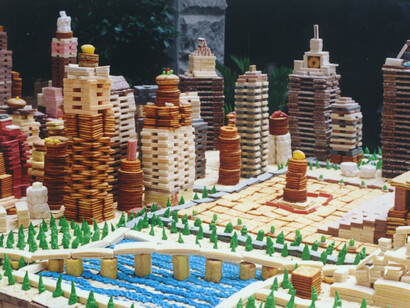
The participatory dimension reaches another expression in Eating the city, a performance and installation in which urban landscapes constructed from sweets and biscuits are gradually consumed by the public. The act of destruction becomes an integral part of the artwork. Cities, like the objects in Waste not, are revealed as temporary formations, subject to cycles of construction, consumption and dissolution.
What makes Soul out particularly compelling is the way it encourages visitors to move between different scales of experience. A family’s domestic history opens onto the social transformations of contemporary China; a borrowed lamp becomes an emblem of community; an edible city raises questions about urban development and the fragility of collective environments.
The dialogue with the MAO’s permanent collections further enriches these reflections. The contemporary installations encounter historical objects whose meanings are rooted in ritual, remembrance and symbolic forms of permanence. This juxtaposition does not erase the differences between cultures or periods. Instead, it creates a space in which objects from distinct contexts can illuminate shared human concerns.
Ultimately, Song Dong. Soul out proposes a form of attention that is both artistic and ethical. It asks us to look again at the things we possess, the people we remember and the spaces we inhabit. Its power lies not in offering definitive answers but in transforming familiar objects into occasions for reflection.
In Song Dong’s hands, the discarded becomes meaningful, the domestic becomes historical, and the ephemeral acquires a quiet dignity. The exhibition reminds us that memory does not reside only in monuments or masterpieces. Sometimes, it survives in the smallest things: a lamp, a button, a container kept long after its original purpose has disappeared. At the MAO, these ordinary remnants become an extraordinary portrait of human existence—fragile, interconnected and continually reshaped by time.