English
 Español
 Français
 Deutsch
 Italiano
 Português
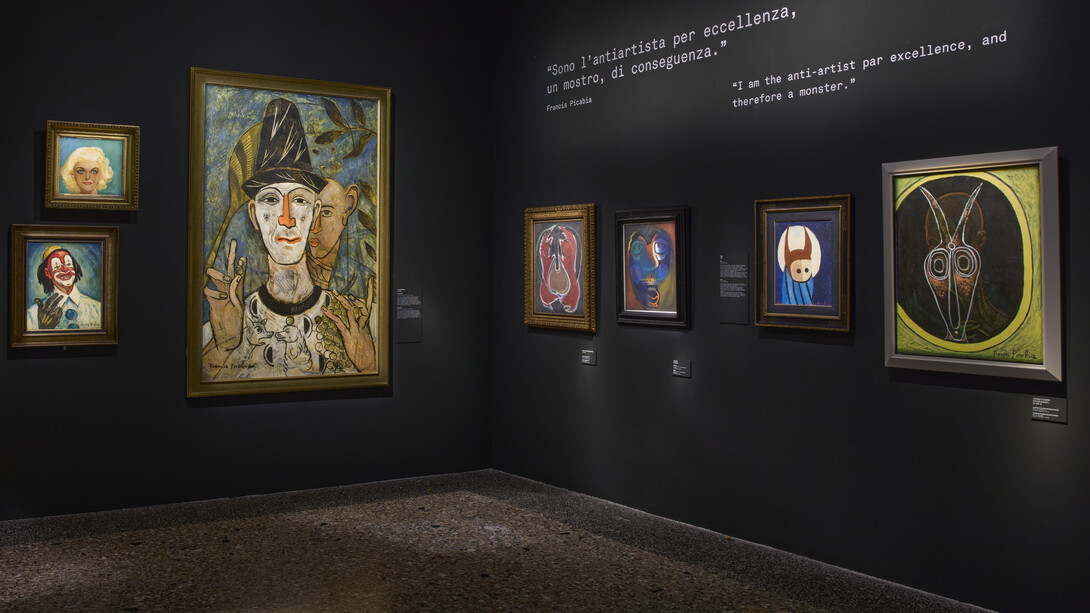
There are artists whose work defines an era, and others who seem to resist the very idea of belonging to one. Francis Picabia (1879–1953) belongs unmistakably to the latter category. Painter, poet, provocateur and tireless experimenter, he moved through the artistic revolutions of the twentieth century without allowing any single movement to become his permanent home. To follow his career is to encounter a succession of beginnings, interruptions and unexpected departures, a journey in which artistic identity remains perpetually open to transformation.
At Palazzo Reale,* Picabia. Aprire le porte della notte* offers an opportunity to rediscover this extraordinary figure through an exhibition that extends beyond a conventional chronological retrospective. Curated by Anne Berest Picabia, the artist’s great-granddaughter, the exhibition brings together more than 170 works from prestigious European museums and international collections, alongside rare photographs, personal documents and archival materials. On view from 9 October 2026 to 24 January 2027, it is the most extensive exhibition devoted to Picabia ever organised in Italy, presenting his work as an evolving constellation of artistic languages, personal experiences and intellectual encounters.
The exhibition’s title provides the key to its interpretation. For Picabia, the night was not simply a period of darkness or withdrawal from the world. It represented an opportunity to intensify existence, to experience life beyond its ordinary limits and to enter a space where imagination could escape familiar conventions. As Anne Berest Picabia observes, he believed that life should be lived twice: by day and by night, with style, transforming existence into a celebration and an adventure pursued to the point of ecstasy. The night therefore becomes both a metaphor and a method, a threshold through which visitors can approach the many dimensions of an artist who never ceased to question what art could be.
Born in Paris to a Spanish father and a French mother, Picabia developed a distinctly international outlook. His life and work connected Paris with New York, Barcelona, Zurich and the French Riviera, placing him in contact with some of the most influential figures of modern culture. His circle included Marcel Duchamp, Gertrude Stein, Pablo Picasso, the dancer Isadora Duncan and the composer Erik Satie. These encounters were not merely episodes in a cosmopolitan biography: they formed part of a cultural environment in which boundaries between disciplines, national traditions and artistic practices could be challenged.
Picabia’s importance lies partly in his extraordinary capacity to absorb and then abandon artistic languages. Impressionism, Fauvism, Cubism, abstraction and Dada each became territories for experimentation rather than destinations. Alongside Wassily Kandinsky and Kazimir Malevich, he was among the pioneers of abstraction, yet he refused to turn any discovery into a fixed formula. Whenever his visual language appeared to settle into a recognisable style, he moved elsewhere. Reinvention was not a departure from his artistic identity; it was its defining characteristic.
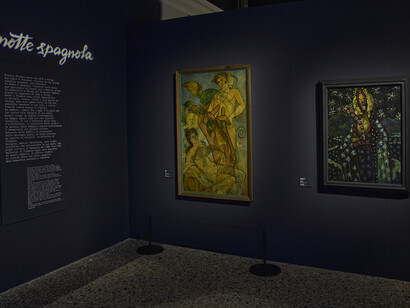
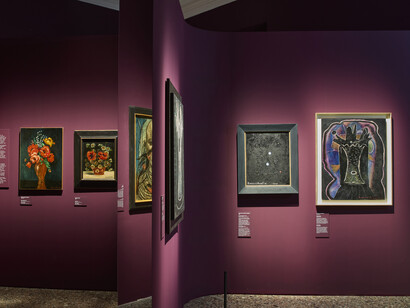
The exhibition makes this restless movement visible through thematic connections rather than a strictly linear account of his career. Love, dance, music, Spanish origins, war and collective creation emerge as forces that shaped both his private existence and his artistic imagination. The result is an immersive encounter with a practice that continually negotiates the relationship between experience and representation, between the world as it appears and the possibilities that emerge when its established meanings are dismantled.
Among the works on display, Balance (1919–20), from the Berardo Collection in Lisbon, offers a compelling example of Picabia’s transformation of modern experience into a new pictorial vocabulary. Mechanical elements, isolated and enlarged, lose their original functional purpose and become forms through which the artist investigates the relationship between the body, movement and inertia. The machine is no longer simply an emblem of industrial modernity: it becomes an instrument for reconsidering how images communicate and how familiar objects can acquire unfamiliar meanings.
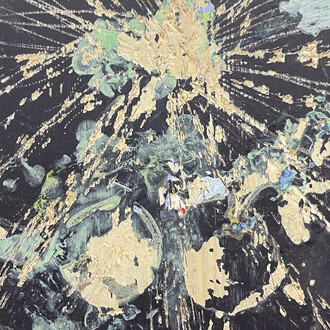
In Salicis (1929), on loan from the Centre Pompidou in Paris, the superimposition and metamorphosis of images introduce another dimension of Picabia’s visual thinking. Drawing on the myth of Danaë and the golden rain, the work suggests a pictorial world in which references overlap and identities remain unstable. Meaning is not necessarily delivered in a single, definitive image; it develops through the interaction of motifs, associations and cultural memories.
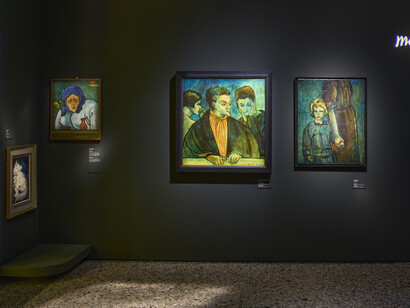
A different atmosphere emerges in Femmes au bull-dog (c. 1940–41), another important work from the Centre Pompidou. Associated with Picabia’s exploration of women, love and desire, it belongs to a phase in which figuration became central to his investigation of human relationships. Meanwhile, Mardi gras (Le Baiser) (c. 1924–25), associated with his so-called “Monster” period, reveals a provocative, carnivalesque sensibility. Its colours, materials and references to popular culture challenge conventional expectations of pictorial refinement, allowing humour, distortion and deliberate excess to occupy the centre of the artistic experience.
These works demonstrate why Picabia remains difficult to categorise. His changing styles were not simply successive responses to fashionable movements. They expressed a deeper refusal to accept that artistic language should remain stable or that a successful experiment must be repeated. His work invites us to consider modernity not as a settled achievement but as an ongoing process of questioning.
The exhibition’s documentary dimension is equally significant. At its entrance, thirteen of Picabia’s Black albums, preserved by the Bibliothèque littéraire Jacques-Doucet in Paris, offer an intimate view of the artist’s working world. Newspaper clippings, drawings, letters, photographs, manuscripts, invitations, pamphlets and notes coexist within these remarkable assemblages. Rather than separating art from everyday life, the albums reveal how ideas developed through collecting, correspondence, observation and the unexpected proximity of disparate materials.
Rare photographs, personal correspondence and historical albums, some presented publicly for the first time, further illuminate the relationship between Picabia’s life and his creative process. Family loans and the contribution of the Comité Picabia provide an important foundation for this exploration, connecting the preservation and study of his work with new opportunities for interpretation. The archive becomes more than supplementary documentation: it offers a way to understand the intellectual restlessness behind the paintings.
The exhibition concludes with Sans titre (1898), from the Roberta Cerini Baj Collection, identified as the earliest known work by Picabia. Its return to public display is particularly meaningful: the work was previously shown only once, at an exhibition in Turin in 1974. Placed at the end of the exhibition, it creates a subtle reversal. After encountering decades of experimentation and transformation, visitors return to the artist’s beginnings, where the future remains entirely unwritten.
This movement from the earliest known work to the many possibilities explored throughout Picabia’s career captures the central proposition of Aprire le porte della notte. Art, here, is not the illustration of a consistent identity but the space in which identity can be repeatedly reconsidered. The exhibition’s accompanying catalogue, published by Skira, extends this enquiry through critical essays, archival material and thematic studies.
At Palazzo Reale, Picabia emerges as both a protagonist of modernism and a precursor of contemporary artistic attitudes. His resistance to labels, his appropriation and transformation of visual languages, and his willingness to embrace contradiction continue to resonate in a culture shaped by overlapping identities and constantly changing forms of expression.
To open the doors of the night is therefore to enter a world without a single point of arrival. Picabia’s achievement lies not in having found one definitive language, but in having made the search itself a form of artistic freedom. His work reminds us that the most radical gesture may be the willingness to begin again—and that sometimes, to see more clearly, we must first allow ourselves to step into the dark.