English
 Español
 Français
 Deutsch
 Italiano
 Português
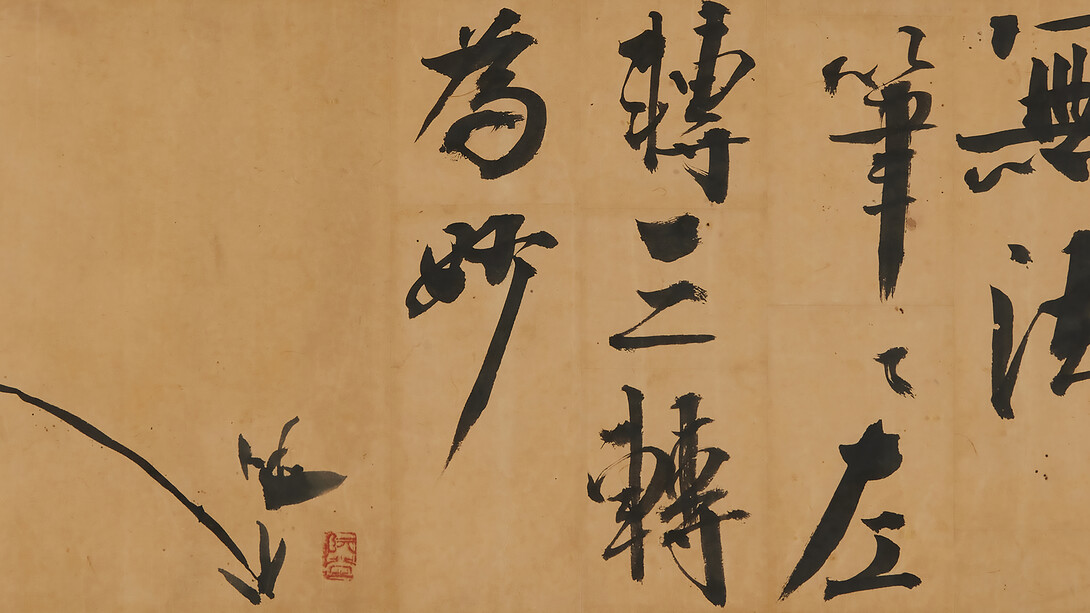
It’s okay to walk slowly.
Pause wherever your heart comes to rest,
Catch your breath, and I hope you will
Take a moment to smell the flowers.(RM)
There is a particular intimacy to the way RM looks at art. His collection does not seem to have been assembled simply around names, movements or market categories, but rather through encounters: with colour, landscape, silence, memory, objects and, above all, artists whose works seem capable of opening up a space for contemplation. RMxSFMoMA: Between You and Me, on view at the San Francisco Museum of Modern Art until 7 February 2027, makes this process of looking visible.
The exhibition brings together works from RM’s collection with others from SFMoMA, creating a dialogue that spans generations, media and geographical boundaries. Its sections—including Bluewater, Friendscape, Home, Photobuddha, People, Passion and Umber (I and II)—suggest less a conventional chronological narrative than a map of affinities. The result is particularly compelling when the Korean artists collected by RM are placed in dialogue with figures from European and American modernism.
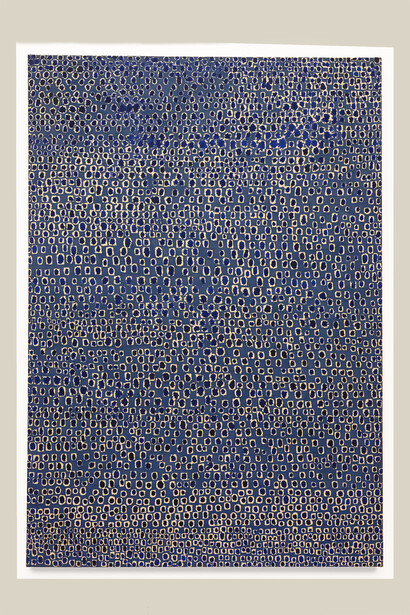
At the beginning of this journey stands Kim Whanki, whose presence is of exceptional significance. His work offers one of the exhibition’s most compelling points of connection between Korean cultural memory and international modernism. The exhibition presents 26-I-70 #141 (1970), from SFMoMA’s collection, alongside RM’s 15-VII-70 #181 (1970), while another work, Plum Blossom, Moon and White Porcelain, dating from the 1950s, appears in the Home section. This juxtaposition goes beyond a simple institutional connection between two collections. It reveals the continuity of an artistic language in which Korean cultural memory and abstraction coexist, interpenetrate and complement one another.
Whanki’s work is particularly significant within RM’s collection because it embodies a dialogue between the local and the universal. The title Plum Blossom, Moon and White Porcelain brings together three images deeply rooted in Korea’s visual imagination, while his later abstract works translate these sensibilities into rhythm, colour and spatial relationships. The transition from recognisable motifs to abstraction does not erase cultural identity; on the contrary, it transforms it. Within RM’s collection, Kim Whanki thus becomes a bridge between heritage and modernity, demonstrating how an artist can remain deeply connected to his cultural origins while developing a visual language that transcends geographical boundaries.
This dialogue becomes even more revealing when we consider Whanki’s artistic journey, from his early engagement with international modernism in Tokyo to his subsequent experiences in Seoul, Paris and New York. His development was not a linear departure from Korean tradition towards Western abstraction but a continuous process of reinterpretation in which memory, experience and artistic experimentation informed one another. The mature dot paintings, in particular, distil this journey into a language of colour, rhythm and repetition that is unmistakably his own.
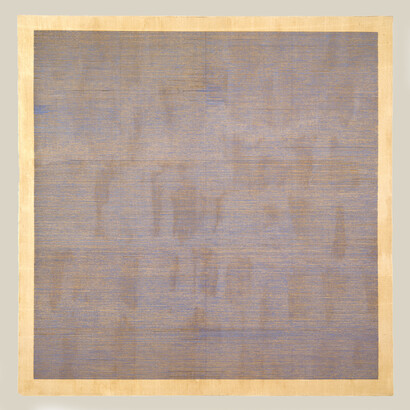
Equally important is the presence of Yun Hyong-keun. His Untitled (1973) appears in Bluewater, while the Umber section brings together several works from different periods, including Umber-Blue (1978), Blue on Black (1973), Burnt Umber & Ultramarine (1991), and later works from the 1990s and 2000s. Yun’s significance within the exhibition lies partly in the principle of repetition. Rather than presenting a single emblematic work, the exhibition allows visitors to encounter the artist through a coherent and sustained body of paintings. The effect is meditative. Blue and umber become more than mere colours: they form an autobiographical vocabulary of depth, restraint and silence, inviting us to slow down.
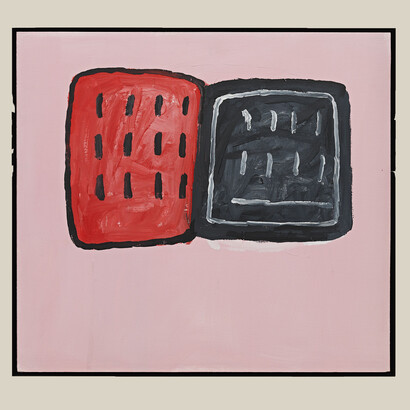
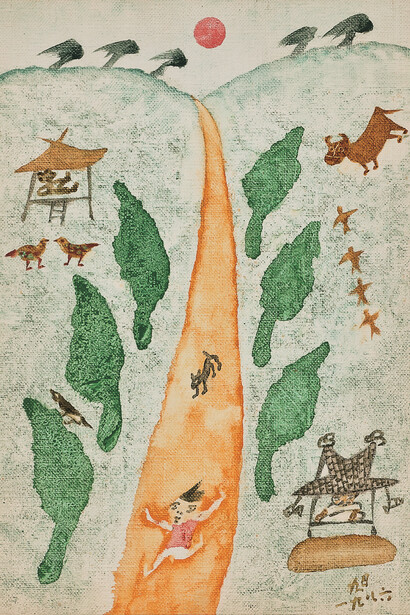
This dimension is also present in Chang Ucchin, another artist extensively represented in RM’s collection. A Boat and a Fish (1960), The River Scene (1988), Road (1986), A Roadside Tree (1978) and Temple on the Mountain (1984) are all part of the Home section. Chang Ucchin’s presence is striking because his images are deceptively simple. Boats, trees, roads, rivers, and temples are reduced to essential forms, yet retain the emotional resonance of lived experience.
Here, the concept of home becomes particularly evocative. A home is not merely an architectural space or a domestic interior; it can also be a landscape, a remembered road, a tree or a distant temple. A personal sanctuary. RM’s selection seems to suggest precisely this broader understanding of belonging: home need not be a physical place but can also be an image we carry within us.
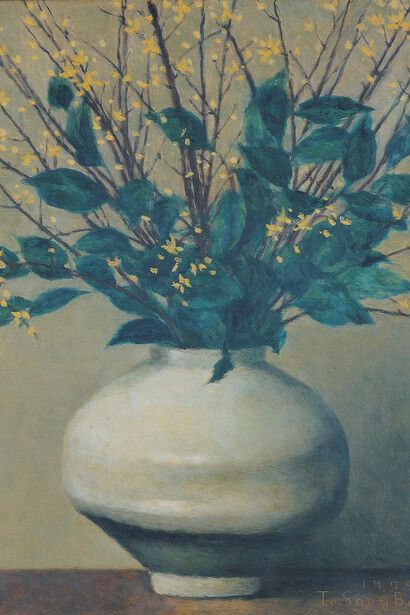
The Friendscape section—a portmanteau coined by the rapper himself—develops this relationship with landscape further. Wolmido (1972) by To Sangbong, from RM’s collection, is placed among works from SFMoMA’s collection, including Georgia O’Keeffe’s Lake George (1922), Yoo Youngkuk’s Work (Trees) (1981), Park Kosuk’s Outer Seorak (1981), Kim Chong Hak’s Winter Landscape (2015) and To Sangbong’s Landscape of Gwangneung (1973).
The significance of such a juxtaposition does not lie in the fact that all these artists paint landscapes in the same way. On the contrary, it is precisely their differences that make the dialogue fruitful. The American landscape and the mountains, coastlines, and seasonal environments depicted by Korean painters establish different relationships with nature. Yet all share a desire to transform landscape into an emotional and formal experience, one grounded in resonance.
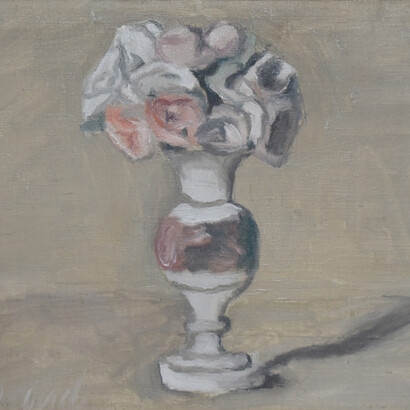
The same principle can be observed in the way the Italian master Giorgio Morandi appears alongside Korean and American artists. SFMoMA presents Natura morta (Still Life, 1952), while RM’s collection includes Fiori (Flowers, 1949). Morandi’s quiet still life paintings have long been associated with an art of concentration: a limited number of everyday objects become the focus of an extended gaze. Within RM’s collection, they establish an unexpected dialogue with Korean still-life traditions and with the understated domestic objects surrounding them.
The idea that the ordinary can acquire meaning emerges particularly clearly in the ceramics and furnishings on display: nineteenth-century furniture, white porcelain vases, buncheong vessels, water droppers and objects dating as far back as the fifth or sixth century. These are not simply decorative elements placed alongside paintings; they invite another way of looking, one in which use, craftsmanship, material and time become part of the aesthetic experience.
Nothing here seems accidental. Perhaps the most explicit encounter between Korean tradition and international contemporary art, however, takes place in Photobuddha. RM’s collection includes Nam June Paik’s Enlightenment Compressed (1994), while SFMoMA contributes Untitled (TV Buddha) (1978). Paik’s Buddha, positioned opposite its own technologically mediated image, becomes a powerful meditation on the ancient and the contemporary, contemplation and media, stillness and movement. Within RM’s collection, Paik also represents a distinctly Korean contribution to global contemporary art: that of an artist capable of transforming cultural memory into a universal visual language.
Another important discovery is Rhee Seundja’s Le vent en témoigne (The Wind Testifies, 1965), included in the Passion section. The work adds a different dimension to the exhibition’s exploration of movement, identity and the continual crossing of boundaries. Born in Korea and having moved to France in 1951, Rhee Seundja developed an artistic practice shaped by deprivation and absence. Her story is one to discover through RM’s own words in the audio guide he narrates.
No words seem entirely adequate to describe Between You and Me, an exhibition exquisitely attuned to each individual visitor’s attention, entirely independent of time constraints or personal background. RM himself encourages visitors to find their own natural path through the galleries. The leader of K-pop sensation BTS thus becomes a bridge between artworks, stories, and viewers. His collection creates unexpected conversations: Kim Whanki in dialogue with SFMoMA artworks, Yun Hyong-keun with the chromatic silence of a Rothko, or To Sangbong with Morandi.
Art exists in the space between an object and the person looking at it. What emerges from this extraordinary collection is neither a definitive account of Korean art nor a conventional survey of modernism, but something personal, biographical and revealing: a testament to the way a contemporary observer has learned to look.
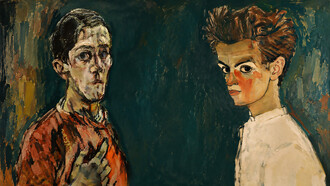
In this sense, the exhibition can be experienced as an expansive self-portrait of RM—a pictorial genre that deeply fascinates him—in which the act of looking itself becomes associative and open to encounter. Between one work and another, between Korea and the world, between past and present, RMxSFMoMA suggests that collecting is a form of conversation.
And communication, as the title suggests, always involves two parties.
As previously underlined, Kim Whanki (1913 – 1974) occupies a particularly significant place in RMxSFMoMA: Between You and Me. The juxtaposition of works from his collection with paintings from SFMoMA reveals the importance of Whanki not only within the history of Korean modern art but also within the wider international conversation on abstraction. His work offers a compelling example of how cultural memory can be transformed into a universal visual language without losing its connection to its origins.
To explore the significance of Whanki’s artistic journey, his relationship with Korean aesthetics and international modernism, and the continuing relevance of his work in the context of RM’s collection, we spoke with Kko-Kka Lee, curator at the Whanki Museum in Seoul.
Whanki’s work is deeply rooted in Korean visual culture, yet it also engages with international modernist languages. How do you interpret the tension—or dialogue—between Korean identity and international artistic influences in his work?
To answer this question, I think it is important first to consider Kim Whanki’s background. Whanki was born in 1913 on a small island off the southern coast of the Korean Peninsula, where he spent his childhood. It is said that there was a Seodang, a traditional village school, in his family home, and in that sense one might say that the foundations of his Korean cultural identity were formed quite naturally from an early age.
At the same time, however, it was in Tokyo, where he studied art at Nihon University, that he began to pursue painting seriously. In the 1930s, he became deeply engaged with the international modernist currents circulating through Tokyo at the time. Rather than following an academic path, he turned towards avant-garde art, and this encounter marked the beginning of his own abstract practice. From there, through his subsequent years in Seoul, Paris and New York, his visual language continued to evolve, responding to new cultural environments and being continually reconfigured through those experiences.
When we look at the period in which he frequently employed motifs such as the moon, mountains, plum blossoms and white porcelain, I would not interpret these simply as an attempt to represent “Koreanness” through traditional subject matter. Rather, I see them as expressions of his own identity—forms through which personal memory, cultural experience and artistic sensibility converged.
Throughout his life, Whanki remained committed to interpreting different cultural traditions, both Eastern and Western, on his own terms and transforming them into a distinctly personal visual language. In that sense, the relationship between Korean identity and international artistic influence in his work is perhaps best understood not as a tension between two opposing forces, but as a continuous dialogue—one that shaped and reshaped his artistic language throughout his career.
The Whanki Museum preserves not only an artistic legacy but also a particular way of looking at art. How does the museum approach the challenge of presenting Kim Whanki to an increasingly international audience?
What is important to the Whanki Museum is not to present Kim Whanki simply as “a representative Korean abstract painter.”
Through exhibitions in a variety of formats, we try to create ways of seeing him not merely as an artist of the past, but from the perspective of the present. For international visitors in particular, we hope to move beyond introducing Whanki simply as a major figure in Korean modern and contemporary art.
Instead, we try to offer an opportunity to reconsider his work within the broader currents of international modernism, while also allowing audiences from different cultural backgrounds to approach and interpret his practice from their own perspectives.
In this sense, the museum’s role is not only to preserve Whanki’s legacy, but also to keep it open to new readings and to create conditions in which his work can continue to be re-examined in changing cultural and historical contexts.
Whanki’s use of dots, colour and repetition gradually developed into an extraordinarily distinctive visual language. What do you consider to be the most important conceptual or emotional shift behind this evolution?
Whanki was an artist whose sensibility was deeply informed by East Asian philosophical thought and by his profound engagement with Korean aesthetics. His interest in such philosophical ideas was not merely abstract. He noted that he had taken Laozi’s Tao Te Ching with him to hospital in 1974. I think this offers an important glimpse into the broader intellectual and spiritual context in which he reflected on both art and life.
These underlying ideas and sensibilities remained present throughout his career, even as his work moved towards the abstraction of his Jeomhwa (all-over dot paintings). By that stage, recognisable Korean motifs had largely disappeared from the surface, but the sensibility behind them had not. Instead, it was transformed into colour, form, rhythm and repetition, and ultimately into a visual language that was entirely his own.
In this sense, I do not see the Jeomhwa (all-over dot paintings) as a departure from his earlier work, but rather as a culmination of it. His cultural memory and personal experience were gradually distilled into an increasingly abstract language. His life itself—his memories, emotions, and experiences accumulated across different places and periods—is deeply embedded in these works.
Today, Korean art is receiving unprecedented international attention. In your view, what can Kim Whanki’s work still tell us about the relationship between Korean artistic tradition and the global contemporary art world—and are there aspects of his legacy that you feel deserve to be rediscovered?
Kim Whanki’s work shows us that Korean art did not have to choose between preserving tradition and embracing Western modernism in order to engage with the wider world. He retained a strong sense of cultural memory while remaining continually open to new environments, ideas and artistic languages. Through this process, he developed a highly individual form of painting that cannot be reduced to either tradition or Western influence alone.
I believe this remains highly relevant for Korean artists working internationally today. Local identity and global artistic language are not mutually exclusive. Rather, they can be continually reshaped through encounter, exchange and translation. Whanki’s work demonstrates how an artist can remain deeply connected to his own cultural experience while developing a visual language capable of reaching beyond a single cultural or geographical context.
At the same time, I think there are aspects of Whanki’s legacy that deserve to be rediscovered. Today, he is often identified internationally with his mature Jeomhwa (all-over dot paintings), but the long process that led to them is equally important. His encounters with international modernism in Tokyo in the 1930s, followed by his experiences in Seoul, Paris and New York, show how his artistic language continued to develop as he encountered different cultural and artistic environments.
Looking again at this broader trajectory allows us to understand Whanki not simply as the creator of an iconic abstract style, but as an artist whose work continued to evolve through movement and cultural encounter. I think this broader view helps us understand Whanki more fully, both within Korean modern art and in relation to international modernism.
Kim Whanki’s works included in RM’s collection and presented in the RMxSFMoMA exhibition offer a particularly interesting point of connection between Korean modernism and a contemporary global art perspective. How do you interpret RM’s engagement with Whanki’s work?
Over the past several years, I have noticed that RM has continued to visit exhibitions at the Whanki Museum. This has given me the impression that his interest in Kim Whanki goes beyond seeing him simply as a representative figure of Korean modern and contemporary art.
Although they belong to very different generations, I believe there is a meaningful point of connection between them as artists who have each worked within international cultural contexts. In that sense, RM’s engagement with Whanki can be understood not only as an act of collecting or admiration but also as a form of artistic recognition across generations.
RM’s continued interest in Whanki suggests that his work still has the capacity to speak directly to contemporary artists and audiences.