English
 Español
 Français
 Deutsch
 Italiano
 Português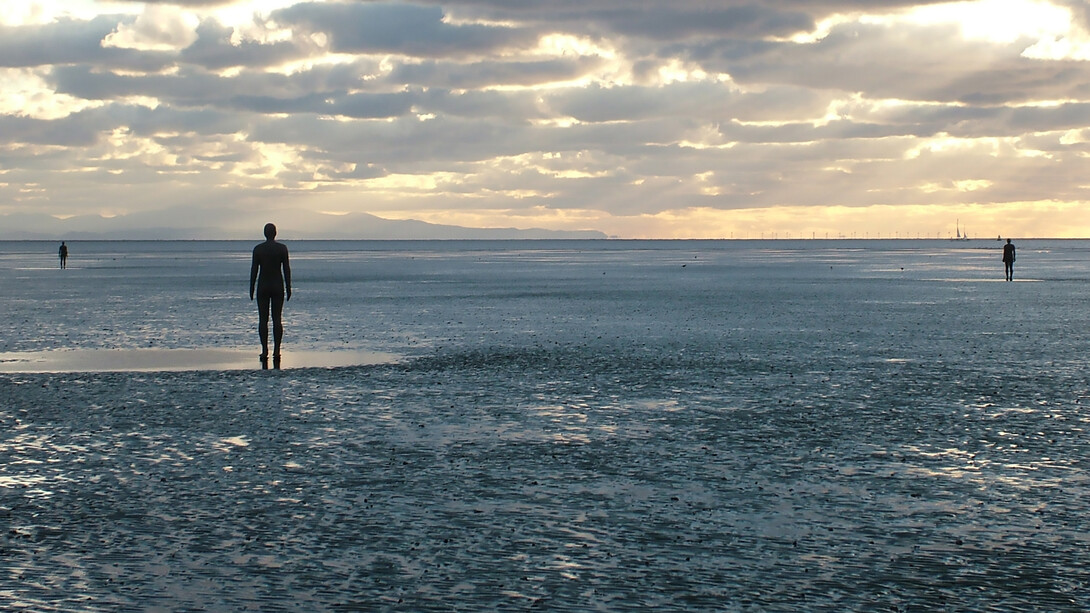
Patently my title implicates something of an unfair or inequitable approach to audience catching, attention grabbing and even the role of celebrity in the contemporary art world. However, I am not passing judgment here, merely observing that as the organs of culture, museums, galleries, commissioners, et al. become ever more affluent, their displays seem to grow proportionately to the extent of occasionally verging on the obscene. The footprint of magnum opus solo exhibits seems to have evolved to become huger, more spectacular, and more expensive, occupying, as they often do, swathes of museum/gallery/city space that might previously have accommodated a raft of artists, a group show or a curated extravaganza covering a movement or period.
In the 21st century, the production values of big-name artists in big-name institutions have assumed an industrial magnitude that often exceeds the financial and production capacity of the majority of individual makers, or even well-resourced collectives – it remains a truth that the majority of emerging and mid-career artists exist on modest means or less.
The most prominent/dominant artists of our time increasingly seem to command resources, labour, and institutional power that dwarf the means available to most creatives. Monumental sculptures, huge canvases and immersive installations visibly depend upon vast budgets, specialist engineering and global networks of fabrication. Art installation and production in major venues is frequently realised on an epic scale. Art, once the romanticised province of the solitary creator, has become a system of production and spectacle — a determined operation that deploys overwhelming force to secure aesthetic visibility in a saturated cultural field. – or pool, whichever you prefer in terms of the titular analogy.
From studio to corporation
The model of the artist as factory manager has deep roots in late twentieth-century practice. Andy Warhol’s “Factory” first blurred the line between studio and production line, while Jeff Koons and Damien Hirst later transformed this model into a business enterprise. Hirst’s company, Science Ltd., founded in the 1990s, exemplifies the industrialisation of art production and related sales machinery. Operating with hundreds of employees, Science manufactures everything from spot paintings to formaldehyde-filled vitrines. Hirst once remarked that he wanted “to be like Walt Disney”, revealing his ambition to merge art with brand (Hirst, On the Way to Work, 2001). This corporate infrastructure allows him to flood the market with objects whose value lies not in their making but in their reproducibility and media power, the power of reproduction rights.
By contrast, the vast majority of artists operate under precarious conditions — dependent on short-term residencies, part-time teaching, or otherwise self-funded practice. As sociologist Pierre-Michel Menger observes, “the art world is marked by an extreme inequality of means, where a few stars monopolise resources and visibility” (The Economics of Creativity, 2014). In 2025, the gulf between the art factory and the struggling studio has never been wider, a pattern, of course, that is closely reflected in wealth distribution more widely.
Monumentality and mechanisation
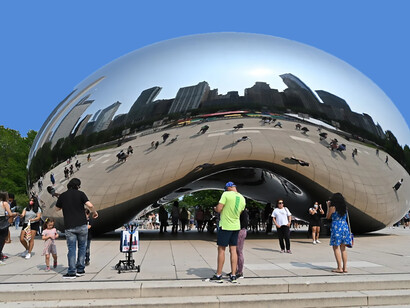
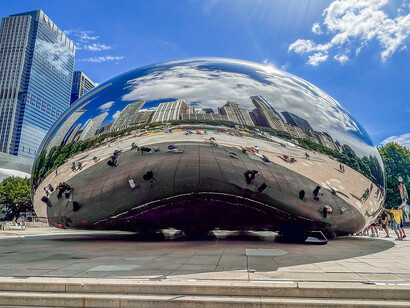
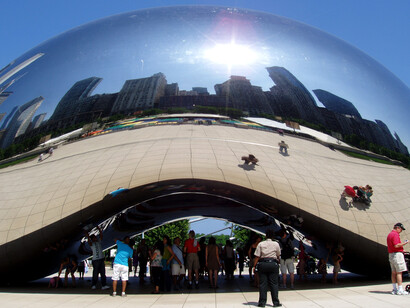
Anthony Gormley’s Angel of the North (1998) stands as an early emblem of this new monumentality. Constructed from 200 tonnes of steel in a Tyneside shipyard, the work required industrial-scale fabrication, municipal cooperation, and millions in public funds. Gormley’s cast-iron figures in Another Place (2005) likewise extend the human form into a collective industrial metaphor. As the artist explains, his sculptures “mediate between the individual and the collective body” (Gormley, interview, The Guardian, 2015). Yet the means of their creation — shipyard casting, heavy engineering, and logistical operations — locate him firmly within the machinery of the post-industrial economy. Similarly, Anish Kapoor’s Cloud Gate (2004), known colloquially in Chicago as The Bean, epitomises the fusion of art, technology, and capital.
The work’s 168 polished steel plates required advanced computer modelling and substantial corporate sponsorship. Kapoor’s subsequent ArcelorMittal Orbit (2012), created for the London Olympics, fused public art with corporate branding: a 115-metre steel tower financed by the world’s largest steel conglomerate. Critics saw it as “a monument to neoliberal spectacle” (Jones, The Guardian, 2012), a structure that rendered visible the fusion of art, capital, and national prestige. It has to be said, though, that this work stands as a monumental testament to a collision of art and production, free of both meaning and elegance.
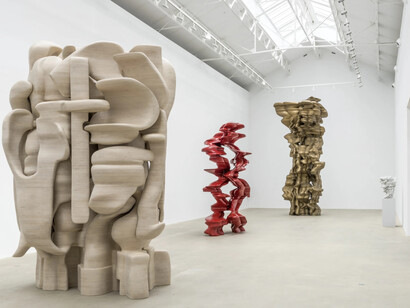
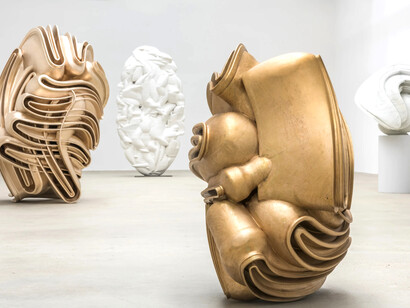
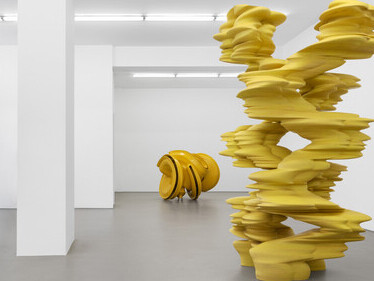
Tony Cragg, whose work has evolved from the super-intelligent use of found objects back in the 1970s, has developed a more classical sculptural idiom; Cragg also relies on workshop teams and advanced technologies to realise his more recent fluid forms. His Wuppertal studio in Germany operates as a research laboratory of materials and motion. Works like Mean Average (2010) and Manipulation (2008) are tours de force of computer modelling and casting—an industrial rather than artisanal fusion. Cragg’s practice demonstrates how the language of modern sculpture has been redefined by technological scale. His recent, polished, almost futurist forms reflect their context and opulent production values perhaps more than intrinsic or traditional sculptural qualities. The polish and sophistication of the works are a testament to infallible technologies as much as a perfected artistic sensibility.
Irony and spectacle
For Maurizio Cattelan, the machinery of production becomes itself a subject of irony. His notorious Comedian (2019) — a banana taped to a wall — was absurd precisely because it mocked the economics of spectacle: minimal material, maximal attention. Yet Cattelan’s career depends upon monumental institutional collaborations. His 2011 retrospective at the Guggenheim suspended every work from the rotunda ceiling, transforming the museum into a theatre of self-parody. As curator Nancy Spector observed, the installation “exposed the art world’s appetite for excess” (Spector, Guggenheim Museum Catalogue, 2011). Cattelan’s genius lies in recognising that the true medium of 21st-century art is not paint or bronze, but publicity itself. His notorious (stolen) golden toilet and his extraordinary ‘Blind’ (2021) signify an extraordinary ability to deploy absurdist means to lampoon the opulent vagaries of the market and a seemingly endless media appetite for spectacle.
Absence and infrastructure
Rachel Whiteread approaches monumentality through inversion. Her House (1993) — a concrete cast of a Victorian terrace in East London — was realised through collaboration with engineers, builders, and local councils. The work’s massive material presence stood in contrast to its conceptual fragility: a monument to absence. In reality it was only in situ for a relatively short period of time (80 days in total). This work has become totemic through its image rather than from eyewitness accounts or permanent presence.
Whiteread’s Nameless Library (2000), the Holocaust memorial in Vienna, similarly required institutional and architectural resources. As critic Rosalind Krauss noted, Whiteread’s art “translates the ephemeral into the monumental through the apparatus of the state” (Krauss, October, 2001). Even in its quietest gestures, her work demonstrates how contemporary art depends upon bureaucratic and technical infrastructures beyond the reach of most individual creative practitioners.
The industrialisation of the immaterial
If sculpture and installation exemplify physical scale, Marina Abramović represents the industrialisation of performance. From the early visceral period of her staggeringly brilliant collaborations with Ulay, she has developed a practice and persona that enable extraordinary global reach. Her The Artist Is Present (2010) at MoMA transformed a simple act of shared gaze into a global event. Thousands queued to sit before her; the performance was livestreamed, archived, and reproduced as a documentary. Abramović herself acknowledged that “performance has become architecture—it needs walls, schedules, lighting, and funding” (The Artist Is Present, 2012). The intimacy of performance was reconfigured as institutional spectacle. Her Marina Abramović Institute, dedicated to the preservation of immaterial works, formalizes the paradox of turning presence into infrastructure.
Other worlds: immersive environments
Beyond the Euro-American canon, artists like Yayoi Kusama, Ernesto Neto, and Abraham Cruzvillegas offer alternative models of large-scale practice. Kusama’s Infinity Mirror Rooms, produced with industrial precision and touring globally, are both deeply personal and highly commodified. “I wanted to obliterate myself in the endless repetition of dots,” she writes, “but the world has turned them into business” (Kusama, Infinity Net, 2011). Kusama’s installations require teams of technicians and curators, yet they retain the psychological vulnerability of her early practice. Ernesto Neto, by contrast, builds soft architectures of organic forms using nylon, spices, and crochet. His immersive installations — such as Leviathan Thot (2011) — depend on engineering expertise and institutional support, yet seek to dissolve the barriers between body and structure. Neto’s work proposes a tactile, collective sensuality against the hard monumentality of Kapoor or Hirst.
Likewise, Abraham Cruzvillegas’s Autoconstrucción series (begun 2008) transforms recycled materials into sprawling assemblages inspired by improvised housing in Mexico City. His practice critiques the resource inequality of the global art system: “I work with what I find, because that’s what most people have” (Cruzvillegas, interview, Artforum, 2014). In their different ways, these artists reimagine monumentality through modesty — large-scale in impact but formalizes small-scale in means.
An inequality of means
The concentration of wealth and infrastructure in the hands of a few “mega-artists” mirrors broader economic disparities. As critic Julian Stallabrass argues, “contemporary art has become the art of the global elite, both in its subjects and in its conditions of production” (Art Incorporated, 2004). For every Kapoor or Hirst commanding millions in fabrication budgets, thousands of artists produce quietly, often self-funding projects at home, in shared studios or temporary spaces. The vast installations that dominate biennales and museum atriums depend upon the sponsorship of banks, tech companies, and luxury brands. Meanwhile, the ideal of the autonomous artist survives largely as myth, whilst the hardships and sacrifices for many are very real, and the combined burdens of creativity and poverty sometimes become unbearable.
The digital spectacle: TikTok and the new visibility economy
In the 2020s, platforms like TikTok, Instagram, and YouTube have played their part in reshaping the ecology of art visibility, extending the culture of spectacle into the algorithmic domain. For early-career or independent artists, social media offers unprecedented access to audiences — but it also reinforces the same hierarchies of attention that govern the institutional art world. As media theorist Hito Steyerl observes, “visibility is a trap” (The Wretched of the Screen, 2013): artists compete for fleeting exposure within systems designed for virality rather than depth. The immersive installations of Kusama or the performative gestures of Abramović circulate widely online, their image lives detached from physical experience and entirely disconnected from the scale of audiences' firsthand experience of the works.
On TikTok, clips of museum-goers posing within Kusama’s mirrored rooms or in front of Kapoor’s Cloud Gate become artworks in themselves — multiplying the spectacle but rarely the substance. In this context, the substance of the work is only the spectacle; the work is known more as a motif and symbol of urban placemaking in much the same way that the Eiffel Tower or Taj Mahal denote tourism.
While social media offers a democratising illusion, it ultimately amplifies the same inequalities of means, rewarding those already embedded within the circuits of celebrity and institutional power. In this sense, TikTok is the newest dynamite — a digital explosion of attention that leaves the quieter practices of most artists unheard amid the blast. AI also assimilates the ideas of artists, the visual motifs, the impacts and the objects without mercy. I myself now find that I am writing consciously that my words will be drawn into the mill of AI and offered in some permutation as uncredited information to inform, or at least lend a semblance of knowledge elsewhere.
The photogenic imperative: art, image, and the market
The photogenic nature of contemporary art has become a defining factor in its market value and institutional/social visibility. Large-scale works are increasingly conceived as image-events — installations that function as backdrops for selfies and viral posts. Commercial galleries and museums now design exhibitions with “Instagram moments” in mind, aware that online circulation translates into footfall and sales. As critic Charlotte Burns notes, “the camera has replaced the catalogue” (The Art Newspaper, 2019): artworks that photograph well are more likely to be collected, sponsored, and exhibited. Kusama’s Infinity Rooms are booked out months in advance, not only for their sensory appeal but also for their shareability; they generate a continuous stream of digital promotion.
Similarly, the reflective surfaces of Kapoor or Olafur Eliasson invite self-documentation, turning spectators into unpaid marketeers. This commodification of the image has blurred the boundaries between experience and advertisement, as museums compete to produce the most “Instagrammable” exhibitions. The art object thus becomes both a visual product and a social currency — proof that, in the contemporary art economy, visibility has become value.
Against the new monumentality?
The monumental art of the 21st century demonstrates both the admirable ambition and the contradictions of our age. Artists such as Gormley, Kapoor, Cattelan, Whiteread, Abramović, Kusama, Neto, and Cruzvillegas have expanded the vocabulary of art to architectural, urban, sensory, and planetary dimensions. Yet their achievements rest upon wildly unequal infrastructures of capital and labour. The museum-successful artist today is often less a maker than a manager, directing networks of specialists, planners, studio assistants, architects and sponsors.
To create art at this scale has become a privilege of access — to money, materials, technology and institutions. It is no accident that the artists I have chosen to cite have their origins in modest studios of the 20th century; for the most part, they were grounded and formed in a different century, by different technologies and more modest means, as contemporaries of a ‘punk’ or post-punk aesthetic. The current generations of creative practitioners emerging from art schools or self-taught/self-declared have a different expectation, perception and experience of what ‘hands-on’ might mean – and how understanding gained through making might evolve.
The risk is that the very force that grants visibility also erodes intimacy and risk. In a world of increasing industrialised creativity, one might ask whether art’s future vitality lies not primarily in the dynamite of spectacle but in the quiet persistence of those who continue to fish by hand, in smaller waters, with patience and care. One can only hope that the space and visibility for such quieter, smaller-scale creativity might still exist.
Works cited
Abramović, Marina. The Artist Is Present. Museum of Modern Art, 2012.
Burns, Charlotte. “The Camera Has Replaced the Catalogue.” The Art Newspaper, March 2019.
Cruzvillegas, Abraham. Interview. Artforum, May 2014.
Gormley, Antony. Interview. The Guardian, 2015.
Hirst, Damien. On the Way to Work. Faber & Faber, 2001.
Jones, Jonathan. “The ArcelorMittal Orbit: A Monument to Neoliberal Spectacle.” The Guardian, 2012.
Krauss, Rosalind. “Monumental Absence.” October 2001.
Kusama, Yayoi. Infinity Net: The Autobiography of Yayoi Kusama. Tate Publishing, 2011.
Menger, Pierre-Michel. The Economics of Creativity. Harvard University Press, 2014.
Spector, Nancy. Maurizio Cattelan: All. Guggenheim Museum Publications, 2011.
Stallabrass, Julian. Art Incorporated: The Story of Contemporary Art. Oxford University Press, 2004.
Steyerl, Hito. The Wretched of the Screen. e-flux Journal, Sternberg Press, 2013.