English
 Español
 Français
 Deutsch
 Italiano
 Português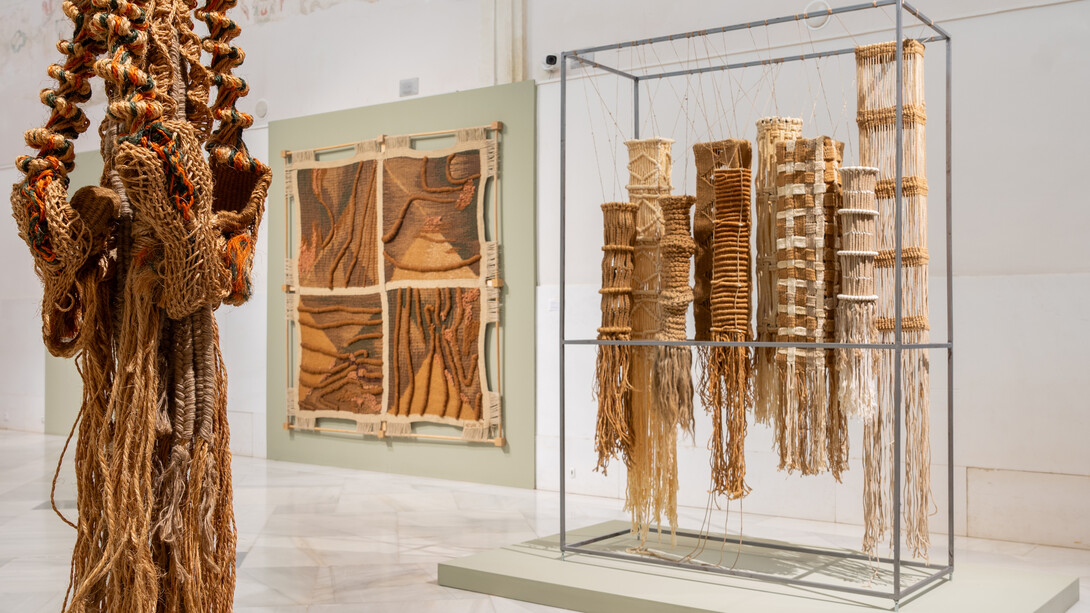
A thread must have something if our lives hang by it.
(Ángel Lahoz)
Given the current international focus on acknowledging the merits of textile work, Weaving the void is a timely exhibition that revisits the creative and educational contributions made by the artist Ascensión Navarro (Gallur, Zaragoza, 1922 – Seville, 2019), known as Chonín, over several decades. Thanks to her family’s generous donation of works to the CAAC and loans from other institutions and individuals, this show restores a pioneering figure in Andalusian textile art to her rightful place in history after forty years of obscurity, ever since Paco Molina organised the last major retrospective of her career at Fundación El Monte in Seville.
Navarro became an artist later in life, when she was nearly fifty years old. After having and raising her own children, she felt the “need to continue creating and gave birth to other works of art”, as she put it. That decision marked a turning point as she embarked on a journey of reinvention and began exploring her creative interests, despite the difficulties women faced in the final years of the Franco dictatorship, when working outside the home was still discouraged.
However, textiles were not uncharted territory to her. Navarro had previously worked in the fashion industry and even ran her own atelier, and the material and technical know-how gleaned from that experience provided an excellent foundation. The fact that she lived with the artist and drawing instructor José Ruesga also meant she had close ties to the art world. In 1967, the move from Seville to San Sebastián began a new chapter in her life, in which interaction with the city’s particularly dynamic civil society and with other women actively involved in cultural and social affairs gave her fresh perspectives and the space she needed to find her own artistic voice.
In Biarritz, whose proximity to the French border made it a haven for Spaniards eager to learn about the latest trends in European art and culture, Navarro discovered textile art at an exhibition that sparked her interest and marked the beginning of her formative phase. That learning process was enriched by her careful observation of the traditional practices and expertise of local artisans, such as making or mending fishing nets or weaving plant fibres, which allowed her to incorporate new formal possibilities. From 1974, she worked as both an artist and an educator, and in that capacity she had a decisive influence on other women textile artists in the city. After moving back to Seville in 1979, Navarro continued to make art and teach, turning her new studio into a space devoted to production, research and knowledge-sharing.
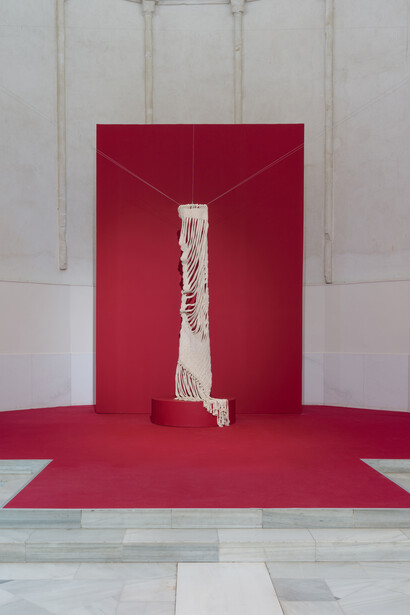
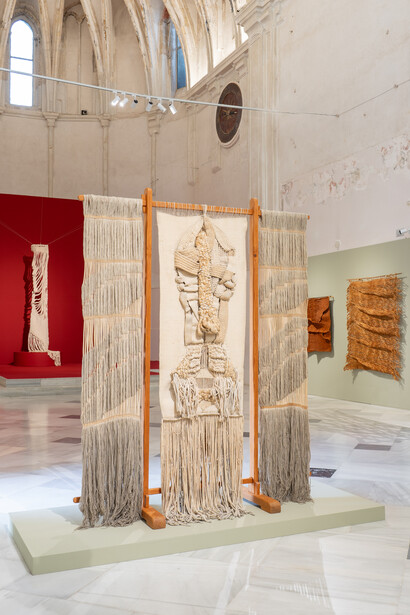
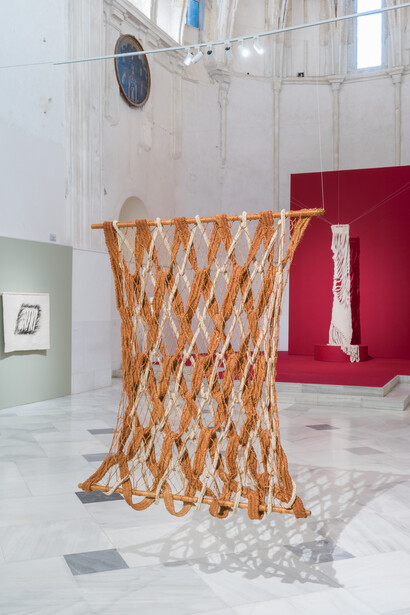
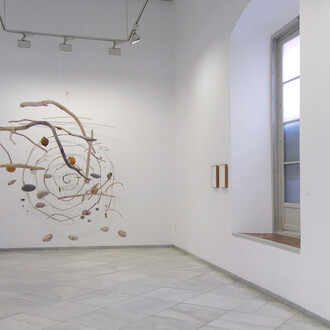
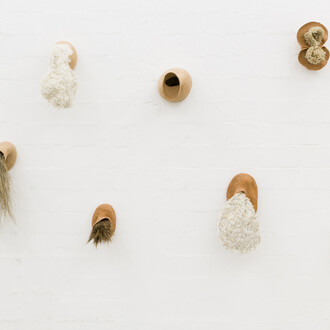
From the outset, Navarro was influenced by art movements like Nouvelle Tapisserie and Fiber Art, which really came into their own with the 2nd Lausanne International Tapestry Biennial in 1965. These movements aimed to move past the traditional concept of weaving and recognise new creations as avant-garde works of textile art in their own right. Like Magdalena Abakanowicz, Sheila Hicks, Aurèlia Muñoz, Josep Grau-Garriga and other artists, Navarro combined loom weaving with time-honoured artisanal techniques such as macramé and netting to create tapestries and textile sculptures in a contemporary language, constantly driven by the quest for three-dimensionality. Her most ambitious pieces are remarkable for their large size and resemblance to installations, and in this exhibition they strike up a special dialogue with the CAAC’s monumental spaces.
Textile art was sidelined in the 1990s and, in a field dominated by women, many artists were forced to resort to alternative media, such as paper, or rebrand their production as craft. As a general rule, their work has tended to be overlooked or forgotten, in yet another example of the systematic erasure of women and their creations from the art-historical narrative. Fortunately, in recent years authors like Isabel Tejeda and Patricia Mayayo have been rewriting that narrative with their research and publications.
Meanwhile, the global push to recognise textiles as a fundamental contemporary art medium over the last decade has prompted the critical rediscovery of women artists from the past. This process has given rise to group shows such as Textiles: open letter (Museum Abteiberg, 2013), Taking a thread for a walk (MoMA, New York, 2019) and Subversive, skilled, sublime: fiber art by women (Renwick Gallery, Smithsonian American Art Museum, Washington, DC, 2024–2025), as well as individual surveys dedicated to figures like Anni Albers (Anni Albers: in thread and on paper, Blanton Museum of Art, 2023), Sheila Hicks (Centre Pompidou, 2018; Stedelijk Museum, 2025) and Magdalena Abakanowicz (Tate Modern, 2022; Musée Bourdelle, Paris, 2025).
In Spain, the CAAC became one of the first museums to highlight the work of historical textile artists with two key exhibitions in 2022: Installative Textiles: from medium to place, featuring Sheila Hicks and Paola Besana, among others, and Expanded sculpture, with pieces by Aurèlia Muñoz, Josep Grau-Garriga and our very own Chonín Navarro. That same year we saw the retrospectives Teresa Lanceta. Weaving as open source, at the MACBA in Barcelona and the IVAM in Valencia, and Josep Grau-Garriga: dialogue with light, also at the MACBA. More recently, the MNCARS in Madrid and the MACBA co-organised another major textile art show, Aurèlia Muñoz: beings, which is now on view.
The title of this exhibition, Weaving the void, references three fundamental aspects of Navarro’s oeuvre. The first is the personal void of post-motherhood, the “empty nest” that inspired her to explore textile art; the second is the formal void or space that her more sculptural works aim to occupy; and the third is the void or gap created in the official discourse of art history by omitting the work of women artists like Chonín Navarro, which this and similar initiatives are now trying to fill. In addition to a selection of Navarro’s creations, the show includes pieces by Aurèlia Muñoz, Josep Grau-Garriga and María Teresa Codina which situate them in the context of the textile art of her time. Additionally, as a tribute to her oeuvre, the final gallery links it to works in the CAAC Collection by other women artists, such as Ángeles Agrela, Paz Pérez Ramos and Soledad Sevilla.