English
 Español
 Français
 Deutsch
 Italiano
 Português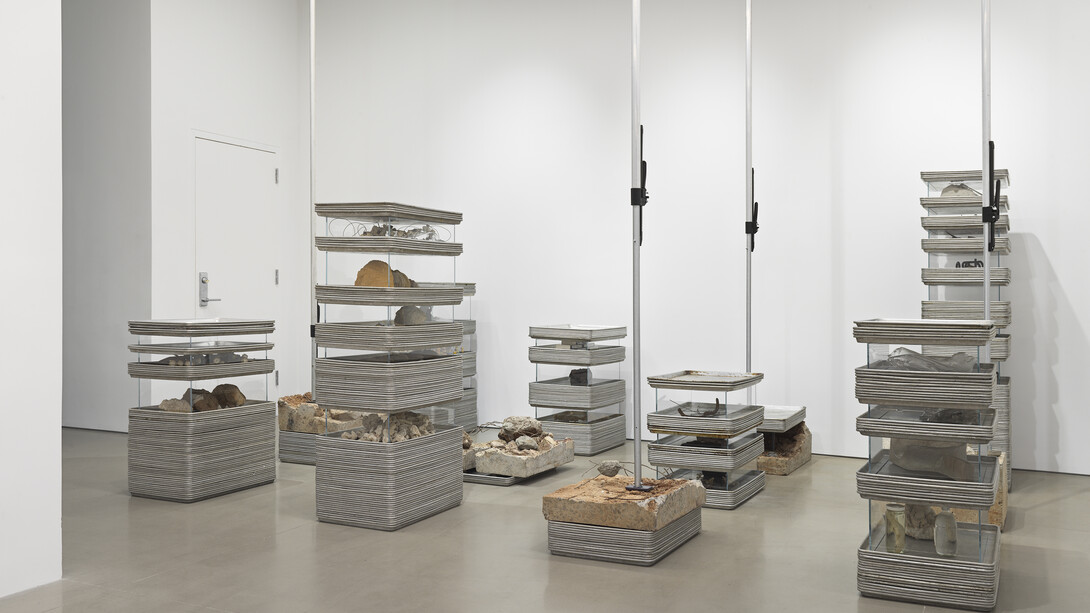
More than an exhibition, Directionless has the scale and ambition of a biennial. In its international scope, the breadth of artists involved, the diversity of artistic languages, and the very structure of its curatorial model, the project conceived by Rashid Johnson for Hauser & Wirth Menorca exceeds the conventional boundaries of the group exhibition to become a platform for reflecting on the conditions of our present. Yet this is not a biennial built upon national pavilions or a rigid curatorial thesis. Rather, it is a temporary community born out of reciprocal invitations between artists, grounded in dialogue, trust and the acceptance of uncertainty as a shared human condition. We are living through an era that seems to have lost its coordinates.
The grand narratives that once shaped our collective imagination—linear progress, faith in institutions, geopolitical stability, even the notion of identity as something fixed and enduring—have begun to fracture. Wars, climate emergencies, migration, technological upheavals and profound social transformations have left us with the unsettling sensation of inhabiting a suspended time, one in which the future appears increasingly unpredictable and the present persistently marked by uncertainty.
It is precisely from this shared experience that Directionless, on view at Hauser & Wirth Menorca from 21 June to 25 October 2026, takes shape. Rather than offering a diagnosis of our historical moment, the exhibition turns its attention to one of its defining emotional conditions: disorientation. Not as failure. Not as loss. But as a possibility. According to Rashid Johnson, artists are not paralysed by uncertainty; they are animated by it. "What they offer isn't a map, but a set of strategies for moving forward when the terrain is unfamiliar." The insight is as simple as it is radical: perhaps what we need are not new absolutes but new, provisional ways of finding our bearings. Perhaps what we call a crisis may also represent an opportunity to imagine other ways of being in the world. In this sense, Directionless is not merely an exhibition. It is a collective exercise in imagination.
The project emerges from a curatorial device that is both straightforward and remarkably innovative. Johnson invited Cristina Iglesias, Firelei Báez and Charles Gaines to nominate artists of their own choosing, including voices beyond the Hauser & Wirth roster. The gesture carries significance beyond exhibition-making itself: it relinquishes the illusion of total control in favour of trust, contamination and the unpredictability of encounter. In an art world often shaped by entrenched hierarchies, institutional branding and market-driven dynamics, entrusting artists with the curatorial process becomes a political act. It acknowledges that knowledge does not move solely from the top down but can emerge through relationships, temporary alliances and acts of reciprocal listening. The constellation of artists gathered in Menorca immediately reveals the magnitude of the project.
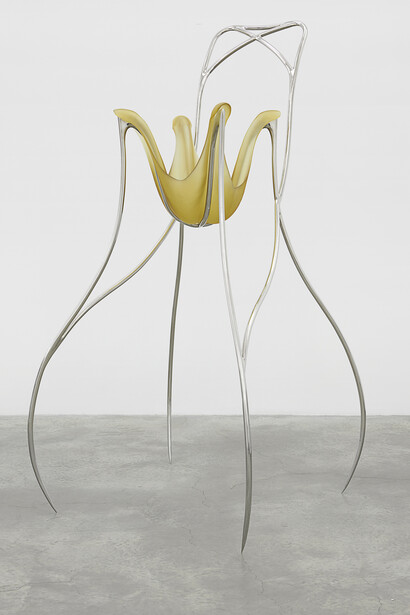
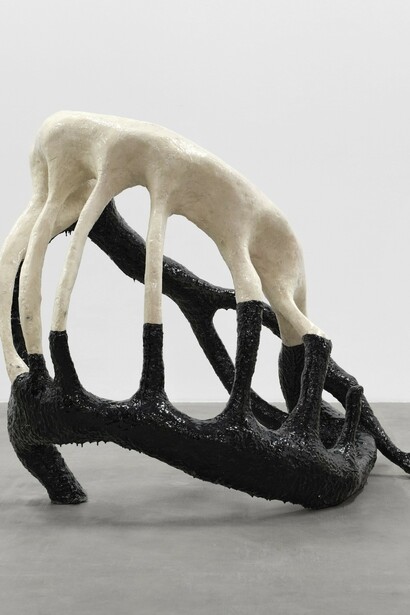
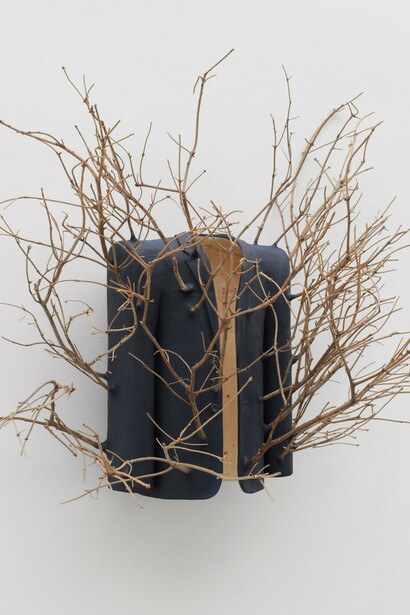
Alongside Rashid Johnson are Lyle Ashton Harris, Firelei Báez, Yto Barrada, Georg Baselitz, Claire Chambless, Ali Cherri, Rineke Dijkstra, Latifa Echakhch, Teresita Fernández, Mirdidingkingathi Juwarnda Sally Gabori, Charles Gaines, Todd Grey, Alteronce Gumby, Mona Hatoum, Hugh Hayden, Leslie Hewitt, Hanna Hur, Cristina Iglesias, Michael Joo, Sigalit Landau, Hannah Levy, Julie Mehretu, Joiri Minaya, Wangechi Mutu, Lorna Simpson, Rayyane Tabet and Meg Webster. Artists from more than ten countries, carrying distinct cultural experiences, aesthetic sensibilities and artistic genealogies, are brought together not to illustrate a single thesis but to inhabit a shared space of inquiry. Their dialogue does not seek reassuring synthesis. Instead, it generates a shifting geography of positions, crossings and possibilities.
The list itself maps some of the most pressing concerns of contemporary art. The diasporic and postcolonial identities explored by Firelei Báez, Joiri Minaya and Wangechi Mutu; the meditations on memory, displacement and migration found in the practices of Mona Hatoum, Ali Cherri and Rayyane Tabet; the representation of the body and subjectivity in the works of Lorna Simpson and Rineke Dijkstra; the relationship between landscape and ecology in the work of Cristina Iglesias and Meg Webster; abstraction as a means of rewriting history in Julie Mehretu and Charles Gaines; and the presence of established figures such as Georg Baselitz, whose work introduces a productive intergenerational dialogue.
What unites them is not a shared aesthetic. It is an attitude. A willingness to move through ambiguity without attempting to resolve it. As the press release notes, the exhibition imagines directionlessness as "a conceptual zone—a space of suspension, drift and openness where new forms of relation, meaning and subjectivity might be imagined". Uncertainty, then, ceases to be a temporary interruption. It becomes a generative space.
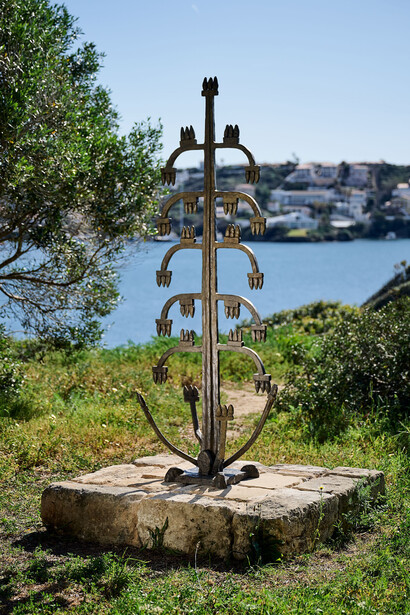
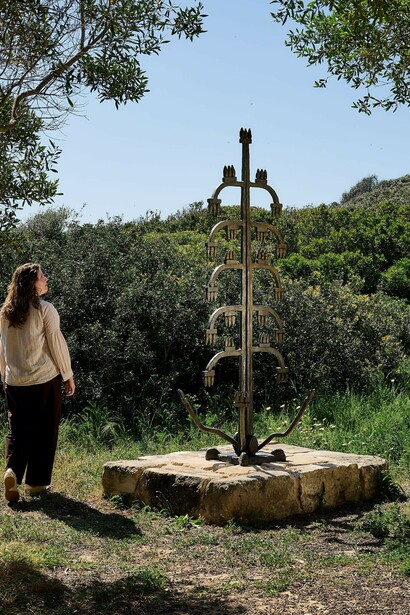
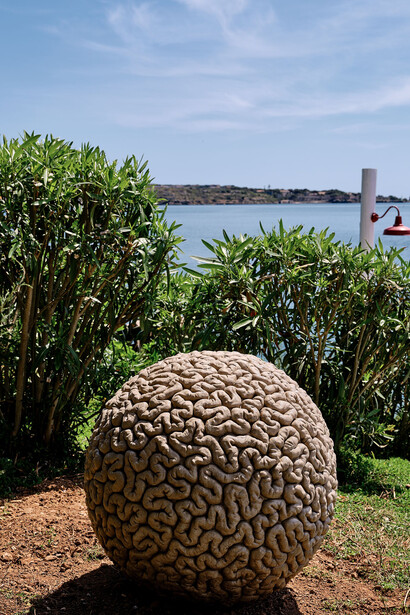
Particularly compelling is the contribution of Cristina Iglesias, who was invited for the first time to shape the outdoor sculpture presentation across the gardens and pathways of Illa del Rei. Iglesias selected artists such as Ali Cherri, Mona Hatoum and Rayyane Tabet to engage directly with the Mediterranean landscape, liberating sculpture from the fixed and monumental register it has so often occupied. These works are encountered in motion. They are traversed. Discovered. They enter into dialogue with architecture, water and vegetation. And it is the Mediterranean itself that emerges as one of the exhibition's implicit protagonists. "Today the Mediterranean, with the heritage of ancient civilisations and migrations, is also a space of suspension and uncertainty... it should serve as a liquid forum, not a frontier," Iglesias observes.
It is difficult to read these words without thinking of the images that shape our collective imagination today: migratory routes; shipwrecks; geopolitical tensions; but also the long history of encounters and exchanges that made this sea one of the world's most fertile cultural spaces. Menorca, situated on the western edge of the Mediterranean, thus assumes a symbolic role. An island. A point of arrival. A liminal space. A place that compels us to rethink the very idea of borders. Perhaps it is precisely this liminality that makes Directionless such a profoundly contemporary undertaking.
For a long time, we understood orientation as the ability to know exactly where we were heading. Today, however, the challenge appears to be something else entirely: learning how to inhabit complexity without claiming mastery over it. Contemporary art possesses a particular competence in this regard. It knows how to remain within ambiguity. It knows how to formulate questions without rushing towards definitive answers. It knows how to create images that do not illustrate reality but complicate it. The works gathered in Menorca suggest precisely this: that uncertainty is not necessarily the opposite of knowledge.
On the contrary, it may be one of its essential preconditions. Not knowing becomes a form of attentiveness. Getting lost may teach us to see differently. Even the exhibition's educational programme, developed in collaboration with the University of the Balearic Islands and the University of Barcelona, reflects this ethos. Workshops, talks, performances and participatory activities transform the exhibition into an open platform capable of engaging diverse audiences and treating learning as a shared process. No longer the museum as a site of one-way transmission. But as a space of experimentation. A laboratory for cultural citizenship.
Ultimately, what Directionless seems to suggest is that the problem lies not so much in the absence of direction as in our contemporary obsession with linearity. We demand clear paths, stable identities and coherent narratives. And yet life rarely unfolds in straight lines. Perhaps true maturity lies in accepting that orientation is always partial, negotiated and temporary; that maps remain necessary but must constantly be redrawn; and that definitive answers matter less than the quality of the questions we are capable of asking.
Like the finest biennials, Directionless offers no single interpretative key. Instead, it invites visitors to construct their own trajectories through a constellation of artworks, ideas and sensibilities. And perhaps, by the end of the journey, the exhibition's title itself takes on a different meaning. 'Directionless' does not signify the absence of orientation. Rather, it suggests the possibility of relinquishing the comfort of a single direction in order to embrace the richness of the many paths that art continues to open before us. In a present that constantly demands immediate answers and unequivocal positions, Menorca reminds us of the value of doubt, drift and mutual listening. And that, sometimes, the best way not to lose ourselves is not to find the road straight away but to learn how to walk together even when the road has yet to be invented.