English
 Español
 Français
 Deutsch
 Italiano
 Português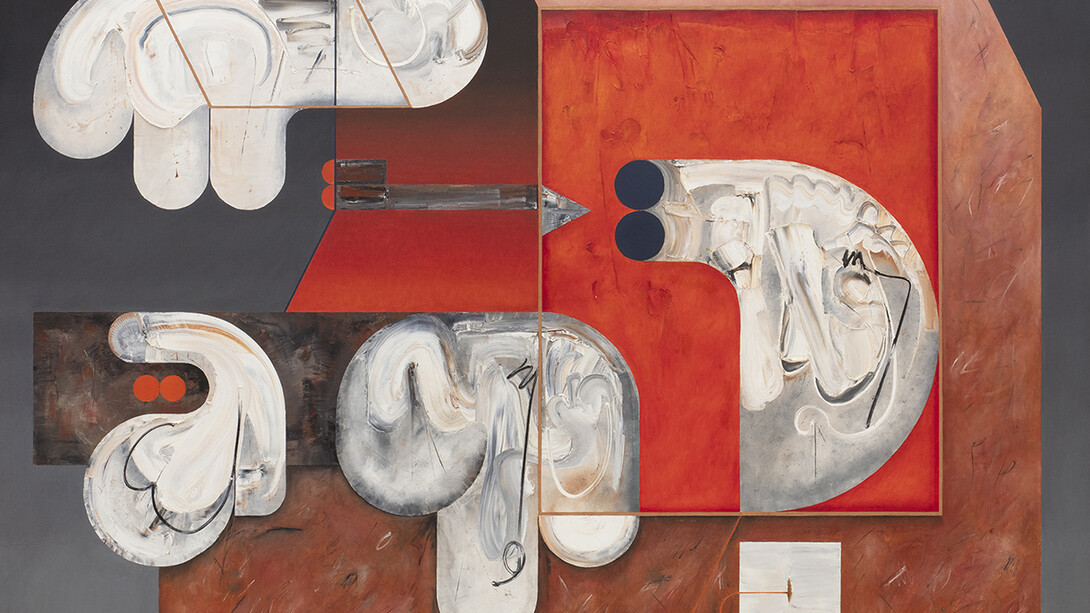
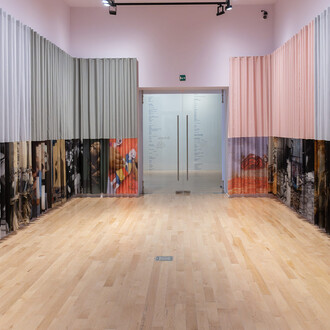
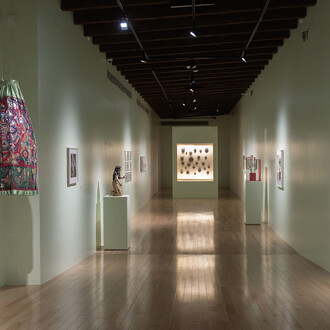
Sculptural evocations presents a journey through the work of Manuel Felguérez by way of a set of sculptures and paintings made between the 1980s and 2015. More than a chronological survey, the exhibition seeks to reawaken our memory of one of the foundational artists of modern art in Mexico, whose work was central to the consolidation of abstract and geometric art in Mexico. His interest in art took shape at the very beginning of his artistic training, when he traveled to Europe in the 1940s and undertook his initial approaches to sculpture. He rose to prominence in the development of geometric art starting in the 1970s, when he succeeded in distilling his painting to the point of achieving a total geometry.1
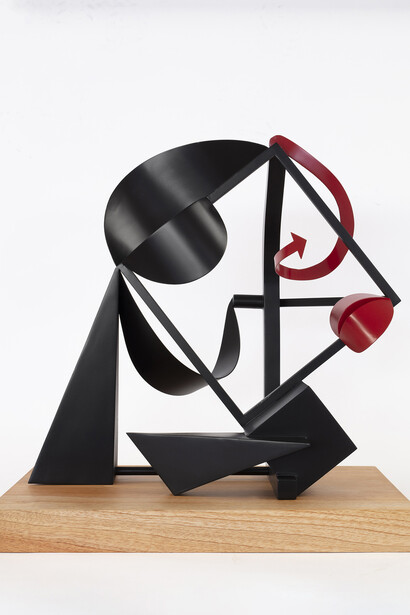
The exhibition features three groups of sculptures. The first comprises models made in polychrome metal, conceived by the artist as designs for possible public sculptures. He initially explored these designs using cardboard models held together with glue; once he had resolved them, he translated them into medium-scale pieces, which are on view in this show.2 These works from the 1980s and 1990s reveal a combination of geometric elements that may recall the characteristic forms of his earlier projects, such as La máquina estética (The aesthetic machine) and El espacio múltiple (Multiple space).3
The sculptures in this first group were conceived to convey a sense of lightness, despite being made of iron and having been intended as models for future monumental works in public space. That quality is evident in the crisscrossing lines that form openings meant to allow air to flow through. This structural solution meant that, if scaled up to monumental dimensions, the pieces would have less wind resistance and remain stable. Such is the case of the public sculpture Puerta 1808, currently located at the corner of Paseo de la Reforma and Avenida Juárez here in Mexico City, a complex structure of linear projections and vanishing points, both of which appear in several sculptures shown in this exhibition.4
Manuel Felguérez began to develop this kind of linear form after a long trajectory in his artistic career. The art critic Juan Acha noted that by around 1956 the need to distance himself from the influence of his early sculptural points of reference—particularly Ossip Zadkine and Henry Moore—was already evident in Felguérez’s work. From then on, the artist set out to find a language of his own, which would lead him, in the 1970s, to consolidate an abstract-geometric body of work. For Juan Acha, this moment marks—albeit belatedly—the emergence of geometric art in Mexico.5 Thus, in these sculptures one can observe straight lines, circles, triangles, and intersections that generate vertices and pronounced angles, all of which make up the formal vocabulary of Felguérez’s sculptures from this period.6
In these pieces, we witness the transition from relief—developed for murals intended for public space and for small-format works—toward a fully three-dimensional sculpture, always maintaining the dialogue between painting and sculpture, two of Felguérez’s central interests. In the 1980s, the artist started expressing his intention to explore volume and the third dimension.7 It was then that he made “sculptures in carved stone, heavy, polished, and rounded objects that readily find their place in the history of modern sculpture alongside such artists as Jacques Lipchitz.”8 His sculptures from the 1990s and the early years of the twenty-first century featured in this exhibition show a progressive move away from strict geometry.
The show also includes a second group of sculptures in bronze that disclose a significant transformation in Felguérez’s work. These are pieces of a more organic character, distant from the geometric rigor and the obvious constructivist influence that had defined much of his earlier work. In them, rounded forms predominate, emphasizing both the density of the material and the sense of gravity inscribed in the way the volumes themselves are shaped. Several of these pieces refer explicitly to living beings, such as Búho (Owl, 1996), Gato (Cat, 1995), Ermitaño (Hermit, 1996), Voyeur (1995), and Mujer de Saliagos (Woman from Saliagos, 1996). A particularly interesting case is Insinuación del círculo (Intimation of a circle), in which Felguérez begins with the outline of a circle before giving it thickness and spherical volume, transforming a two dimensional figure into a fully three-dimensional form.
Some of the works gathered in this exhibition evoke the work of the Russian constructivist sculptor Naum Gabo. One can detect resonances with Spiral theme (1941) in the unfolding of organic forms constructed out of curved lines that characterizes such works of Felguérez’s as Dinámica lineal (Linear dynamics, 2012). Likewise, pieces such as Construction in space: two cones and spheric theme (Penetrated variation) (ca. 1937–1940), in which Gabo combined geometry with a sense of movement, find a visual echo in Insinuación del círculo, the curving lines of which follow the idea of the German sculptor Adolf Hildebrand, whose book The problem of form in painting and sculpture (1907) reflects on the importance of the movement of lines in sculpture: “Our idea of the sphere is rather that of a two-dimensional circular line, plus an idea of movement by which this circle is repeated equally in all directions.”9 In this way, Felguérez intimates a circle by marking the moving lines of a semispherical form. Despite the formal affinities between Gabo and Felguérez, their use of different materials nevertheless stands in contrast: while Gabo frequently turned to industrial materials such as acrylic and Plexiglas, Felguérez made his sculptures mainly in metal alloys and wood. Although Manuel Felguérez never made an explicit reference to Naum Gabo, it is clear that much of his sculptural imagination drew on the avant-gardes that developed in both Eastern and Western Europe.
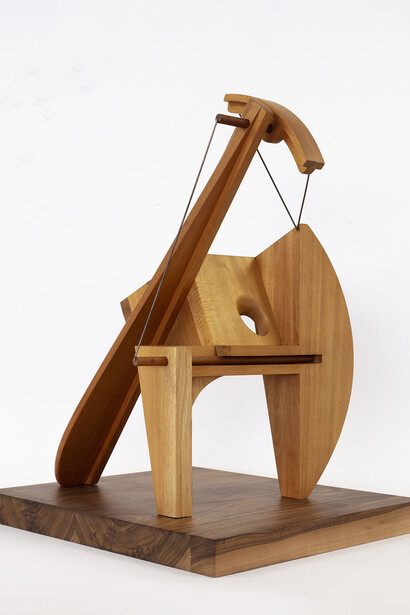
Finally, this show presents a third group of sculptures made in wood, all of which are small scale models of works that Felguérez later developed in large format, also in polychrome iron. Such is the case of Sextante del cuadrado (Sextant of the square, 1989), whose larger-scale namesake is part of the collection of the Museo Universitario Arte Contemporáneo (MUAC).
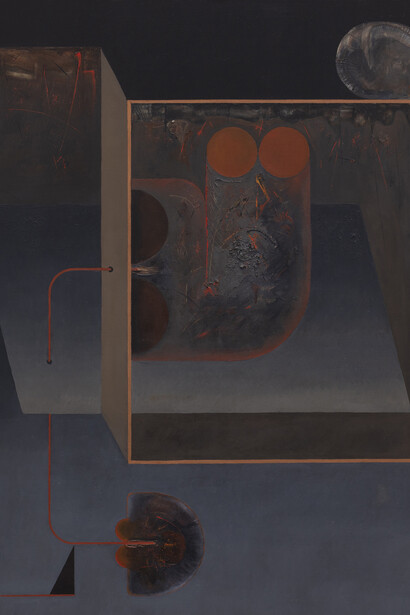
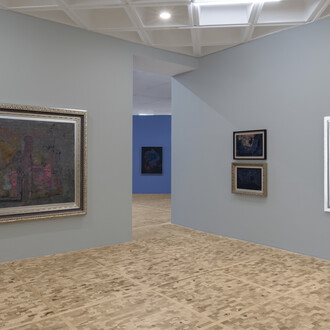
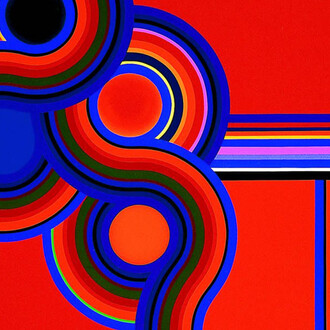
The exhibition also includes five paintings made by Manuel Felguérez during the 1980s, which show a clear transition from the work derived from La máquina estética in the 1970s, characterized by rigorously geometric compositions on the pictorial plane. In these works, the artist began integrating organic forms that engage in dialogue with the geometric structures, anticipating new formal explorations. In them one can see the artist’s quest to “layer and thicken painting,”10 a characteristic element of his final period of work. In the paintings, the brushwork and the application of oil paint with a spatula reveal a technique of great material richness, capable of emphasizing the density and physical qualities of the pigment. At the same time, the color palette of these paintings differs from the one that characterized the works made for La máquina estética, where vibrant colors predominated above all. By contrast, these pieces are distinguished by a range of earthy tones—ochres, browns, and reds—as well as by the incorporation of grays in different shades and silvery hues. Especially notable is the painting Mientras muere la tarde (As the afternoon dies, 1982), in which Felguérez incorporates the colors of a sunset through a gradual transition from orange to yellow, alluding to the characteristic hues of the moments just before nightfall.
One can observe Manuel Felguérez’s conceptual flexibility in his movement between sculpture and painting. His continual shifting from one medium to the other recalls the distinction Adolf Hildebrand drew between the sculptor’s mental materials and those of the painter. For Hildebrand, the sculptor works from kinesthetic ideas, to which, in his words, he “gives expression by fashioning them out with his hands in solid material.”11 The painter, by contrast, begins with visual ideas and expresses form through images projected onto a two-dimensional surface.12 Felguérez’s practice articulates both modes of thought: he turns to volume when working from kinesthetic experience, and to line and plane when developing visual images. Yet one of the most significant aspects of his work lies precisely in the dialogue between the two languages. Throughout his career he explored how to translate forms conceived on the two-dimensional plane into three-dimensional space—that is, a process that involved recreating the image in order to turn it into a spatial and volumetric experience.
The exhibition makes clear that experimentation with different media, materials, and modes of artistic thought was a regular part of Felguérez's practice. This vocation can be discerned in his earliest bronze sculptures, through his use of scrap materials in works such as Mural de hierro (Iron mural, 1961)—originally installed at the Cine Diana in Mexico City—as well as in the projects developed for El espacio múltiple, the polychrome reliefs, and the cardboard and polychrome iron sculptures that grew out of La máquina estética. In the same way, his final works confirm that this material exploration remained active through to the very end of his artistic output, incorporating new materials such as wood.
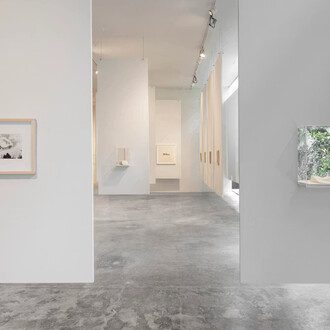
Sculptural evocations seeks to recover a part of Manuel Felguérez’s late work as a way of reconstructing the artist's creative universe, thereby issuing a call to collective memory. The exhibition invites us to imagine the space of his studio, to look at the sculptures made during the last years of his career, and to discover the formal and material solutions he developed in each of them. The show brings together pieces whose original space was the artist’s home and workshop—works that were awaiting a new opportunity to be seen and appreciated.
(Sculptural evocations by Manuel Felguérez. By Vera Castillo)
Notes
1 Cuauhtémoc Medina, El futuro era nuestro (Mexico City: Museo Universitario Arte Contemporáneo, 2020), 79.
2 Ibid, 126.
3 These pieces were fundamental for Felguérez because of the way they explored both matter and form, marking a
watershed in the development of his sculptural and pictorial work.
4 A show of this kind of sculptural exercises was exhibited in Manuel Felguérez: trayectories (2019) at the Museo
Universitario Arte Contemporáneo.
5 Juan Acha, “El geometrismo de Felguérez: afirmación personal y ambiental,” in Felguérez: El espacio múltiple
(Mexico City: INBAL, 1974), 16.
6 Jorge Reynoso Pohlenz and Alberto González Torres, “Sistema e indeterminación: el juego como método de
trabajo,” in Manuel Felguérez (Mexico City: Universidad Autónoma Metropolitana, 2009), 31. Reynoso Pohlenz and
González Torres note that Felguérez’s purely geometrical abstraction in this period was “a consequence of ongoing
explorations into specific geometrical forms, like the circle, square, and triangle.”
7 As early as the 1960s, though, Manuel Felguérez had started experimenting with reliefs, namely with Mural de
hierro (Iron mural, 1960), which he made with recuperated materials. In this sense, his work referred to that of the
U.S. artist Louise Nevelson, whose experimentation with assemblages was prominent in this period. Pilar García, in
El futuro era nuestro, 100.
8 Dore Ashton, “Manuel Felguérez y sus formas ideas,” in Manuel Felguérez (2009), 22.
9 Adolf Hildebrand, The problem of form in painting and sculpture (New York: G. E. Stechert & Co., 1907), 31.
10 Manuel Felguérez in interview on Canal 22, “El espacio múltiple: Manuel Felguérez,” video on YouTube, posted by
Mercedes García Ocejo, December 4, 2025.
11 Hildebrand, The problem of form, 32.
12 Ibid, 33.