English
 Español
 Français
 Deutsch
 Italiano
 Português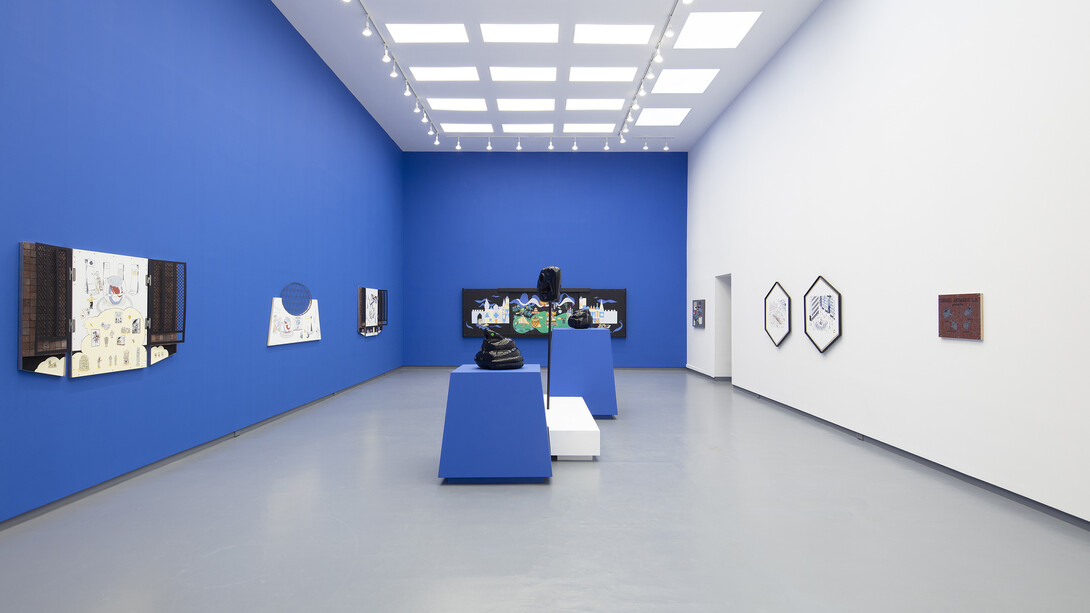
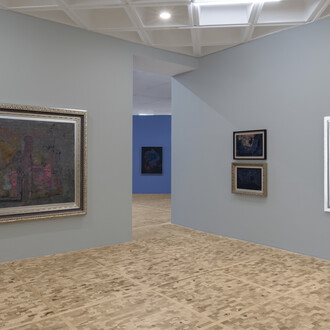
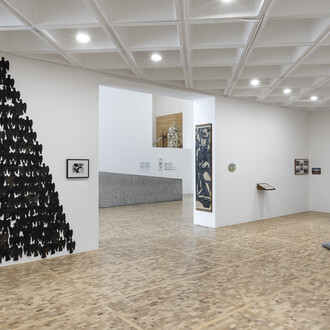
The work of Josué Mejía (Mexico City, 1994) is notable for being the result of a practice that involves substantial historical research as a means of reconstructing and questioning the various strategies behind politics, cultural diplomacy, and propaganda that were elaborated across the twentieth century, especially in the context of the Cold War. Drawing on this background, Mejía addresses topics such as U.S. power over the continent, the Mexican state’s strategies for sustaining nationalist politics, diplomatic relations between Mexico and the United States, dictatorial regimes in Latin America, and other pivotal moments that have shaped the region, which form the scaffolding of the work presented in this exhibition.
Over the course of his career, Josué Mejía has studied different historical, political, and economic processes in which art and culture have functioned as a kind of mechanism to sustain North American expansionist politics, as well as the consolidation of the Mexican government that emerged from the revolution. This has led the artist to explore not only diverse techniques and formal solutions—especially fresco, illustration, video, and installation—but also to position himself as a creator who turns the past into one of his primary tools for rethinking, from a contemporary perspective, the intentions and objectives underlying imaginaries.
Throughout this exhibition, which brings together recent production, Mejía revisits the role of figures such as Mary Blair—one of the most important illustrators at the Walt Disney Company—who created the artistic concepts for films such as Alice in Wonderland, Song of the South, and Cinderella. Likewise, he brings in Mickey Mouse and Walt Disney himself as a way to analyze different devices of cultural diplomacy and these agents’ intervention in the dynamics established between capital and transnational politics.
One thread that runs through the works featured here is a reflection on the construction of discursive strategies and exhibition devices as a way to consolidate narratives through which, for example, Mexican national identity was established, starting from the idea of a historical invariant that traversed artistic production conceived from the pre-Hispanic era until modernity. This approach, championed by the museographer and curator Fernando Gamboa, was one of the defining elements of Mexico’s participation in the world’s fairs of the post-revolution period.
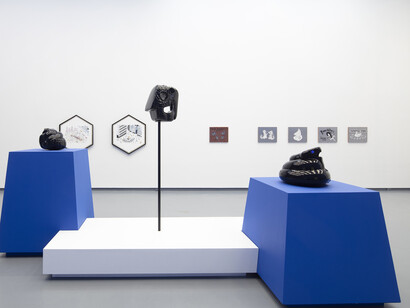
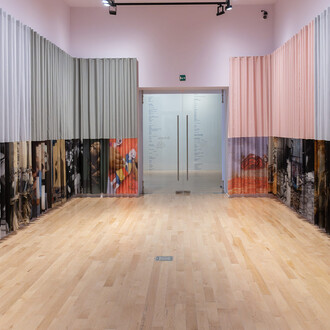
In this sense, the schematic lines of gouache drawing in the piece Pabellón México 64 / Pabellón México 65 (Mexico Pavilion ’64 / Mexico Pavilion ’65) reprise different museographic elements that Gamboa created for the pavilion that Mexico presented at the World’s Fair in New York City from 1964 to 1965. It is important to consider the nature of these events, which date back to the mid-nineteenth century, when great powers like England—which organized for the first time the “Great Exhibition of the Works of Industry of All Nations” (1851)—proposed gathering various Western countries in a showcase that would bring together their industries, technological and scientific advances, cultural production, and other achievements, with the aim of representing the progress and modernity attained by humankind up to that point.
Mejía uses the New York World’s Fair of the 1960s as his point of reference because it was the first time that major transnational corporations such as Pepsi-Cola, Coca-Cola, and Chrysler had their own pavilions, while the Walt Disney Company was responsible for designing several attractions and spaces; in other words, it was the moment when the economic and political might of the greatest world power joined forces to shape the aspirations for a technologized future that had been glimpsed during the postwar era.
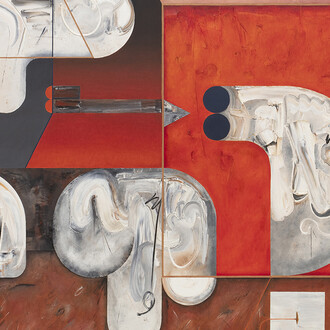
In his work Estábamos de frente o Pabellón de México en la Feria Mundial de Nueva York 1964–1965 (We Were at the Front, or Mexico Pavilion at the New York World’s Fair, 1964–1965), in acrylic and gouache on stainless steel sheet, Josué Mejía represents the two moments when Mexico participated in the fair, separated by an interval of several months and by two different ways of presenting Mexico to the foreign gaze. In the first stage, which ran from April 22 to October 18, 1964, the Mexican pavilion presented a project by architect Pedro Ramírez Vázquez and his partner Rafael Mijares, based primarily on representing Mexico as a nation in the full swing of industrial progress and economic development, with a modern infrastructure that was driving foreign investment.
However, this approach did not entirely convince the U.S. organizers, who were expecting a Mexican pavilion closer to the tradition of the exhibition Twenty Centuries of Mexican Art, held at the Museum of Modern Art in New York in 1940. Fernando Gamboa was thus appointed commissioner-general and art director of the pavilion in its second stage, with the aim of showcasing the country’s cultural and artistic richness through 100 works of viceregal art, pre-Hispanic pieces, and modern and contemporary art, many of which had already been presented at other international events also organized by Gamboa, such as the Mexico Pavilion for the Brussels World’s Fair in 1958.
Mejía’s drawings focus on the elements that distinguished the Mexican pavilion in both phases: museographic devices, the presence of pre-Hispanic pieces, and the dialogue sought between different historical periods. As in the work Pabellón México 64 / Pabellón México 65, the artist analyzes not only the works on display but also the museographic elements and their arrangement in the pavilion’s architectural space, such as the X-shaped screens that Fernando Gamboa designed to allude to the debate about the correct way to write “México” in Spanish—with an X or a J—which was taken up in the twentieth century by intellectuals such as José Vasconcelos and Alfonso Reyes, who defended the use of the letter X as a way to underscore national identity and Mexicanness itself.
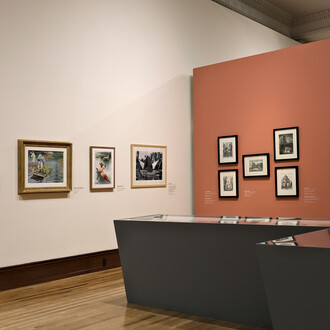
It is important to point out that across his artistic output, Josué Mejía has also addressed Disney’s role in popular culture, and more specifically, its involvement in various politically motivated strategies to bolster the United States’ presence on the continent. In this way, Mejía revisits the work of the illustrator Mary Blair, reproducing a series of postcards made by the artist for Hallmark, in which she depicted some of the details that most caught her attention when she visited Mexico in the 1940s.
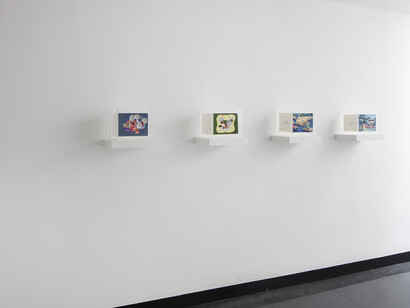
Blair traveled through different Latin American countries, and in Mexico she spent time in places that furnished her with visual references to create the artistic concepts for the film Saludos amigos (1943) and scenes from The three caballeros (1944). As part of his reinterpretation of Blair’s work, Mejía made a series of colorful and detailed gouaches based on the postcards that Blair made in 1945.
Xochimilco, its natural surroundings, and its trajineras; posadas and their connection to Mexican religiosity; the Isthmus and the national femininity embodied in Tehuanas: these are some of the subjects Blair chose and that Mejía, in turn, revisited, accompanying them with four fictional letters imagining possible correspondence between Mary Blair and such figures as Miguel Covarrubias, Jean Charlot, and Walt Disney himself. In these imaginary letters by Mejía, Blair’s voice conveys enthusiasm for landscapes, traditions, and colors, while describing to her colleagues the impressions Mexico has left on her work.
Along the same lines, and harking back to the research Josué Mejía carried out on the figure of Walt Disney and his connection to the Mexican art world, the exhibition presents a series of cartoons titled Mickey Mouse por Rivera, Jean Charlot y Eisenstein, which take as their starting point the admiration and curiosity that the famous mouse inspired in these artists and the Soviet film director, as well as the formal and narrative possibilities of animated cartoons. For example, in his murals on the second floor of the so-called “Patio de las fiestas” in the Secretaría de Educación Pública building (1928), Diego Rivera sought to emulate the dynamism of the figures and the narrative continuity that had so captivated him in Disney’s cartoons.
Mejia’s drawings were catalyzed by certain phrases excerpted from texts and by what the artist considers “visual coincidences” shared by Diego Rivera, Jean Charlot, and Sergei Eisenstein in relation to the figure of Mickey Mouse. In one of his drawings, Mejía references this interest of Rivera’s by way of a statement in which the muralist declared that Mickey Mouse was “one of the genuine heroes of American art.” With this as his backdrop, Mejía created a scene in which Mickey stands smiling and friendly before a group of sugar figurines—made specially for the Día de los Muertos celebration—arranged in a semicircle, as if they were about to strike up a dialogue with the cartoon character.
The artist also addresses the interest of Sergei Eisenstein—who made the film Que viva México!—in the famous cartoon, which by 1930 was already revolutionizing the way images were consumed around the world. Mejía draws on the concept of “plasmaticity” that Eisenstein developed—following a visit to the Disney studios—to describe the capacity of animated bodies and objects to alter their original form over the course of a dynamic narrative.
In his own cartoon, Mejía represents plasmaticity through Mickey Mouse’s body, the torso and arms of which stretch until his limbs form a kind of mountainous landscape that frames the scene. Mickey holds a star in each hand, while he looks with an expression of amazement at a skeleton holding a scythe, as if about to raise it to cut off the mouse’s own head. The landscape features cornstalks standing upright and, in the background, a sun on the verge of setting behind men in sarapes and sombreros, elements that Mejía takes from Eisenstein’s original drawings and that refer to his way of conceiving “Mexicanness.” In connection with this drawing, Josué Mejía notes: “From Eisenstein’s perspective, Mickey appears then as an unconscious revolutionary: a body capable of defying the rigidity of industrial modernity through metamorphosis, laughter, and the relief that people find in him after a tough day of work.”
In the work featured in this exhibition, the artist uses illustration—both as a formal medium of expression and as a source for reflecting on the work of other illustrators—to address the complexity of a historical moment and to propose a conceptual approach to the technical and formal solutions in animated cartoons. Although these characters were long believed to have been created as “innocent and naive” entertainment for children around the world, the truth is that their use as propagandistic tools and instruments of interventionist vanguardism has revealed, over the years, their capacity to penetrate and persuade audiences in favor of American capitalism and imperialism.
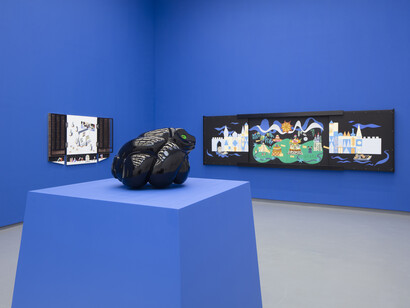
In this same vein, Mejía points out and questions this role of cartoons—and of the Disney Company itself—through his collage that revisits the illustrations conceived by Mary Blair for It’s a Small World, the famous boat ride originally created for the 1964 New York World’s Fair, and later relocated to the Disneyland theme park. In this piece, Mejía developed a clock with a mechanical system capable of marking only four different hours, as if broken. The hours indicated by the clock record the moments when various military interventions and coups d’état supported by the United States took place in Latin American countries: in Guatemala, on March 23, 1982, at approximately 4:00 a.m.; in Chile (1973), with the support of the army, Augusto Pinochet overthrew Salvador Allende and established a brutal dictatorship that lasted until 1990, at approximately 11:52 p.m. during the attack on the Palacio de La Moneda; Argentina (1966), the coup d’état, known as the “Argentine Revolution,” took place on June 28, 1966, formally beginning with soldiers entering the Casa Rosada after 5:00 a.m., with General Julio Alsogaray breaking into the presidential office at around 5:20 a.m. to demand the resignation of Dr. Arturo Illia; Uruguay (1973), the interruption of democracy by military forces on June 27, 1973, when at 10:30 p.m. President Juan María Bordaberry justified the coup in a national radio and television address.
Through his works, which make an initial visual impact that immediately hooks the viewer, Josué Mejía proposes a set of methods of work that come together in historical research as a guiding thread for developing reflections of an aesthetic or formal nature, while also challenging us to engage in critical thinking: to question the origin of images and visual discourses.
The solid and coherent body of work by this artist admonishes us and also invokes an old—and utopian—ideal of modern Mexican art: to champion a social function through artistic creation and to make the artist a fully active member of society. In the system of contemporary Mexican art, does it make sense to look to the past and question it in order to build discourses critical of the images and narratives stood up by the state and its cultural agents? The work of Josué Mejía will give us some answers.
(Text by Mireida Velázquez Torres)