English
 Español
 Français
 Deutsch
 Italiano
 Português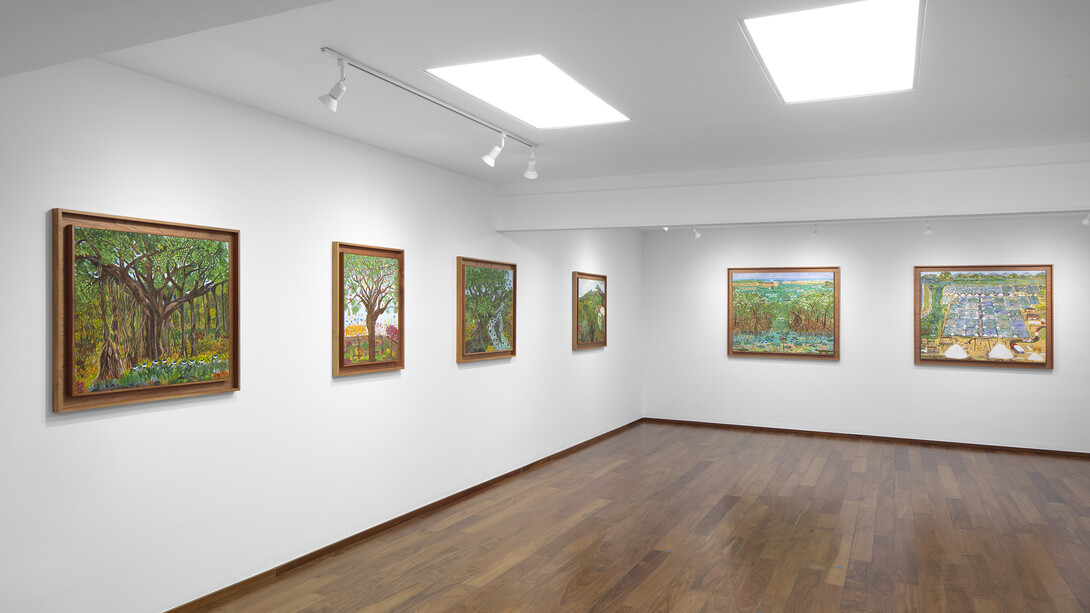
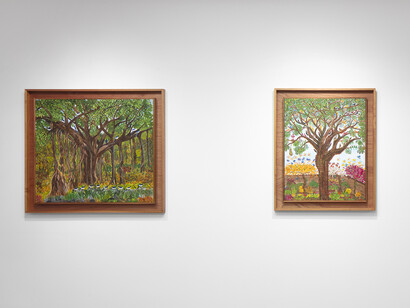
Patricia Ochoa is an artist from Colima whose development in painting refers both materially and thematically to pictorial production in early twentieth-century Mexico. During that period, there was an effort to construct an aesthetic that would highlight the “distinctive qualities of Mexican identity” through the genre of landscape and the revaluation of the natural environment. Although Ochoa does not intend to address this notion of national identity directly, her work does reveal a marked affinity with the peaceful landscapes of the Colima region. Though her painting might seem anchored in an intimate and familiar setting, it also configures a social milieu deeply linked to Colima's history.
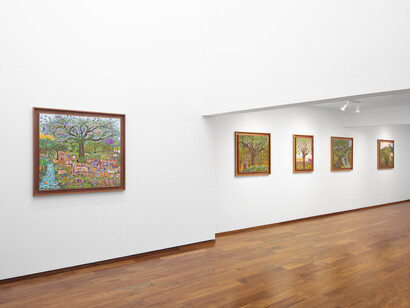
This exhibition, titled Rituals of soil and salt, brings together paintings that the artist has produced over the past decade, with the aim of bringing the public closer to pictorial practices developed outside of Mexico City and acquainting it with Patricia Ochoa’s intentions and interests. It also invites visitors to delve into the western part of the country and to appreciate not only the material qualities of her work but also the thematic dimension that her project explores.
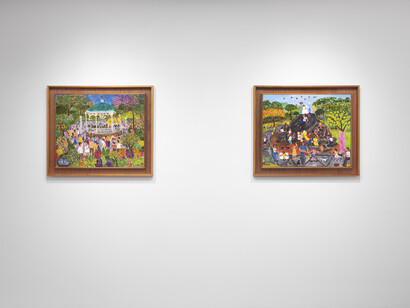
Ochoa’s paintings represent human activities and characteristic customs from different municipalities in Colima, encompassing everything from social and cultural development to the economic processes of various communities. For example, Todo bajo la parota (Everything beneath the elephant-ear tree, 2024) depicts families in the midst of a birthday celebration, with all the paraphernalia that entails: food being prepared, the moment when the piñata is broken, and recreational activities like swimming in a stream, playing soccer, sharing a communal meal, or a dancing in a group. Everything takes place under an imposing elephant-ear tree, which occupies much of the composition, sheltering a variety of birds that rest on the branches of the vast tree. The painting invites us to imagine the sound of that flock, which extends from the canvas into its surroundings.
Something similar occurs in El centinela (2020), where, drawing from own her family memories, the artist accounts for the economic activity of a ranch owned by her family, located on the banks of the Marabasco River, at the geographical border between Colima and Jalisco, near the Pacific Ocean. This piece presents a distinctive feature of her practice: an aerial perspective that allows us to appreciate the extent of the territory. This bird's-eye view not only allows us to situate the space where the ranch was located—where Ochoa lived from her early childhood up to the age of seven—but also to recognize the labor of those who worked there. The artist made the painting on the basis of her own memories: an area surrounded by freshwater canals and vegetation, as well as the small school that her father founded for the workers’ children. For Patricia Ochoa, this work constitutes a tribute to those who were part of life at El Centinela ranch, and at the same time, a way of sharing her family history with others whose experiences have been different.
By representing geological features like volcanoes, as well as flora and fauna, early twentieth-century artists constructed part of the imaginary of Mexico as a fundamentally rural land, albeit in constant transformation with the emergence of large cities. Something similar occurs in Volcán con árboles (Volcano with trees, 2021), which features the Colima Volcano—a geological formation that was represented in its time by José María Velasco and Dr. Atl—surrounded by different species of flowering trees. Likewise, Volcán desde el puente de colima (Volcano from the colima bridge, 2019) presents another view of the same volcano. In the latter case, it is no longer a distant landscape where biodiversity predominates, but rather a more “human” view; that is, a perspective elaborated from the point of view of someone on a bridge over a stream, decorated with clay and talavera.
The painting Las salinas de Cuyutlán (The salt works of Cuyutlán, 2025) is another composition in which the artist takes up some of the economic and collective history of an area on the northwest coast of the state of Colima, in the municipality of Armería, well known for its salt production. In Mexico, and particularly in Colima, salt production has been a fundamental pillar of economic development since the colonial era, giving the region’s salt works a relevant role in commercial activity ever since. In the specific case of Cuyutlán, sea salt is collected in a traditional way. Ochoa’s painting is another detailed aerial scene that presents the process of extracting salt by creating small pools on the lagoon floor during the dry season. Seawater gets deposited in these ponds and left to evaporate from the heat of the sun, until only the salt remains.
Patricia Ochoa’s interest in this subject comes not only from its historical and social context but also from a personal dimension: her grandfather was a salt worker, so her own history is intertwined with this traditional labor activity of the region. Additionally, the painting depicts the land destined for the salt works, with the pools full of salt in the process of being collected by workers. The characteristic landscape of the Cuyutlán area is visible in the background, with hills and mountains as well as a river that starts in the lower left part of the canvas and extends toward the upper center of the composition. Finally, a highway runs parallel to the river, bordering the salt pools. The pictorial scene allows us to examine how human activities transform the landscape, particularly by modifying the terrain, for example, by building pools or paving roads that facilitate access to work areas.
The landscapes and typical scenes featured in Patricia Ochoa’s paintings lead to a reinterpretation of our deep connection with nature: bodies of water, trees, and the diverse animal species that inhabit them occupy a central place in her work. The painting El chupadero (2025) makes evident her commitment to organic forms, representing the Tecomán mangrove, an ecologically important area and a habitat for many species of fish and birds. This piece not only highlights the richness of the ecosystem and its biodiversity but also leaves a visual record of the site’s natural history. In this way, the painting constructs an imaginary from the landscape of the Colima region. This interest is also linked to the artist's commitment as an ecologist for several years, as well as her concern for the protection of the environment and these natural spaces. As she puts it, it is about “defending nature,” native trees, and the territory, leaving a record of what these places were like. This affective bond with the natural environment is a defining feature of her work, with roots in her childhood. Her parents significantly influenced the development of her sensibility: her father by inviting her to contemplate the starry skies at the ranch, and her mother through an abundant garden of plants and flowers that awakened in her a special fondness for vegetation.
Patricia Ochoa’s work draws from the history of landscape painting produced in Mexico in the 1910s, when a “call of the countryside” was being promoted, whose echoes of a certain primitivist and pristine nostalgia are still heard to this day. In this sense, her work can be situated as part of an extensive tradition in Mexico concerned with addressing life outside the city and its activities. The fluidity of her brushwork recalls the bucolic impressions of Ramón Cano Manilla or the dappled landscapes of Fernando Castillo, but Patricia Ochoa’s visual approach is undoubtedly distinguished by her position toward returning to her homeland and to life away from the urban rhythm, linked to different recreational and work activities, as well as to a more leisurely temporality. In fact, contemplating her paintings demands an attentive gaze from the viewer: each work invites one to discover details that tell small stories within a bigger narrative.
In Patricia Ochoa’s work there is a steadfast intention to visually preserve a territory, a space, or a moment: a landscape, a family gathering, a workday, a dance in a town pavilion, or even everyday life. In this sense, her painting not only documents but also proposes a way of looking at and valuing one’s own environment.
(Text by Vera Castillo)