English
 Español
 Français
 Deutsch
 Italiano
 Português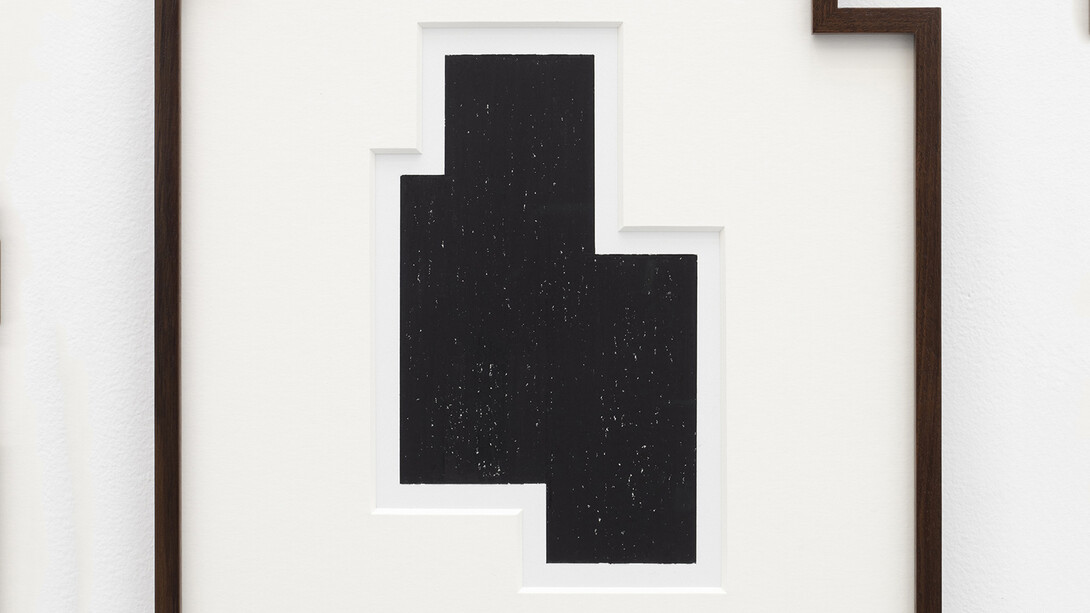
I
“Originality consists in returning to the origin.” This assertion by the Catalan architect Antoni Gaudí contains a transcendent truth: authenticity is inseparable from its history. It pairs well with another remark, this one by the writer Eugenio D'Ors, also Catalan: “Anything that is not tradition is plagiarism.”
For Guillermo García Cruz (Montevideo, 1988), these two quotations offer an easy way to illuminate his trajectory. In the early years of his career, the artist devoted himself to figurative painting of a decidedly realist character. For someone born in the Southern Cone, a shift toward geometric abstraction would seem natural and effortless thanks to the artistic avant-gardes of the region, which privileged this visual language as a result of the master Joaquín Torres-García’s return to his home town of Montevideo after his European exile in 1934. Nevertheless, the influence that most captivated Guillermo García Cruz lies neither in the School of the south nor in the Constructive universalism that Torres-García left as a great artistic inheritance to the South American painters of the twentieth century, and especially to his followers in Uruguay. Instead, the artist turned to the concrete art that was born on both banks of the Río de la Plata, and above all to the theoretical postulates of the artists associated with the Madí movement.
This attraction is not reducible to the obvious formal kinship between García Cruz’s work and that of the Madí painters, or their Brazilian peers in the Frente or Ruptura groups. The true point of connection lies in the revolutionary ideas about abstract painting held by that generation of artists and intellectuals. Looking back to the origins of Latin American abstract art gave his work a renewing impulse, making it profoundly original (to paraphrase Gaudí). But this originality resides, I contend, beyond any formal affinities between his work and South American concrete art. The painting and sculpture of Guillermo García Cruz imply a vigorous and thoroughly contemporary renewal of those artistic traditions, articulated through a deeply authentic discourse grounded in the technological reality of our own time, as we shall see.
II
We must recall the challenge that the first abstract artists of the Río de la Plata area set for themselves: a need to bring some dynamism to the rigid orthogonal structure of the canvas that we have inherited from the Renaissance. The Madí group’s program advocated for art to assume irregular geometric forms, which pictorial surfaces would cut quite freely. With this in mind, those painters sought to liberate creation from its ties to tradition and commit to a painting that was wholly abstract.
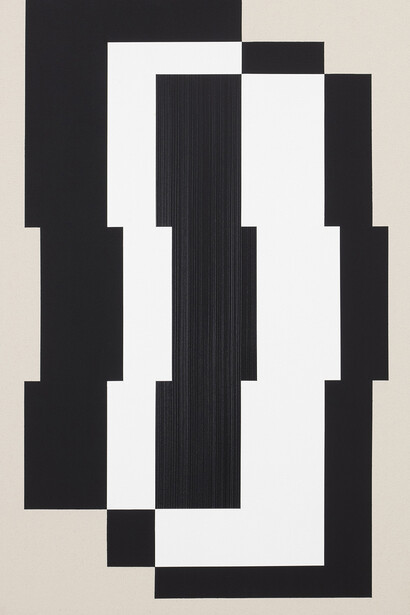
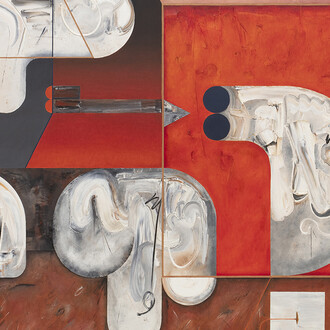
In Guillermo García Cruz’s work we find a similar gesture. His frames evidently do not maintain strict orthogonality, and somewhere within them, a kind of displacement occurs—a disruption of both the represented image and the object itself.
As noted above, the artist goes beyond introducing breaks into the frame and physical support medium of painting, as practiced by the pioneers of Southern abstraction. A bird’s-eye view of Madí works or Brazilian concrete art reveals an unusual freedom in this act of breaking orthogonality, a willingness to move beyond the painting’s border. The range of solutions to this compositional problem was enormous among the Latin American modernist artists associated with this tendency.
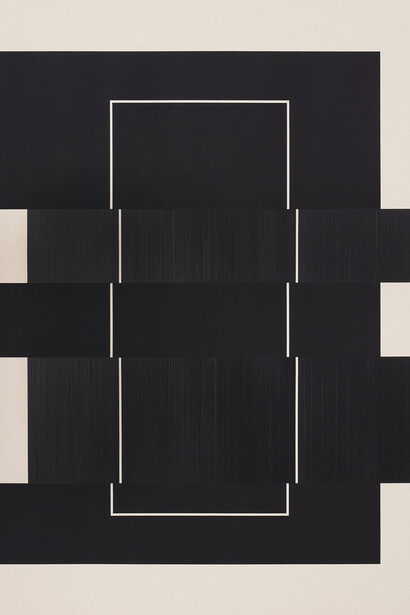
In contrast to that historical abstract-geometric strategy, García Cruz—beginning with the first pieces of his series, undertaken around 2020—proposes that the breaks in the frame be uniform, parallel to the upper or lower edge of the work and almost always occurring toward the center of the composition as a thick horizon line, or bands that seem to have shifted “by accident.”
In his more recent work over the past two years, García Cruz lays even more emphasis on this compositional strategy. This creative gesture governs the work with a very precise regularity, and in this sense the paintings are rigorous in how they manifest these displacements of the frame. One might ask why he did not embrace the same freedom as the Constructivist artists when fracturing the dominant orthogonality, and why, on the contrary, he maintains an almost mechanical (one might say minimalist) rigor in his contribution to the question.
III
I would venture an answer to this question. I believe that the correspondence between García Cruz's work and the modern (and Southern) innovation of “breaking” the frame is based not on any imitation of that modern gesture—which would be rhetorical and banal—but on converting this formal turn into a reference, a “footnote” as it were, from which to develop an original theoretical argument about the ubiquity of the image in our time. In other words, Guillermo García Cruz has transformed a historical formalist strategy into a conceptual argument that is very much of the present.
Unlike the oblique and “broken” frames of the artistic modernism of Buenos Aires, those of García Cruz respond to a different symbolic scenario. They do not seek to erase a tradition, as the avant-garde spirit of artist Gyula Kosice demanded in the Madí Manifesto of 1946, calling for an art divorced from the representation of reality. On the contrary, Guillermo García Cruz’s works are a reflection, the obsidian mirror onto which a theory of the contemporary image is projected. These works do not escape the torrent of images that surrounds us; rather, they are its shadow.
I noted above that this artist’s work is connected to the dominant, invasive media imaginary of our time. To be more precise: these paintings portray two facets of this endless universe of technologically mediated images. The first consists of glitches, those “minor” errors that appears in the technified visual world, which Wikipedia describes as “temporary, graphic, or amusing, allowing the experience to continue.” The other facet of García Cruz’s abstract-geometrical immersion in our visual reality is inspired by the mobile phone, the most universal and ordinary of our interfaces. Working from its rectangular format, the artist proposes a whole series of works that, like a set of mirages, lead us to believe we are looking at a series of immaculate geometric paintings, when what we are actually seeing is the shadow of that other rectangular mirror which, from the palm of our hand, rules over our daily lives and our personal archives of images.
IV
One of the earliest manifestations of glitching can be found in cinema, in scenes meant to simulate a malfunctioning television set. Suddenly the screen breaks into irregular horizontal bands that segment the image (like in García Cruz’s works), contaminated with a kind of “visual noise,” a rain of lines; in a sense, the television image becomes “abstract.” In this type of cinematic gag, the protagonist typically delivers a sharp blow to the set, and the screen snaps back into order. Somehow, the image becomes “real” again.
It is quite true that the birth of abstraction at the dawn of the twentieth century was grounded in the utopia of art’s independence from concrete reality. The painter sought an alternate experience in his work, inspired by the idea of understanding creation as a path to inner consciousness and of seeing the canvas from a spiritual vantage point foreign to reason—what Malevich called “the supremacy of pure sensibility” (whence Russian Suprematism, as is well known). Ever since then, geometric abstraction, concrete art, and geometricism maintained this principle of constructing an alternate imaginary, independent of the perceivable world.
It is precisely this encounter between the tangible art of painting and the virtual, mediated (“abstracted”) presence of glitches that makes García Cruz’s work truly original and daring as an artistic discourse. He manages to see glitches as one of the sites where abstraction has landed in the present. When glitches appear—a “temporary and graphic” error, as Wikipedia would have it—they generate a moment that is “abstracted” from the virtual, obsessive, imaginary universe, dominated by an excess of realism and by our imperious demand for extreme fidelity. We live immersed in a torrent of high-resolution images, in an excess of reality, of virtual hyperrealism, of renders and CGI. When glitches disrupt that fidelity, we are overtaken, suddenly and briefly, by a moment of estrangement—a word that is, let us recall, a synonym of abstraction. Thanks to glitches, in other words, we are abstracted from the sharpness of our high-resolution visual archive.
V
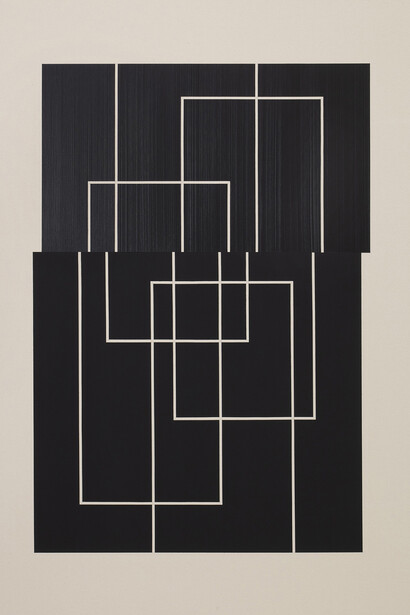
In this series of recent works, Guillermo García Cruz adds another layer to the relationship between abstraction and reality. Rectangular parallelepipeds (or rectangular cuboids, to use the technical term for the geometrical shape of mobile phones) enter into dialogue with one another, collide, and become interwoven. In some paintings their outlines join the “broken” structures described above. In others they are the absolute protagonists of the pieces, and one cannot help but associate them with Hélio Oiticica's neo-concrete “Meta-schemas.”
But once again, García Cruz gives the Latin American artistic tradition another turn of the screw, and what we see are not simply orthogonal silhouettes in black. What we are actually looking at is one of the most universal forms of our time transformed into pure geometric abstraction: these jet black cuboids are the shadows of our ordinary mobile phones elevated to the status of works of art.
Ultimately, this body of work by Guillermo García Cruz is a precise allegory for how abstract art, starting with its original condition as a way to escape the real world (according to Kazimir Malevich), is always the portrait of its time. These consistent, delicate, and precise geometric paintings, which recall the screens of our cellphones when not in use, condense within the dense, absolutely black ground of their forms the infinite album of the enormous visuality of our era.
(Guillermo García Cruz in five movements. By Carlos E. Palacios)