English
 Español
 Français
 Deutsch
 Italiano
 Português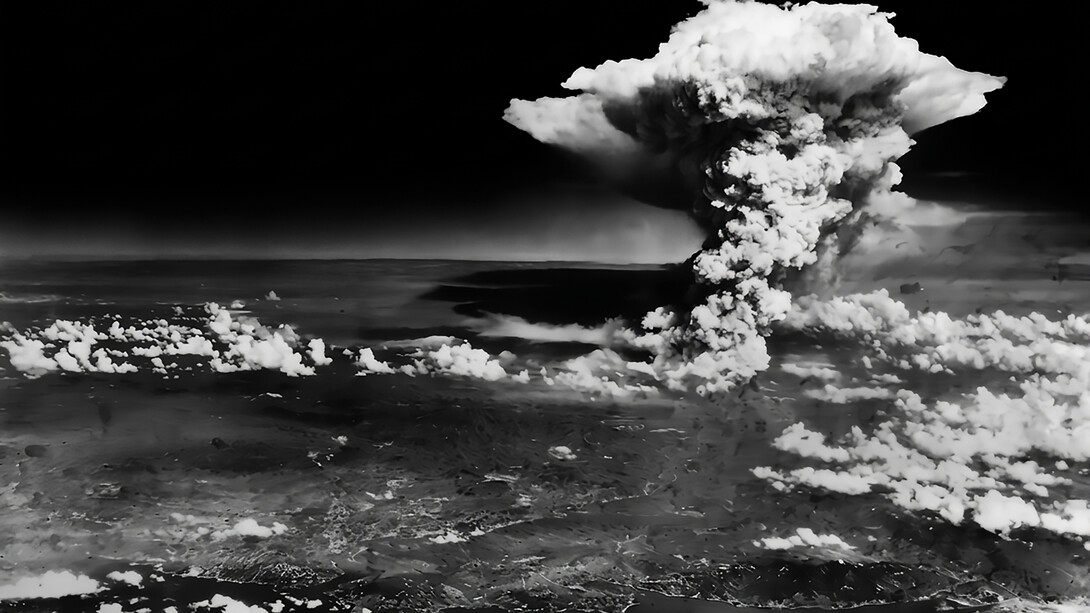
Our earth is being lost. We are treading a world where the flag may not be seen in the dawn’s early light, where march on, march on may not ensure victory, where vowing to thee, my country, may not uplift, and where freedom or death may no longer be a choice. To turn away from ruin, we must remain optimistic and focused.
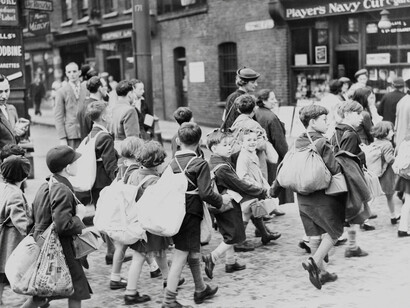
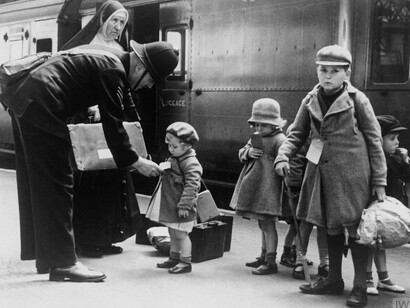
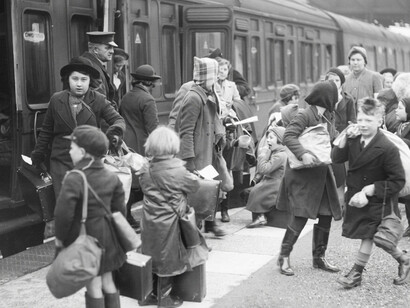
Silently in their eternal ecological ritual, birds fly north, stay awhile, then congregate in large flocks and set out south together. Where home is, I don’t know. I do know that in the south many see the cycle's initiating move as when the birds fly south. Herein rests the circularity of life, its creative and vicious cycles and the quandary implicit in binary communications; he leaves, and I grumble, and she grumbles, and I leave. World War II was in full swing; refugees came north to avoid German bombing. As war came to an end, they went home. One current stalemate is: I will withdraw if he disarms / I will disarm if he withdraws. Meanwhile, Iran contemplates strikes against European targets. Meanwhile, rogue drones go off course and fall like doodlebugs.
In 1945, V.E. Day came: Victory in Europe, Victory over the Enemy. It was summer, school was out, soldiers returned from the front, wood was being collected for a great bonfire, and fireworks were on the market. We played at the bottom of a sloping field on our very own ship, a tree growing out of the soft earth and from a stream of slowly flowing water. Which captain brought it into port that day because we were hungry? I don’t recall. Disembarking and hungry, we headed home. It was August, and I am sure that the war still raging in Asia was far from our minds. Little did I know that V.J. Day was just a week away, and my future teacher would be returning from Burma after having suffered malaria. I was nine when the city of Hiroshima was completely levelled. There was so much to be made sense of then. 80 years on, I have not managed to do so. As the radiation hung around, so did the agony, and it stretched out over the decades.
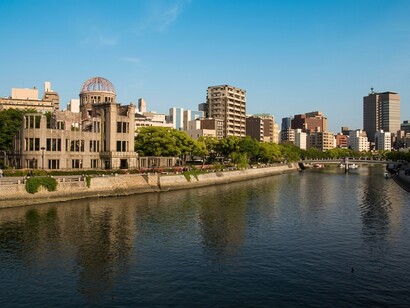
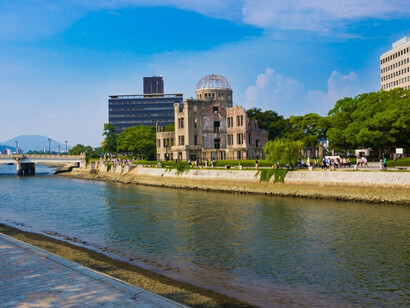
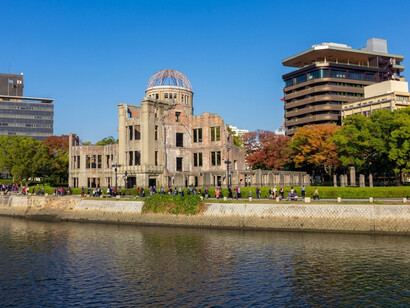
At 8:15 in Hiroshima on August 6th, 1945, 80,000 people melted from intense heat, vaporised in a moment. In just a few seconds, Little Boy’s blast of nuclear light, brighter than a thousand suns, left the city in rubble and drenched in radiation. They had heard the air raid siren, gone to the bomb shelters, and left with the all-clear siren 40 minutes earlier. Little Boy exploded at an altitude calculated for maximum spread of effect and maximum impact. The extreme heat generated created massive updrafts, with dust and debris rising while water vapour in the upper atmosphere condensed, resulting in “black rain”. The radioactive mixture of soot and ash fell back on the destroyed city. Its signature was a massive, terrifying plume rising to shape itself into the mushroom cloud. I first saw the shape of it on the front page of the Daily Herald. What did it mean? One week later, Japan surrendered "unconditionally" to the United States. We celebrated VJ Day, victory over Japan. Each year since, Japan commemorates the victims. Each year since 1948, the Doomsday clock has been set. I recall Bertrand Russell but not Einstein then.
On 6 August 2026, my sister Noreen died, exactly 81 years after the first atomic bomb was dropped on Japan in 1945. Over the preceding several months, we have spent precious minutes on the telephone – five, ten, sixteen, twenty-five minutes at a time – mulling over our wartime childhood, reassembling our bright and blurry memories. We recalled the blackout, the darkness at night, and the rare moments when we could see the night sky, and we reimagined the wind and water drops on our skin on the Moors; we went through the Woodhead Tunnel again by train. We sang snatches of songs (On Ilkly Moor) and hymns (We plough the fields and scatter) and remembered a Northern comedian whose closing line was, “May your God go with you.” We spoke of doodlebugs (German VI Rockets), which she never heard but clearly recalled the air raid shelter and remembered the gas masks and monkey boots waiting in readiness in the doorway. Our early life was etched out between the village of Staincross, designated Wapentake, or small administrative area of Viking influence, and the Doomsday village of Royston in the Norman West Riding and a higher administration in the county of Yorkshire.
The Shire was the highest level of administration and was in York. The Norman West Riding no longer exists. We were raised by a mother who narrowly avoided the ravages of TB and a quiet father who was always there. Dad had few sayings but managed to instil in me a healthy scepticism. Mother had many sayings, which were always educational, one of them being, 'You can’t stop the birds of sadness flying around our heads, but we can surely keep them from nesting in our hair.' Our days were spent at home or in school between coal mines, farmland, fields, woods and the Yorkshire moors. Reminiscing gave us a rare opportunity for recall, which closed the geographical gap between us. It demonstrated that in spite of the difficulties of the war, we could still be happy as children since we were cut off from the burden carried by our seniors.
The events that took place between the two summers of 1939 and 1940 are etched in my here-and-now memory, chiselled on my developing brain as a result of the retelling of events, persistent stories and songs, as well as references made by teachers in church school. Wartime cartoons by Giles, which later became a constant Christmas present, helped out; Munich, Peace in our time, Early morning, September 1st, 1939, WWII commenced with Germany invading Poland. Hours later, England declared war on Germany: the Phoney War and the Siegfried Line, the now legendary evacuation from Dunkirk and the Battle of Britain and, of course, Coventry. On the home front, guarded by the Home Guard, I sensed there was worry about a coming invasion as civil defence plans got underway, starting with blackouts on windows and the collection of used materials for the war effort, and, of course, food rationing and home gardening.
"Hang out your washing on the Siegfried Line, hang out your washing, mother dear" was an often-heard song, and voices well known were heard—the King’s, Churchill’s, and our Gracie, Gracie Fields. As I write now, I can’t help but recall the summer of 1945 and the first atomic bomb. I was 9 and too young to understand much but not to sense that an unbelievable event had occurred. Countless unanswered whys still disturb, and powerful declarations have not been effective. In paying tribute to my sister, I am looking back to Hiroshima through a glass darkly and know in some mysterious way it helped shape my life. In 1945 I was too young to fully comprehend or absorb the meaning of the blast of nuclear light, brighter than a thousand suns, or the information coming out of Japan. As my understanding of the atomic bomb and the enormity of its destructiveness grew, I became more focused, and so did the comforting idea that if its horrors were well-remembered, they would act as a fail-safe to the future use of atomic weaponry.
Having read Children of the Dead End relating to the Irish potato famine, I read Children of the Ashes relating to death from the sky and nuclear radiation. As a teenager, I marched with my mother protesting the production of nuclear technology. Today, 8 decades on, the destructive power readily available is far, far greater than when Hiroshima and Nagasaki were destroyed. 80 years on, as I see my comforting idea fading and treaties trashed, I try to ramp up recall of the effects of the heat of radioactive fallout.
I write now as the world trembles, and it is incumbent on all practical, rational people of goodwill and reason to act as they live to reduce the multidimensional tremor. We all should be concerned about worsening living conditions and child mental health. The power of people is necessary in the preservation of world peace and philosophical order. We have to neutralise and cancel all enemies of humanity and the enemies of all living things on Earth, whether glaringly obvious or well hidden! We have no other choice! Indifference spells disaster! The future fate of environmental and biological continuity is at stake. Humanity is now held in the clutches of social dementia and wrapped in the shadow of Armageddon. Social dementia is a growing existential risk precipitating mental disease that is becoming endemic. It can precipitate the worst relationship between nuclear weapons and AI. As social dementia gains greater footing and altruism retreats, the pressure can cause more people to inflict pain on others. Our world is in need of a significant boost of confidence, a new awakening. It has to be multidimensional.
Peace in all policies, appropriate development, population health, and human rights have to go hand in hand to help restore political sanity to the world and to rebuild confidence in the UN. The United Nations needs transformation and reinforcement; we have little else going for us, and no one can say what will happen next, what will prevail, heads or tails.
Neither Elon Musk nor Geoffrey Hinton, the “godfather of AI”, is better at predicting tomorrow than my mother was at reading tea leaves in wartime (WWII) or my reading of Greek coffee grounds today. Since Hiroshima, the risk of nuclear war has risen greatly, while the overall reaction to nuclear weapons is a whimper. There was no easy way then; there is no easy way now. For humanity to get out of the mess that it has put itself into, we must find ways to brighten its creative bright side, refashion its socially demented mindset, and redesign education so as to reflect the golden mean.
Were you there when the haunting Negro spiritual crucified our Lord? Being there at ground zero at such a moment can never be forgotten. Such world-shaking events are remembered in different ways, and for some of them we can recall exactly where we were when the news reached us. Others somehow bypass all of our senses. Radio breaking news told me of an attempted assassination of the Pope while on the inbound Eisenhower Motorway in Chicago; fortunately, I had just reduced speed. He survived! I was in Ambelokipi (Garden of the Grapes) with my daughters when the Greek Junta fell, and the lid of the sky above Athens seemed to lift. Cypress fell! Chicago exploded with MLK’s assassination in Memphis; I was giving a lecture on brain physiology on the South Side. In 1963 I was in Athens on Spirou Mercouri Street when Kennedy was shot. All these happenings occurred around midday to early afternoon on my calendar.
I know exactly where I was when I learned of the atom bomb drop. I was in my childhood village, a village recorded in the Doomsday Book on the Crescent near the Pond. It registered as a horrendous event for which I had to race home and tell the family about. I did to find a mushroom standing in for a tablecloth. The call by my mother for food was much more important than my news, and the newspaper was removed from the table. As I grew and as a result of education, I learned more of the atom and the molecule, of E=mcsquared, of radioactive decay and the half-life, chain reactions, neutron flux and radiation. Later in America and in Chicago I visited Fermi’s workplace and became an honorary member of the Chicago Physics Club. As I grew, I read about decolonisation, development, and denuclearisation, and I’ve often thought that Dag Hammarskjöld, who once said we die on the day when our lives cease to be illuminated by the steady radiance, renewed daily out of wonder, might have been killed.
I was at the ship when chance, coupled with deliberate decisiveness, placed her close to the epicentre of the atomic bomb blast. She was an iconic actress of the Japanese theatre adored by the Japanese public, an actress of ineffable beauty who was drenched in radiation in Hiroshima. As she came out of darkness, slowly regaining her senses after the atomic force, accompanied by a flash brighter than a thousand suns, she made it to the river. Little Boy, released at altitude from Enola Gay, had given her her final epic script, which was to inform the Emperor of the horror in the city.
In its eerie stage setting, black rain dripped from a dark sky, and the backdrop consisted of black, white, and grey nuclear shadows. She entered the river, floated down it for some time, and was then pulled out by soldiers. Two weeks later, in Tokyo, her skin was gone, corroded; she had no hair; nothing remained of her youth and beauty. The happiness she gave to her doting audiences was over. Fate presented her with an ultimate role in a dreadful drama, and having reached the Emperor, her mission was complete, and her life was over! She never knew of Big Man and Nagasaki. There was no curtain call and no applause as the curtain came down.
What the world yearns for now is some peaceful force, a myth of all myths, a symbolic compass that will return humanity to reason and men to their senses. A formal reinstatement of a Universal Declaration on the Illegality of Wars on Earth would be a good start. An immediate ceasefire in all conflict zones, protection of civilians everywhere, and the release of hostages and unjustly imprisoned individuals held by states would be a great improvement. We should not let this paradise on earth be taken away.
The only other thing that I can propose is that a dramatic and symbolic negotiation of world peace be conducted in the sacred place of Delphi, with an agreed-upon Universal Peace Treaty to be signed in the Old Hellenic Parliament of modern Greece. For should the light of the world be extinguished, turning it back on again may prove impossible. How else will that which cannot be, nevertheless, become?
PS: On the 81st anniversary of WWII, a dangerous legacy lingers together with important messages still to be heard and acted upon: forgive but never forget, and an appeal of human beings to human beings: Remember your humanity, and forget the rest. I will never forget the onstage difficulties of a blindfolded Lawrence Olivier traversing space without sight.
References
Between war and wisdom: How philosophy, public health, and civic responsibility can help humanity confront its greatest existential threats.
Memories of Yorkshire: a journey through time. Reflecting on life in the West Riding and beyond.
The spinning coin: nuclear memory and social dementia: Eighty years after Hiroshima and Nagasaki, a call for reason, empathy, and global renewal in an age shadowed by war, climate crisis, and moral drift.
Once upon a time in Gaza: A reflection on public health, cultural resilience, and the enduring struggle for humanity amid devastation.
We are all Ukrainians: Safe passage for Ukrainians is safe passage for humanity.