English
 Español
 Français
 Deutsch
 Italiano
 Português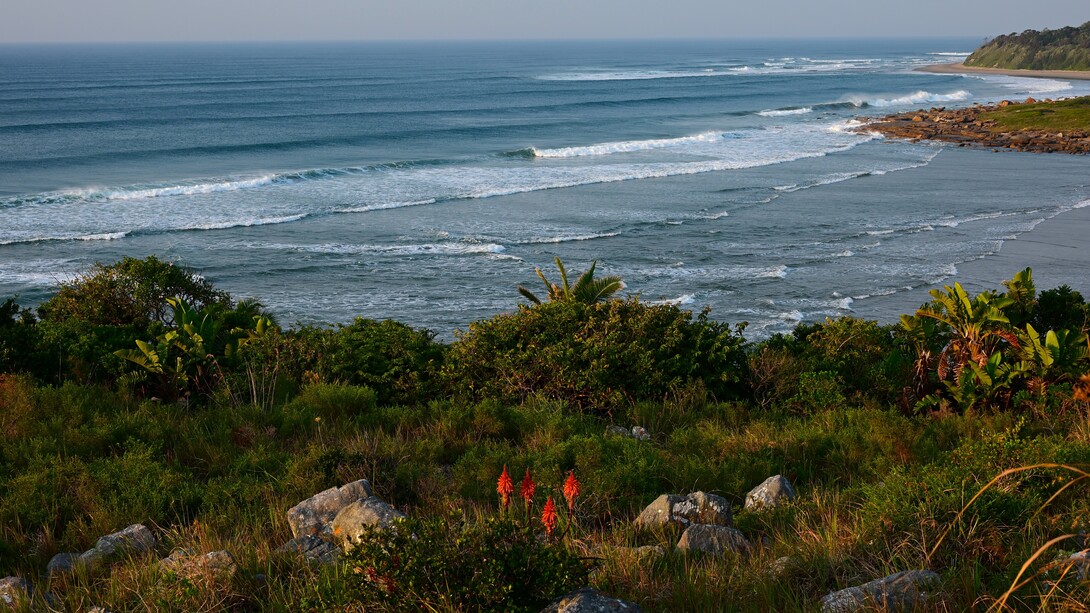
“We have everything here. We have land, we have food, we have livelihoods, we have our ancestors.” Sitting against the backdrop of a stunning coastal landscape in South Africa’s Eastern Cape province, Khumbulani Hlongwe described to me the different crops he grows, what he and his family consume locally and what he sells, and how he supplements his income as a part-time tourist guide1. Khumbulani is a young member of the Amadiba people of Mpondoland, and his story suggests the powerful possibility of bucking the global trend of youth leaving rural areas to flock into cities in search of jobs, education, and the undoubted attraction of urban life.
In June this year I visited a few villages of the Amadiba people, talking to people of various ages and genders to gain some understanding of their struggle against mining and other forms of ‘development’ that the government wants to impose. My specific focus was their governance and decision-making processes, especially what enabled a significant participation of ‘ordinary’ people, and especially of women, in such processes. I had heard of the Amadiba struggle some years back and visited them briefly on a couple of earlier occasions, meeting with a couple of the movement leaders. This time around, I wanted to hear a more diverse set of people, including youth, women and elders.
Challenging ‘development’
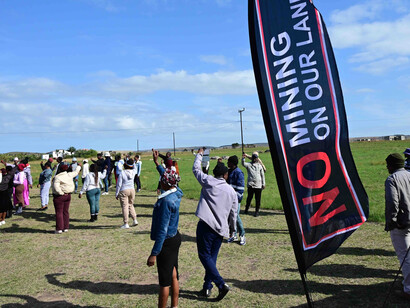
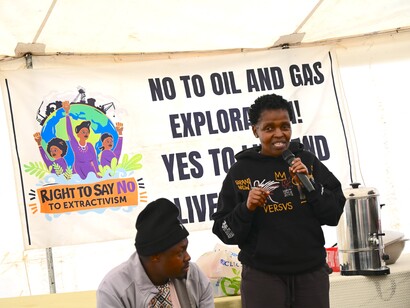
Over the last couple of decades, the Amadiba people have had to contend with a series of proposals for ‘development’ brought by the South African government: mining of the beach sand that contains titanium by an Australian company Mineral Commodities Limited, oil and gas exploration in the ocean adjoining the territory by Shell corporation, an expressway whose alignment will go through biodiversity-rich commons and valuable farmland, and a smart city. The Amadiba Crisis Committee (ACC), formed in 2007, has spearheaded the resistance, thus far successfully. This has included on-ground mobilization and protests, political advocacy, legal action, counter-mapping to show what will be lost due to these projects, and generation of other data and information for use in the advocacy.
A number of other groups have joined in, including Sustaining the Wild Coast, formed by local community members; Oceans Not Oil; the Alternative Information and Development Centre; and researchers and lawyers on a pro bono basis. The community has already won a crucial victory in the Constitutional Court in 2018, which ruled that it had the right to say no to the proposed mining; the oil & gas proposal was also stayed but, after a renewed challenge by Shell, is awaiting judgement of the Constitutional Court.
The articulation of the community against these projects has been a powerful combination of the loss of livelihoods (farming, fisheries), damage to the environment (pointing to this being one of South Africa’s biodiversity and endemism hotspots), violation of cultural rights (desecration of burial and sacred sites, and of the spaces on land and oceans where their ancestors reside), and disrespecting nature. They have also rejected the government’s classification of the community as ‘poor’ and in need of ‘development’; they say they have land and each other, they are independent, and are by no means poor. Importantly, the land is held in commons by the community as a whole, though families are assigned individual plots which they can pass down through generations. Their agriculture is diverse and productive, and they also derive nutrition, livelihoods and other needs from the ocean.
Youth articulations
I spoke to several young people in 4 settlements, wanting especially to know about why they had stayed back in, or come back to, the territory in contrast to the general trend of migrating to cities. The responses I got, in addition to that of Khumbulani quoted above, were striking:
Lungelo Mtwa Sukude has come back to his village, Baleni, after studies, rather than settling in the city. He is a tourist guide, runs an internet cafe in his village, writes, and makes films (currently one on food in his area). He started the Amadiba Community Network to enable access to 'remote' villages. He talks about wanting to do all this not only out of interest, but also to give back to his community, to make products that are meaningful to his people's lives, to change the narrative away from mainstream dominant ones to what is emerging from his own community – 'to tell our stories'.2
Cromwell Monwabisi Sonjica, of Mtentu village, is an Executive Committee member of the Amadiba Crisis Committee (ACC), and helps sustain or create livelihood options for youth such as participatory video and film making, bee farming, agroproduce. He asserts: “we are independent, we live off our own land and our oceans, we have never gone to bed hungry.”3
Bhekeni Danca of Mpindweni village and a member of the area’s Traditional Council says they get all their basic needs from the land and the ocean. “We heal ourselves with the water of the ocean.” If the projects being proposed by the government are allowed, they will destroy this way of life.4
Siyabonga Ndovela of Mtentu village speaks eloquently about the importance of the commons, the role of youth, alternatives to destructive 'development', and more. As an Executive Committee member of the Amadiba Crisis Committee, he is active in the mobilisation of the community. He is also a researcher and a tourist guide, and tells me, with emotion in his voice: “My grandfather was part of the Mpondoland revolt (against the apartheid government’s attempt to alienate us from our land) … he told me to ensure that when he dies, no company comes and digs up his bones …. I want to stay on here to make sure the land is protected for our future generations, just as our forefathers protected it for us.”5
Mvuyisi Shude, a young farmer of Mtolani village, says he went to the city but found that everything had to be paid for; there was little freedom. Back home, he grows a variety of crops, gets produce from the ocean, and is content. As part of the anti-mining movement, is he afraid? “No, there is nothing to be scared of; our ancestors are buried here, we have a spiritual connection with the land, and I am not afraid of dying to protect what is ours.” He knows how people were evicted for the Wild Coast Sun hotel (near Sigdi), were promised rehabilitation but is now crowded into a small area; he does not want such a future.
In my visit to the area in late 2024, I had interviewed Lonwabo Dlamini, a young farmer-cum-tour guide. He also wants to start a home-stay (these are becoming more common across the territory) and is confident that with these kinds of options, young people do not need to leave. When he told me that the mining company’s promises of building a hospital and a university were just empty promises, I could see that political education of the youth by ACC and others has been quite effective. “It’s not that we don’t want hospitals and universities, but we don’t want these if they are coming with mining that will destroy us.”6
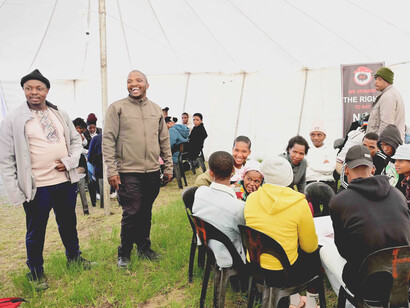
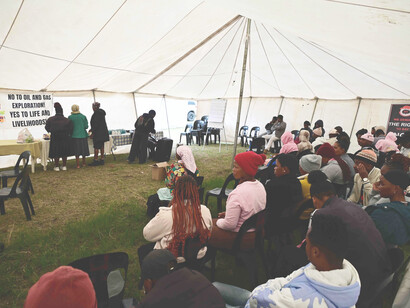
The movement against destructive development has also inspired youth to stay on or come back, for they find pride in such a struggle or see that they do indeed have a viable future if the territory is secure. The ACC organizes periodic political education workshops. During my visit, I participated in one, held on the 50th anniversary of the Soweto uprising, when 20,000 school students agitated against the apartheid regime’s attempt to impose Afrikaans (of Dutch origin) in educational institutions. 176 youths were killed on the day. The workshop, held in Sigidi village, asked participants what they knew of this uprising and its importance for today’s youth, discussed the challenges of the proposed development projects, and went into the history and dynamics of community mobilization against them.
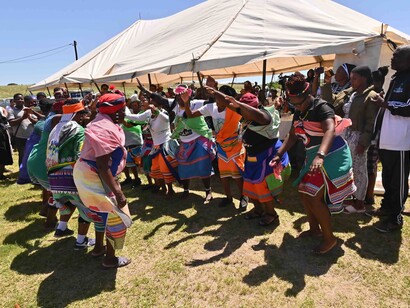
A role- play of rural vs. urban brought out some interesting perspectives on the expectations and aspirations of the participants. I was particularly impressed by the level of discussion, led by ACC’s Nonhle Mbuthuma7, a recipient of the Goldman Award, and others such as Siyabonga and Cromwell. And as importantly, how the entire group would break into a song-dance routine, with mostly songs of resistance and celebration, at every small opportunity!
This is not to unnecessarily romanticize the situation. Undoubtedly many young people have found it more attractive or necessary to move out, and not everyone would want to be in what could be physically more demanding occupations. Certain facilities that youth would want or expect, such as communications and road connectivity, are still poor in some part of the territory. But these are improving, and youth are themselves spurring on such changes, such as Lungelo Mtwa’s internet café. It also helps that several of them, such as Sinegugu Zukulu (co-recipient of the Goldman Award with Mbthuma), have researched and become adept at describing the enormous geological, cultural, ecological and historic value of the territory, and are able to transmit this knowledge to youth.8
Continuing challenges
It is also not as if there is full unity in the Amadiba community regarding the development projects. There are those who would like to welcome them, perhaps hoping that this will create much-needed jobs or bring in financial wealth. One of its Chiefs, Lunga Baleni, even agreed to let the Australian company undertake mining, and it took strong community opposition to block this.
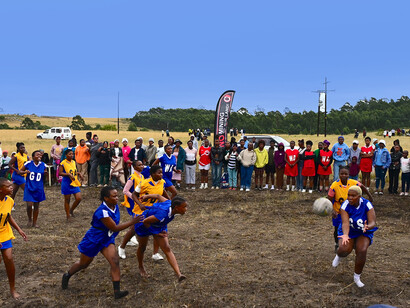
While such actions do lead to internal tension, the Amadiba Crisis Committee has been making attempts to create spaces for dialogue. On one of the days I was there, a football and netball tournament was organized in Mdatya, home of ACC’s former chairperson Bazooka Radebe, who was assassinated in 20169. The event had teams from across the territory, and I was told that even those who are critical of the resistance movement were invited. Sports can be a powerful tool for bonding (though also the reverse, depending on the spirit with which the event is carried out!), and reportedly events like this, or food festivals, have helped to spread greater information and awareness about the implications of the development projects, and open up spaces for internal dialogue.
On top of the mining and oil & gas proposals, one that the community is currently grappling with is the proposed routing of the N2 highway through the Amadiba territory. People here are not opposed to the road per se, but to its alignment that will damage considerably valuable agricultural and biodiversity-rich lands. With professional help, the community has even suggested a different alignment, showing how it is less damaging as also less expensive. But the proponents of the current alignment are adamant; the ACC and others feel that this is possibly because of the greater commercial opportunities it will open up, including a renewed push for mining.
The government and corporations are continuing to try to convince community members that these projects will create significant new jobs. These arguments are not easy for people, especially youth who are seeking livelihoods, to easily dismiss. It will take all of the local movement’s powers of persuasion, strong support from collaborating organisations, the continued creation of alternative livelihood opportunities, and nurturing the foundational cosmology of ‘the land is us, we are the land’, to sustain what has so far been a globally inspiring example of resistance and reconstruction.
References
1 Interview of Khumbulani Hlongwe, 17 June 2026.
2 Interview of Longelo Mtwa, 16 June 2026.
3 Interview of Cromwell Monwabisi Sonjica, 15 June 2026.
4 Interview of Neliswa Mdukisa and Bhekeni Danca, 17 June 2026.
5 Interview of Siyabonga Ndovela, 16 June 2026.
6 Interview of Lomwabo Dlamini, 5 October 2024.
7 Interview of Nonhle Mbuthuma, 5 October 2024.
8 Interview of Sinegugu Zukulu, 17 June 2026.
9 Amadiba Crisis Committee. (2026, June 16). Yesterday on Youth Day…