English
 Español
 Français
 Deutsch
 Italiano
 Português
In every region, the voice of water is heard telling of endless disaster.
(Hendrick Marsman)
A disaster, for which we are not prepared, which we never imagined, suddenly descends to sweep us away.
(Cavafy)
While I speak of peace, covert enmity under the smile of safety wounds the world.
(Henry IV)
Be prepared to give an answer to anyone who asks you to give the reason for the hope that you have.
(Peter 3:15)
The Athens Accord of Discontent is a philosophical appeal to the international community to confront the growing existential threats facing humanity, including nuclear proliferation, climate change, and the challenges posed by artificial intelligence. Issued by the World Philosophical Forum in anticipation of its 17th Dialectical Symposium in Athens, the communiqué argues that these interconnected crises reflect not only political and institutional failures but also a deeper erosion of rational thought, civic responsibility, and ethical judgment, conceptualized as social dementia. Drawing on the intellectual heritage of ancient Greek philosophy, it advocates the restoration of philosophical reasoning, humanistic education, and global citizenship as essential foundations for peace, human dignity, and sustainable development.
Central to this vision is a proposal for an international peace initiative rooted in the symbolic and philosophical significance of Greece, culminating in a Universal Peace Treaty. The communiqué ultimately challenges the international community to move beyond declarations of concern toward meaningful collective action. By placing philosophy, civic education, and human responsibility at the center of its appeal, it calls for a renewed relationship between rational thought and political decision-making. Its central proposition is that philosophy must not remain an abstract intellectual pursuit but become an active force in confronting the existential challenges facing humanity.
Distinguished members of world society, the United Nations and its sister organizations, the Council of Europe, the legitimate Greek authorities, and the European Parliament: we address you with dismay at your less-than-golden silence in response to our appeals. We remind you of your moral obligation to preserve and improve our one and only world for our offspring and our children's children, who will inherit it. Incredibly, serious concerns for humanity and its homeland, the Earth, from food and water shortages to existential problems, are not taken seriously.
When we regard peaceful development as dependent on weapons of mass destruction that supposedly will never be deployed, when we ignore or deny global warming, or when we blame humanity's potential destruction on its own genius without making it possible for the same genius to make an equal effort to pull it back from the abyss, it seems we face an insurmountable obstacle.
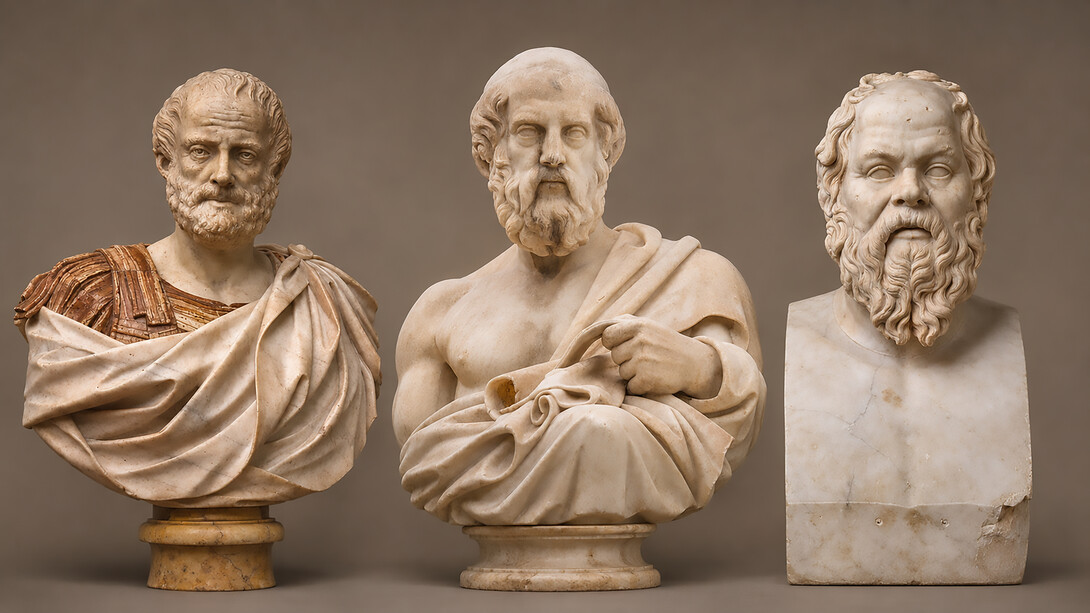
From Greece, we seek to unite the world's philosophical aspirations for peace and harmony. We firmly believe that indifference to this Athens Accord spells disaster. The World Philosophical Forum defends humanity against social dementia and the spread of nonsense, while promoting environmental protection. Social dementia implies a regression of decision-making and rational thinking from the higher functions of the cerebral cortex to a lower level, undermining the achievements of evolution and civilization. Hippocrates wanted us to know that from the brain, and the brain alone, come our pleasures, joys, laughter, and jokes, as well as our sorrows, troubles, grief, and tears. Our minds flourish in freedom and peace, through experience shaped by civic education.
As we approach the World Philosophical Forum's 17th Dialectical Symposium, we remain committed to preserving world peace, applying philosophical order, and neutralizing all enemies of humanity and living things on Earth, whether obvious or well hidden. For this effort, we seek the support of world leaders, the international community, and the legitimate Greek authorities. Few boats row as energetically toward peaceful shores as the World Philosophical Forum.
The World Philosophical Forum has repeatedly reached out to the White House and former U.S. presidents, the Kremlin, members of the European Parliament, the Greek authorities, the United Nations, and the World Health Assembly. Its proposals seek to avert global catastrophe through philosophical reconstruction and a dialectical reboot. As one American president said, the last thing we need is Neanderthal thinking, while an earlier president, who helped draft the American Constitution, wondered whether his raised voice would be heard in the course of human events. Today, the reduction of nuclear arsenals is becoming increasingly unlikely, averting climate catastrophe is becoming increasingly difficult, and artificial intelligence is creating a paradoxical world stage. Brainpower will take center stage, faced with an uncertain choice between human-directed superintelligence and an intensifying, algorithmically driven social dementia.
Throughout history, populations and nations have faced threats against which they could not defend themselves. Yet human ingenuity enabled them to survive, sometimes with enormous losses and lasting trauma. In such chaos, responsible people must make difficult choices, as they always have. During the Middle Ages, Europe's economy collapsed as its population fell precipitously because of the plague, or Black Death. Despite the devastation, European societies rebuilt and developed in new ways. Our own age is no exception.
The World Philosophical Forum sees today's danger as the outcome of two dark and overwhelming processes: continuing biological annihilation, as millions of years of evolution unravel and the physiological complexity necessary to sustain human consciousness disintegrates; and the terrifying emergence of social dementia in societies across the Earth. We envision philosophy guiding the systems and practices that prevent self-destruction and social dementia. A good beginning would be an end to all military conflicts on Earth through a Universal Delphic Declaration on the Illegality of Wars on Earth and Beyond, alongside universal, unified civic, humanistic, and philosophical education. This could be the starting point for our proposed high-level meeting in Greece and the restoration of our shared lifeline. An immediate and sincere ceasefire in every conflict zone, the protection of civilians everywhere, and the release of hostages and those unjustly imprisoned by states would be a great knock-on precursor.
Support for the Forum from the Greek and European authorities could benefit Greece, protect diversity, and help overcome today's dysfunctional mindset. Yet without a decisive global political turnaround, without eliminating or at least curbing threats to humanity's survival, and without the work of organizations such as our Forum, nothing is possible. Democracy can be mortally wounded and destroyed. Once again, from Athens and on behalf of the World Philosophical Forum, we affirm our belief in the sanctity of all life and the richness of diversity on our one and only planet Earth, inherited from our forebears. Today the Forum is a force for 'positive peace,' a term used by the Global Peace Index to describe the attitudes, institutions, and structures that create and sustain peaceful societies. Its reluctantly supported halls represent a truly open society, with gates open to all.
From the historic ground of Greece, we raise our voice about the state of our traumatized world. We call on people of goodwill to strengthen the signal of our message against noise (S/N) and misinformation that threaten to drown it out. This connection will reinforce our place to stand and help us fashion the fulcrum and lever with which we may just nudge the world. In doing so, we reject narrow approaches, restrictive academic boundaries, and discrimination on the basis of ethnicity, religion, gender, age, or social group. This nudge is also intended to moderate and counter frightening scenarios of the future that rely on sensationalism or flimsy or nonexistent scientific evidence. We urgently need a single compelling rallying cry, the 'Cry for Peace,' together with a shared universal vision of a culture of peace and a strategy for appropriate development and prosperity, founded on equality, human rights, and philosophy.
This text prepares for the World Philosophical Forum's 17th Dialectical Symposium. Welcome home, Dialectical Symposium! It will be held at the Cultural Center of the Municipality of Piraeus, in cooperation with the Association for Culture and Development, and we have the special pleasure and honor of inviting you to this important gathering for philosophical dialogue. The Forum will take place on 20–22 November 2026, under the banner of practical philosophy, the problematic value system of our time, and ways to cultivate healthy personalities. It follows our Extraordinary Supranational Convention in Singapore (15 July 2026), which launched an appeal to world leaders to end all military conflicts on Earth.
We argue here that Homo sapiens faces an unprecedented, clear, and immediate threat of annihilation, moving rapidly toward the abyss of extinction and a possible Armageddon. We reiterate our shared moral responsibility to leave a better world to future generations. People of goodwill are united by their common humanity and determination to build a better world. We believe that peaceful development, equal opportunity throughout life, the fullest realization of human potential, and the social well-being of all are prerequisites for a better future.
We recognize the inherent dignity and equal and inalienable rights of all members of the human family as the only reasonable foundation of freedom, justice, and peace. We share the conviction that security cannot be achieved by prolonging the arms race, that cultures deserve celebration, and that life and hope must be offered to future generations. Within the wisdom of philosophy, we emphasize global citizenship and the golden mean, illuminating equal civic rights as a gateway to world peace. We hope that the Athens Accord will continue and have strong, far-reaching effects.
Noteworthy initiatives are already seeking positive change for humanity and its institutions. The efforts of Ban Ki-moon, former secretary-general of the United Nations, and Irina Bokova, former director-general of UNESCO, whom I have nominated for the International Gusi Peace Prize, deserve recognition for their contributions to peace, philosophy, and global citizenship worldwide. Again, we repeat: 'Education first!' and 'There is no UNESCO without philosophy!' Important efforts are also being made by the United Nations, the World Academy of Art and Science (WAAS), and the Bulletin of the Atomic Scientists, which warns that humanity faces two simultaneous existential threats: the stockpiling of nuclear weapons and climate change, placing its future in extraordinary danger.
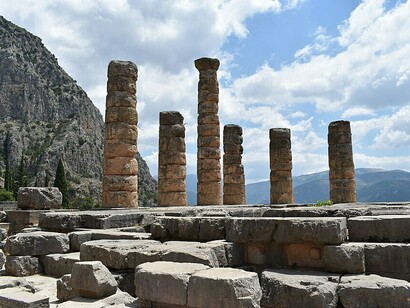
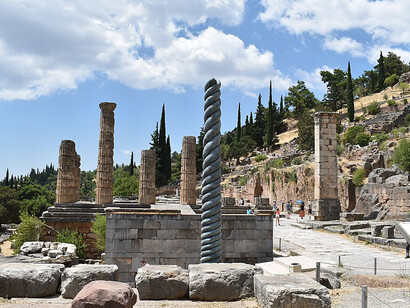
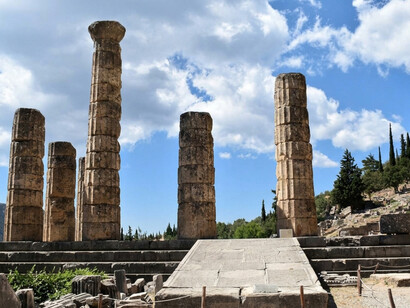
Once again, we propose a dramatic, meaningful, and symbolic high-level brainstorming negotiation for world peace at the sacred site of Delphi, along the Sacred Way, or in Mystras, followed by the signing of an agreed, altruistic, compassionate, and philosophically grounded Universal Peace Treaty in the Old Hellenic Parliament of modern Greece. Our goal remains the responsibility of global citizenship: to preserve our humanity and ensure meaningful lives for future generations on a less hostile Earth. Today's children are disenchanted with the state of the world and clearly see that the quality of their tomorrow may be far lower than their parents' already difficult yesterday.
They deserve to be winners, not children of a dead end. My personal suggestion to Greece is not to wait until humanity reaches the end of Hellenic reason before taking responsibility for investing in the wisdom of Greek philosophy. For as long as we endure, philosophy is humanity's route back to reason and a means of translating a culture of peace into concrete action. The advice of Odysseas Elytis remains timeless: when evil strikes, when your mind is clouded, when you are at a dead end or midway along the road and do not know which way to turn, draw knowledge, supplies, and water from the sources of ancient Greek letters.
Our message is timely: the spinning coin is in humanity's hands, heads or tails, a fading civilization on one side and humanity's boundless talent on the other. Fortunately, it has not yet landed. As thinking beings, we must wonder which system will collapse next. We must not leave it to chance whether the coin comes up heads or tails, one or zero. The brain is the center of imagination, thought, and creativity; without it, there would be no religion, mythology, literature, science, or philosophy. It is where reality is shaped through engagement with the environment and can become more collective. The value of science lies in its philosophical power. Pessimism is permissible, but complacency is not, while despair is dangerous.
PS: I now hold up my stone, born on Ariadne’s beach and picked up by my wife 64 years ago. It entered into the song of a true troubadour, Kostas Hadzis, who:
…Wondered why I gently took it from his hands.
Held it with love and kissed it with respect. Sir, I said, there is no stone on earth not irrigated by blood.
Lots spilt here on planet Earth.
But the Earth still lives and still breathes. Our Earth still lives.
Recite to yourselves, with your family: our Earth still lives, our Earth still lives. Our Earth still lives!