English
 Español
 Français
 Deutsch
 Italiano
 Português
The digital revolution goes much beyond the “industry 4.0” simplification, as if it were just a step up in industrial capitalism. The transformation is structural, and the measures urgent, as the chaotic mismatch between 21st century high-tech and the century old institutions deepens.
What stands in the way is not technical impossibility but political choice and the hard but crucial work of building a coalition behind it.
(The Global Justice Report, May 2026)
Reading about human history is inspiring, in that we get amazed at how humanity manages to do beautiful things, conquer space, invent so many gods, and even be kind to each other, while continuously destroying, killing, and torturing, whatever the means, to be “the winner.” Winner of what? I love a popular song in the Brazilian Northeast, “why so much greed and running about, if no one is here to stay?”1 And of course, the much more famous “…a poor player that struts and frets his hour upon the stage, and then is heard no more.” We already knew all about it.
Can’t we rather concentrate on making these roughly 33 thousand days we have as our lifetime capital pleasant? I mean generally pleasant, not hyper-pleasant for a few heroic winners, when being a winner means we beat the losers and get into further conflicts and end up making a mess for everyone. There is no avoiding that we must update our chimpanzee-side DNA. Starting my day with the daily news of how many were killed in Gaza yesterday is numbing. News? Homo sapiens?
We apparently need some kind of reality shock. Forgive me for repeating the argument, but what we presently produce in the world, according to IMF figures, has reached $219 trillion, global GDP in purchasing power parity dollars, which is equivalent to $9,000 a month per a four-member family. Thanks to so much technology, what we presently produce is more than enough “to eradicate the roots of injustice and conflict and create opportunities for a more dignified life for all.”, as we read in Pope Leo XIV's encyclical Magnifica Humanitas2. This encyclic, by the way, is a powerful call to bring our economics, AI, and other achievements down to what we really need: “the common good: building a world in which everyone can flourish.”(13)
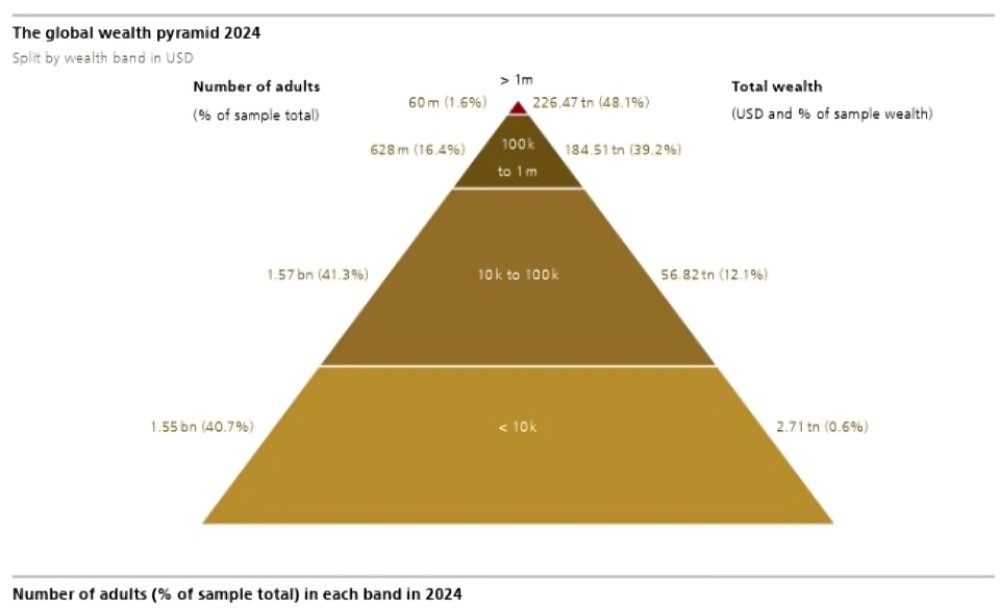
UBS – Global Wealth report 2025 – p.22.
In this area, I like to quote UBS (Union des Banques Suisses), they know everything about fortunes, they manage them. At the very top of the pyramid, we see that 60 million adults, 1.6% of the total, have accumulated a wealth of $226 trillion, 48% of overall wealth. At the bottom, 1.55 billion adults, 40.7% of the total, have only $2.7 trillion. This is the level of inequality we reached, and it is deepening. A 1.2% tax on the richest could double the wealth of the poorest 40.7%. Paying 1.2% at the top would make no difference for the fortunate, but doubling wealth at the bottom would make a huge difference, drastically reducing suffering in the world.
The fact is that the deeper down the money goes, the more it is useful, while at the top, more millions or billions just generate more financial hubris and more power. The more they have, the more they “invest”, meaning more financial profits, generating what is called the “snow-ball effect”. Three-quarters of humanity at the bottom do not “invest”, they do not have the problem of what to do with spare money at the end of the month.
Actually, they are often in debt, paying interest to the top. It is a self-expanding drama. And the political power makes it easy to make everything legal. Tax havens and the like. We are caught in a self-propelling drama. Food insecurity at the bottom of the social pyramid, for example, we have 150 million stunted children; over 5 million under-five kids die every year from ridiculous and preventable causes.
It is not only that money at the bottom is more useful, improving quality of life, it is also more productive. While at the top the fortunes lead to more financial profits, at the bottom it goes into purchasing useful goods and services, thus stimulating demand, which in turn accelerates production and jobs. When China oriented the economy for overall quality of life, taking 800 million out of poverty, it did not reduce the rate of economic growth, on the contrary, it stimulated it in what we called broad-based development.
The American economy has been reoriented to serve the elite in the las decades, generating deepening inequality and the corresponding political chaos. They now resort to tariffs and invasions, draining other countries. But the key argument here is that money at the bottom of the pyramid is not only more necessary but also more productive. The bottom of the pyramid here is the large majority of the world population.
So the key issue, in fact, is reorienting the huge resources that flow up to the very rich and bringing them down to where they are useful. The key measures, of course, and we have seen them work, lay in reorienting the tax system. If you tax the financial speculation profits, you not only can reorient the resources to health, education, and other useful services, but you can lead the billionaires to seek productive investment. This is the key, making production a more profitable decision and making financial speculation more costly.
And we must get to some kind of global tax system, since with immaterial money flows and so many tax havens the whole system simply escapes economic regulation. Take the BEPS (Base Erosion and Profit Shifting) framework, the Zucman 2% tax on fortunes over $150 million, or the ATTAC tax on global financial flows, very low but obligatory, to at least make the flows transparent, you name it. The technical details have all been worked out, but the global power corporate power blocks all progress. Oxfam brings us detailed information3. A global economy, high-frequency trading with algorithms, and no global tax system or regulation deepen the mess we are facing. More tariffs, anyone?
An important initiative by the Global Justice Report, linked to overall studies of the WID (World Inequality Database), recently presented a structural reorientation of the use of financial resources: “The global wealth and income taxes come in addition to national tax systems and target only the very top of the world distribution, around 1% of the world's population.4”
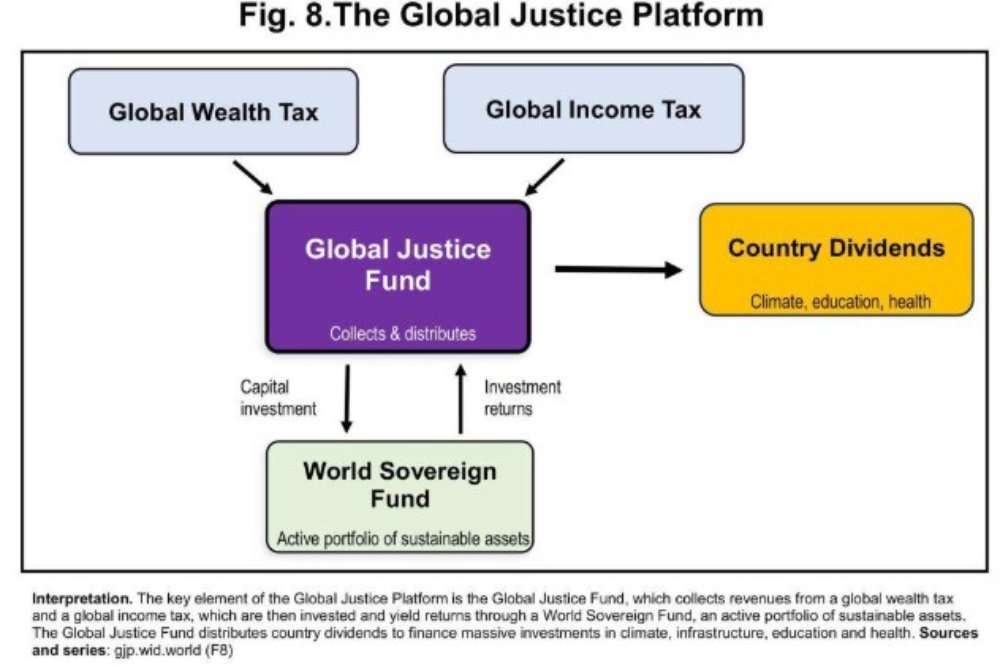
Presenting a Global Justice Project in itself goes into the heart of our challenges. Making the financial system useful and funding what we need instead of draining productive initiatives is a key challenge. Another key issue is control over communication and information flows. The central factor of production nowadays is intangible, science and technology, even money, presently just information on computers. We created the knowledge expansion machine, and with IA the transformation has radically accelerated. In the industrial capitalism structure, we sought workers’ appropriation of the machines, but control has been taken over from the top by the financial, communication and information corporations.
The digital revolution involves the network society presented by Manuel Castells, the surveillance capitalism presented by Shoshana Zuboff, and deep transformations we find in the zero marginal cost society by Jeremy Rifkin and the corporate ethics studies by John Ruggie, a search for new forms of organization by Robert Reich in his The System: Who Rigged It, How We Fix It, and Trebor Scholtz’s studies on how we can regain control from the bottom up—just to name a few. It is a revolution indeed, 10 times deeper than the industrial revolution, as Demis Hassabis describes it, and we are trying to put the pieces together. I myself wrote The Digital Revolution: New Social Challenges, on the interaction of the main forces5. It is not just a new situation; it is an ongoing deep transformation process.
The key issue here is that just as the new immaterial financial system can be brought back under control, for money is just information on computers, the knowledge society we are facing opens huge opportunities, as immaterial knowledge can be spread around the world with practically no additional costs. Building new factories and railways represents high material costs, but reorienting finance or knowledge for socially useful initiatives involves essentially new forms of organization. It is a huge political challenge, certainly, but a question of social reorganization, management, and regulation. Socially and politically, it is software, not hardware. It demands common sense, not huge investments.
The success of Wikipedia is spreading with Wikinomics and so many online systems of free access to the immaterial world6. Joseph Stiglitz shows the absurdity of the copyright and patent systems, when knowledge, once the initial costs are covered, can be used all over the world. Lawrence Lessig wrote The Future of Ideas in 2001 Elinor Ostrom and Charlotte Hess organized Understanding Knowledge as a Commons in 2007, Tim Berners-Lee shows the way in his This is for Everyone in 2025, Sebastian Mallaby shows the AI battlefield in his The Infinity Machine in 2026. We are building solid new understanding.
It is indeed a chaotic transformation process, but the basic fact is that the immaterial world can indeed be available to everyone, a world of opportunities, and we are just taking the first steps in creating the overall institutional change to make the new technological world socially useful. We are in a new world, not so brave, and using the private unregulated profit-maximization systems with AI and algorithms, while the regulation frameworks and institutions keep getting stuck in the century-old ideological simplifications, Milton Friedman style.
We are not in the Mont Pelerin Society anymore. Our tasks must be presently centered on the adequation of our institutions, on the national and global levels, to the new challenges and opportunities of the digital revolution. Just as a reminder, 2.3 billion people are in food insecurity and the climate change clock is ticking. There is no Marie Antoinette brioche solution here.
Notes
1 “Para que tanta ganância e correria, se ninguém veio aqui para ficar?”
2 Leo XIV, Magnifica Humanitas, 2026, (n.35).
3 Oxfam, Untaxed wealth hidden offshore. 2026.
4 Global Justice Project. Global Justice Report. May 2026.
5 L. Dowbor. Digital Revolution: new social challenges. Ethics International Press, UK, 2024.
6 Don Tapscott and Anthony Williams. Wikinomics: how mass collaboration changes everything. Portfolio Hardcover, 2006.