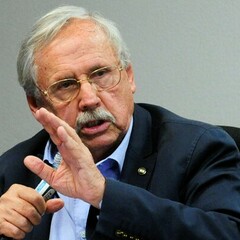
Ladislau Dowbor is a well-known Brazilian economist, having published over a hundred books and papers on the main economic, social, and political challenges we presently face, in Brazil and in other countries. He works as a full professor at the Catholic University of São Paulo, in the areas of political economy, management, and education. All his studies are accessible free of charge (Creative Commons) on his website https://dowbor.org with translations into English, Spanish, French, Chinese, and other languages. This website has become an important scientific hub for researchers.
Dowbor studied political economy at the University of Lausanne, in Switzerland, and earned his doctorate at the Central School of Planning and Statistics in Warsaw in 1975. After two years teaching at the University of Coimbra, Portugal, he joined the United Nations, assisting newly independent African countries in the organization of their economies for seven years. This period included consultancies for the Secretary General of the UN, with the Special Political Problems Bureau. Due to his opposition to the military dictatorship, he was exiled and could return to Brazil only in 1981, with the general amnesty. He then joined the Catholic University in São Paulo, but maintained international consultancy for the UN, particularly in South Africa after the apartheid, but also in Asia, Central, and South America. His invitation to work with the office of the UN Secretary General in 1980 was blocked by the intervention of the then Brazilian military dictatorship and the connivance of the new Reagan Administration.
Back in Brazil, Dowbor joined the Luiz Erundina administration of the city of São Paulo, as Secretary in charge of environment, international relations, and community organization. In this quality, he contributed to the Rio-1992 Earth Summit, in charge of the parallel International Environment Technologies Exhibit in São Paulo, with Maurice Strong. He also became an advisor to the Lula Institute, participating in the first discussions on the Fome Zero program, which would become the Bolsa Familia in his following administrations. At the President’s request, he ensured the scientific coordination of the research on the decentralized development policies for Brazil.
Dowbor’s numerous activities as a professor, public administrator, Chief Technical Advisor and consultant for the UN, working in rich and poor countries, as well as his fluency in different languages, led him to write numerous books, papers and scientific reports which are characterized by the simplicity of the approach, resulting in great part from the fact that they are based on field experience, and the need to bring practical responses do so many challenges. It also brought him to present the issues beyond the economic dimensions, linking them with the social, political, and cultural dimensions. He thus became known for the ease readers have in understanding complex development issues, with down-to-earth arguments.
In his more recent writings, The Age of Unproductive Capital (Cambridge Scholars, 2019) is an important reference, with Noam Chomsky presenting it as “a revealing and deeply informed study of the enormous power that has accrued to financial institutions and the deleterious impact on the global economy as financial transactions drain the economy and undercut productive investment. Dowbor’s focus is on the Brazilian experience, analyzed with care and insight, but the implications, as he clearly shows, are global in scope.” This and other publications were also based on discussions and publications with Hazel Henderson, Ignacy Sachs, Carlos Lopes, and so many colleagues in Brazil. Collaboration with the Concilium Civitas University in Warsaw led to a number of publications with researchers from Harvard, Cambridge, Université de Paris, London School of Economics, as well as with universities in Angola and other African countries, and Beijing University.
Dowbor is presently working on the line of the Digital Revolution, centered on how the new technologies, particularly the AI opportunities and challenges, are changing our views on our future. In this line, he published Rescuing the Social Function of the Economy: Brazil is Back, (Cambridge Scholars, 2023), Digital Revolution: New Social Challenges, (Ethics International Press, 2024), and Systemic Challenges in the Digital Age, (Ethics International Press, 2025). All these books are accessible free of charge on his website.
A last word on this website, where you can presently find roughly 1,500 titles, encompassing Dowbor’s publications, books, and papers written in collaboration with other researchers, as well as many publications presently based on the Open Access or Creative Commons approach. This has to do with the author’s approach that knowledge has to be understood as a commons, and that universities must become a tool to ensure knowledge spreads throughout society, instead of being only a ladder for individual success through diplomas. The new technologies and online access can foster the necessary social inclusion, as well as the governance transformations the environmental catastrophe demands.
Ladislau Dowbor is fluent in Portuguese, English, French, Polish, Spanish, Italian, and Russian.
He lives in São Paulo, has one wife and four children. : )





























 English
 Español
 Français
 Deutsch
 Italiano
 Português