English
 Español
 Français
 Deutsch
 Italiano
 Português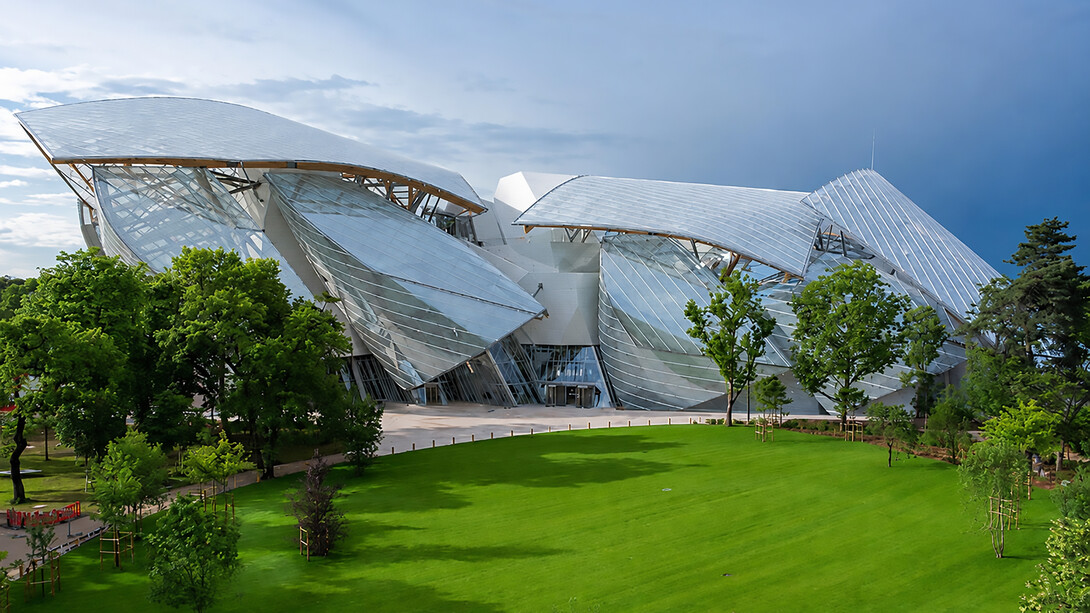
A temple, with its blazing altars of temptation.
(Émile Zola)
Louis Vuitton, Prada, Cartier … the names long associated with luxury fashion are also the names of the most famous private art collections, open to the public. Thanks to the rivalry between fashion design billionaires, private collectors' museums became a defining characteristic of the 21st-century art scene.
Art patronage is not a new phenomenon. From Gaius Cilnius Maecenas, who gave his name to the generous support of the arts, through the Church during the Middle Ages, the Medici and the Sforza in the Italian Renaissance, kings and popes, to gallery owners, artists needed and received the financial support that enabled them to practise their skills relatively untroubled by material necessities. Today, art patronage is present in the form of arts councils, foundations and private collectors.
Art as luxury brand
The rivalry between billionaires Bernard Arnault (founder and CEO of LVMH) and Francois Pinault (of Yves Saint Laurent fame) has benefitted the city of Paris in more than one way. When fire destroyed part of Notre Dame, Pinault pledged $113 million to help with its restoration; the next day, Arnault promised to donate $200 million. These donations enabled the work to progress at pace, and the cathedral was open within the promised five-year span.
In addition to successful luxury brands and an appetite for property and vineyards, the two men share a passion for art. Pinault, a dedicated collector of contemporary art, was at the point of building a museum on Isle Seguin on the Seine but abandoned the project because of extensive administrative delays. Instead, he decided to house part of his collection – over 10,000 works – in Venice, in Palazzo Grassi on the Grand Canal and at Punta della Dogana, open in 2006 and 2009, respectively. The two museums also host temporary exhibitions of contemporary artists, as well as a range of cultural activities and events. The Palazzo Grassi, an 18th-century noble residence, was restored and remodelled by Japanese architect Tadao Ando, who also oversaw the project of reclaiming the 17th-century warehouse which is today Punta della Dogana.
In Paris, in the Bois de Boulogne, Arnault responded with a spectacular futuristic building designed by architect Frank Gehry. Opened in 2014, the building appears like a giant ghostly boat, its glass sails inflated by a westerly wind, advancing slowly. The sails are made of 3,600 curved glass panels, wrapped around ‘the iceberg’ – the white central cube made of fibre-reinforced concrete where the galleries are housed. The sense of fluidity is elevated by the water flow on the lowest level of the museum. Water cascades down a set of terraced spaces, and the pathways around it enable the visitor to amble alongside the water flow. Beyond the galleries, reflection, light and glass blur the boundaries between art and architecture. The museum is home to works from Arnault’s collection and specially commissioned site-specific installations. Every year, the foundation mounts two major temporary exhibitions, ranging from a single artist (Egon Schiele, Cindy Sherman) to famous collections (Courtauld, Morozov) in order to provide a wide perspective of modern and contemporary art to a wide and diverse audience.
Renaissance of historic landmarks
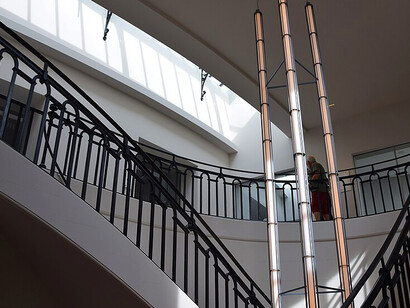
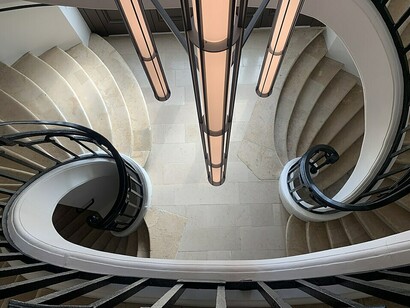
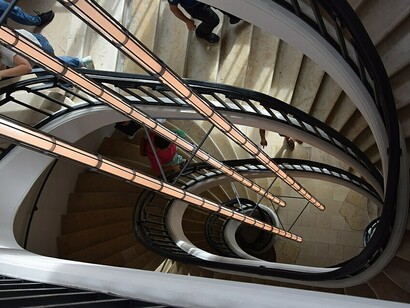
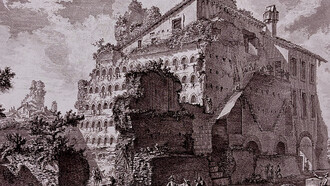
As the rivalry between the two businessmen continued, Pinault realised his dream of displaying some of his art collection in Paris. Built in the 18th century to store and trade grain, the imposing building known as Bourse du Commerce in the first arrondissement retains its circular shape and some of the original layout. One of the features to remind one of its early function is the double-helix staircase – two intertwined spirals that never met – enabling the ‘forts’ to carry the bags of grain up without fear of accidentally meeting the workers coming down. The following century, the building was given a new role, and the architect Henri Blondel had the task of adapting the building to its new function. Internally, he added new height and another level to accommodate offices. In the splendid rotunda, visitors can admire – and criticise – the immense panorama painting, dedicated to commerce around the world. The spectacular edifice was inaugurated in 1889 during L’Exposition Universelle.
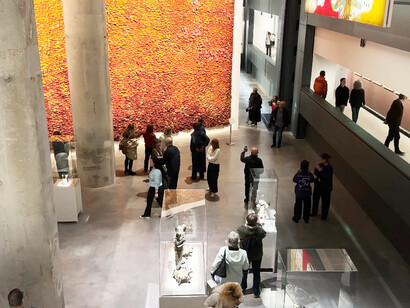
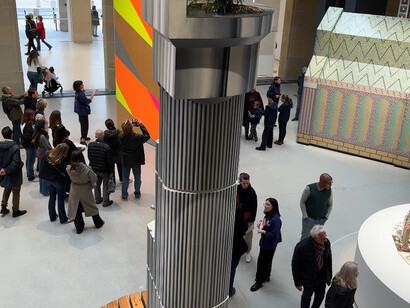
For this Paris base, Pinault engaged Tadao Ando again to redesign the neoclassical building. The major change to the interior was the placing of a 10-metre-high cylinder in the centre of the building, extending the display area to over 3,000 square metres. In its new incarnation, the edifice houses François Pinault''s extensive collection of contemporary art, as well as mounting temporary exhibitions and events.
At Fondation Cartier
A few minutes’ walk away, opposite the Louvre, stands another 19th-century building that transformed itself and its function to follow societal changes and preferences. The iconic Haussmanian edifice, with its uniform façade resting on a row of arcades, started its life as the Grand Hotel du Louvre. With the universal exhibitions of 1855 and 1867, Paris anticipated an influx of visitors, and there was a need for luxury hotels. The Grand Hotel du Louvre was built at the request of Napoleon III to be the largest and the most modern in Europe.
It featured 700 rooms and introduced facilities never before seen in Europe – foreign exchange, an information desk, and steam-powered lifts. There were luxury boutiques on the ground floor, and by late 1880, as the demand for shopping increased, ‘The entire Hotel du Louvre was converted into a store', as proclaimed by the slogan advertising the Grand Magasins du Louvre. The Magasins thrived into the 20th century, through two wars, but eventually closed its doors in 1974. It was replaced by Le Louvre des antiquaires, a group of 250 independent merchants of high-end antiques and oriental objects, who occupied the building until their eviction in 2019.
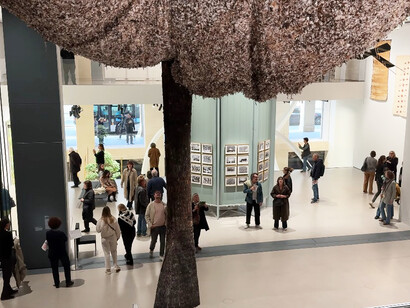
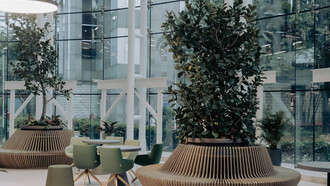
Joining the architectural renewal of the area in Paris’ 1st arrondissement, Fondation Cartier relocated from its steel and glass building in Montparnasse to the establishment in Place du Palais Royal. French architect Jean Nouvel, creator of the Cartier base in Montparnasse, was commissioned to design and adapt this Haussmannian iconic building to the demands of an innovative artistic space. The daring design enables the interior of the building to host all forms of contemporary art. Inside, five platforms can be adjusted to various heights, creating the possibility of over one thousand combinations of spaces. The cityscape views can be added or removed with the aid of mechanical guard rails, while retractable ceilings moderate natural light. Rather than exhibiting what the space permits, there is potential for adapting the space to the artwork – be it painting, sculpture, installation or performance.
Here are three more proofs, if proof were needed, that Paris remains the city of creative excellence – a city that honours its artistic heritage while looking forward, celebrating experiment and innovation.