English
 Español
 Français
 Deutsch
 Italiano
 Português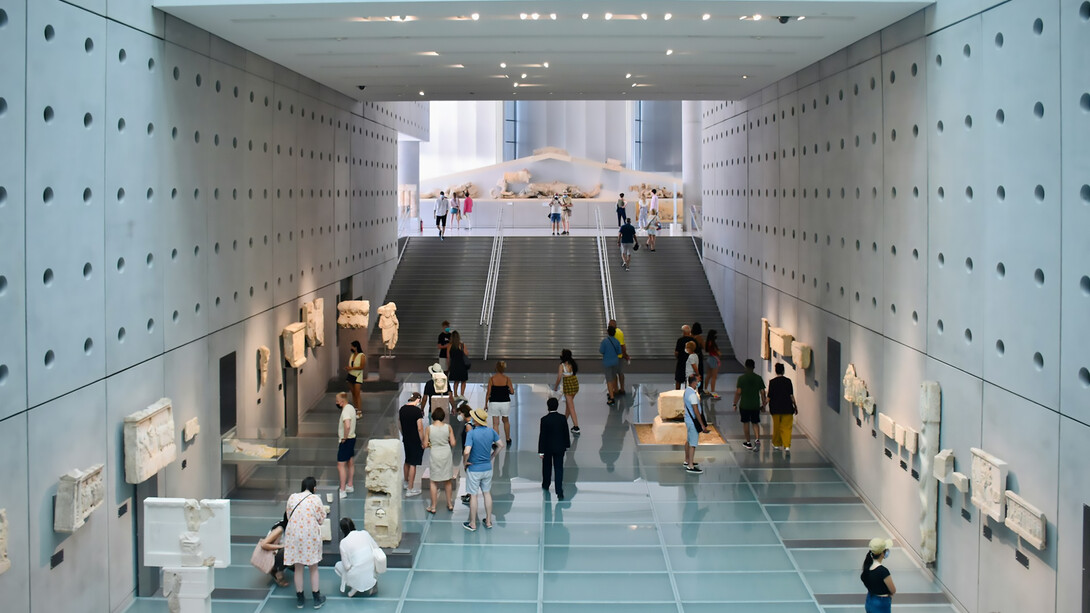
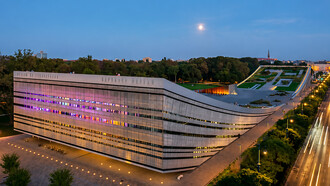
Designed by Bernard Tschumi in collaboration with Michael Fotiadis, the Acropolis Museum in Athens, Greece, opened in 2009. It occupies a site 300 meters south of the Acropolis Rock on the Makrygiannis plot. Its placement is not incidental or practical. The location is integral to the museum’s mission of engaging visitors with the Acropolis. Conceived as a thematic institution housing exclusively the finds from the Acropolis, the museum establishes a direct visual, spatial, and conceptual relationship with the monuments on the archaeological site, especially the Parthenon. The building demonstrates how contemporary architecture can serve as a curatorial instrument, using orientation, proportion, and transparency to reconstruct the architectural and narrative unity of the Parthenon while maintaining sight of its original setting.
The creation of the museum responded to both spatial and conceptual limitations. The 19th-century museum on the Acropolis, even after successive extensions, could no longer accommodate the growing collection of artifacts or the increasing number of visitors. Many architectural sculptures had been removed from the monuments to protect them from atmospheric pollution. This further broke the link between structure and embellishment. The new museum's 25,000 square meter area and 14,000 square meter display spaces enable the presentation of the Acropolis as a single, coherent archaeological entity and the unification of scattered relics.
Excavations before construction revealed the remains of an extensive ancient Athenian neighborhood beneath the Makrygiannis site. Therefore, the architects incorporated those ruins into the museum’s design by lifting the building above them so they are visible at its base. The result is a deliberate continuity with the new building: past and present are bound into a single architectural language. Although the museum is not separate from history but rather physically anchored within it, this building reinforces an understanding of the Acropolis as belonging to a larger civic, cultural, and historical landscape.
The museum is organized across four levels, guiding visitors through the chronological and topographical development of the site. The ground floor presents artifacts from sanctuaries and settlements on the slopes of the Acropolis. The first floor traces the history of the summit from the 2nd millennium BCE to the end of antiquity. This vertical progression culminates in the Parthenon Gallery on the third floor, which serves as the architectural and intellectual centerpiece of the museum.
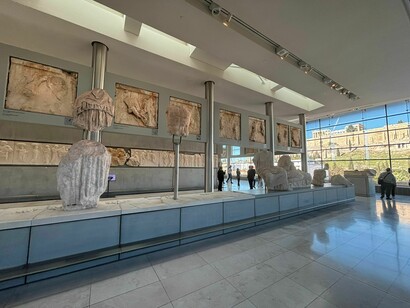
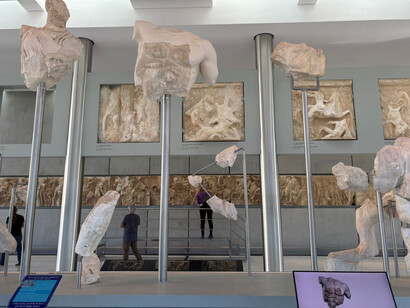
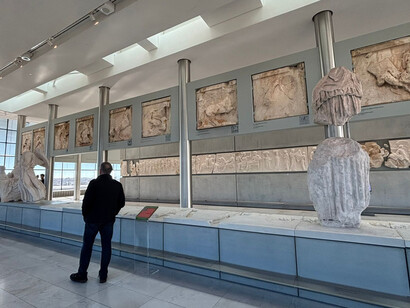
The Parthenon Gallery is designed as an abstraction of the temple. At the center of the glass-enclosed hall stands a rectangular concrete core, constructed in the exact dimensions and orientation of the Parthenon’s cella, the inner chamber of the temple that housed the cult statue of Athena. This core functions both structurally and curatorially. Mounted along the exterior walls of the core is the frieze, which is a continuous horizontal band of sculpted figures that originally encircled the upper part of the cella. The frieze depicts scenes related to the Panathenaic festival that provide insight into the religious and civic life of classical Athens. It is displayed at a lower height, allowing visitors to examine the carving and sequence of figures in detail, where it was originally elevated above the temple columns.
The metopes, square panels positioned along the outer wall of the Parthenon, are suspended between steel columns corresponding in number to the temple’s original colonnade design. Each metope depicts a mythological battle or contest. The pediments, the large triangular spaces at either end of the temple’s roof, are represented in the gallery at their corresponding east and west positions. These pediments originally contained statues portraying the birth of Athena and her contest with Poseidon. In the museum, the surviving figures are displayed in the round, allowing viewers to appreciate the exceptional quality of carving. Original sculptures preserved in Athens are exhibited alongside plaster casts of pieces held in the British Museum and other institutions around the world.
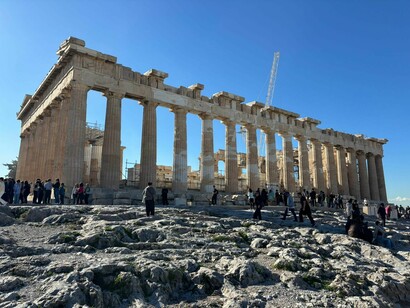
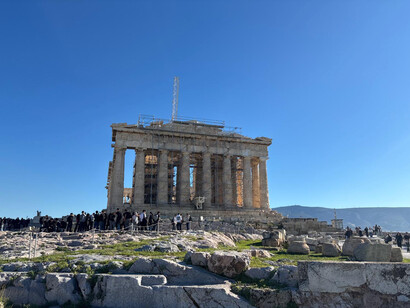
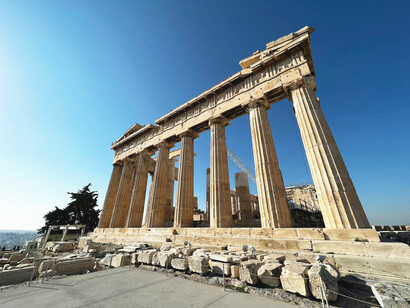
The significant feature of the gallery is transparency that allows natural Attic light to illuminate the sculptures and establishes uninterrupted visual contact with the Parthenon on the Acropolis hill. The gallery is precisely aligned with the temple so that the monument appears in the same orientation as the sculptures within the hall. Visitors stand within a contemporary spatial translation of the Parthenon while observing the original structure across the landscape. The Parthenon, situated on the hill, which lost much of its sculptural embellishment, and the sculptures inside the museum, which have been detached from their architectural framework, are conceptually connected. The design of the museum and its curatorial approach bridge the gap between fragment and whole by recreating the spatial connections that originally characterized the monument's significance, rather than physically replicating it.
The Acropolis Museum and the archaeological site are complementary components of a single experience. Visiting only the archaeological site shows the scale and structural power of the Parthenon but without its sculptural components. Visiting only the museum allows detailed study of the sculptures but without the architectural and topographical context. Each experience only becomes complete with the other. The visitor moves between the monument and museum in a process of cognitive reconstruction. This relationship enhances both emotional and intellectual engagement. The physical separation of structural components and sculptural artifacts cannot be fixed to a full extent due to historical dispersal and conservation issues. However, the physical alignment between museum and monument allows the mind to possibly comprehend what has been separated. To stand in the gallery containing the Parthenon sculptures and somehow be made more aware of time. It is only now, when we see the monument through the full spectrum of knowledge, that we are able to fully appreciate its greatness and the meaning of the sculptures as architectural ornaments.
The Acropolis Museum is a great example of how contemporary architecture can function as a curatorial instrument. Transparency offers a means of acknowledging but cognitively overcoming separation, proportion acts as a tactic of architectural translation, and orientation acts as a means of historical placement. By situating visitors between fragment and monument, between analytical display and the physical site, the building reconstitutes the architectural and narrative unity of the Parthenon within sight of its original location. The Acropolis can be understood at its most only if both of the mentioned spaces are experienced. Together, the archaeological site and the museum form a continuous landscape. Antiquity is actively understood as a cohesive architectural and cultural accomplishment in this integrated experience, rather than just being preserved.