English
 Español
 Français
 Deutsch
 Italiano
 Português
Cinema at its best
Kokuho is cinema at its best, one that delivers an experience that takes you out of your daily routine to a wondrous imagined world and holds you there, fully absorbed in it, for nearly three hours, drawn deeply into every scene and hanging on every word uttered by its characters. That experience is summed up towards the end when the illegitimate daughter of the main character, who has reached the pinnacle of his art as a Kabuki actor, tells him that while she harbored resentments against him for abandoning her and her mother, she forgives him every time she watches him on stage since each time he transforms her world.
This film truly is about how art magically transforms reality.
Epic in scale, the film follows two childhood friends from their training under the strict regimen of a Kabuki opera master actor, played by Ken Watanabe, to their early successes, the sundering of their friendship owing to one being declared the heir of a leading Kabuki family, the travails and tragedies to which both are thrown, their reunification, to the lead character’s transcendent performance in one of Japan’s favorite Kabuki opera plays, “The Heron Maiden.”
In its telling, the film brings us on an unforgettable exploration of undying universal themes in art and literature, among them the “deal with the devil” to gain the summit of one’s art or profession, that true friendship cannot survive without being profoundly tested, the tempestuous triangle of father, mother, and son, and that love and betrayal are twins.
Kabuki opera has often been regarded as a dramatic form inherited from feudal Japan that can really be appreciated only by the Japanese. What the camera does that is not possible on stage is bring the audience into intimate contact with the actors of the play being enacted, and with the help of good subtitles, get one into the Japanese mindset, with its deep connection with the classical dance and music of an ancient art. The performance of “The Heron Maiden” by Kikuo, the lead played by Ryo Yoshizawa, brings one as close as a non-Japanese can get to the ineffable beauty of Kabuki.
Art is a contract, where the audience suspends disbelief in return for transformative entertainment. And among the “realities” that Kabuki suspends is the difference between man and woman. The film reproduces this suspension of disbelief in separate genders. Kikuo and Shunsuke, played by Ryusei Yokohama, engage in rowdy male-bonding with geishas offstage, but on stage, they are magically transformed into the most sensitive of women, to whom the audience unhesitatingly relates as women. One comes away from the film with a sense of how plastic gender really is and that it’s only society’s policing that keeps gender roles strictly separate. One speculates that Kabuki developed partly as a way to have a “legitimate” loosening of gender roles in a society where, in daily life, the behavior expected from each gender was and continues to be strictly defined. This tight policing of the border between art and life is captured in the scene where a male spectator falls in love with the woman Kikuo is portraying, then gets enraged and gets his sidekicks to beat him up when he discovers Kikuo is a man.
One cannot speak too highly of Lee Sang-Il’s direction, Satoko Okudera’s screenplay, and Sofia El Fani’s cinematography and choreography. “Perfect” is an inadequate word. And the casting —where one character in an epic-length film who does not fit can throw the whole film out of kilter— is flawless.
Easily the best film of 2025, and I have seen a lot, including all the films nominated for best film and best international film at the Oscars. I clapped spontaneously at the film’s ending, and I was not surprised when the rest of the audience followed my lead.
Coming of age in the flats of Bangkok
Flat Girls is a welcome relief from the ghost stories and TV soap operas that dominate the Thai entertainment scene. This is an understatement. This film is actually one of the most moving coming-of-age stories to hit global cinema in years.
Jane (Fairy Kirana Pipityakorn) and Ann (Fatima Dechawaleekul) have grown up as close friends in a lower-class residential apartment complex, or “flats” for policemen and their families. In their mid-teens, they are at that stage of erotic exploration where they’re uncertain if it’s just friendship that binds them or if they, in fact, love each other “in that way,” as they put it. Enter Tong, played by Pakorn Chadborirak, a light-weight thirtysomething cop and failed family man, who loves hanging out with both. The inevitable triangle develops, but it is one that director/screenwriter Jirassaya Wongsutin spins in a subdued, delicate fashion.
The relations among the three play out within a working-class world trapped in the grungy riverside tenements whose insides tourists in Bangkok usually don’t get to see. Ann’s mother is addicted to gambling, bringing her family into constant conflict with Jane’s mother, who is the residential complex’s moneylender. Initially encountered as the overbearing wife of a senior police officer, Jane’s mother breaks down, with her increasingly frenzied debt collection revealed to be driven by her desire to accumulate the cash that would enable her to buy a house to escape to before her philandering husband deserts the family.
Ann also dreams of leaving to become a flight attendant. As her family’s economic situation deteriorates and her emotional relations with Jane and Pong become more complex, this urge intensifies. Her dream of escape comes to be symbolized by one of those glittering cruise ships catering to the middle class and tourists that the three love to watch as it plies Bangkok’s Chao Phraya River. In the film’s climactic scene, her conflicting feelings drive her in desperation to do what she has always dreamed of doing, and she finally decides to board the boat.
Flat Girls is a simple tale, but one that is transformed into a memorable movie by the two leads’ sensitive and poignant portrayal of the different stages of an intimate friendship as the threatening world of adulthood closes in on them.
I have long asked myself how best to describe that ineffable thing known as the “Thai sensibility.” This film is its definition.
Engaged to a shooter
After dragging myself through two films that appeared to serve no other purpose than to make sure its stars remained in the public eye, and were still available to snap up more more contracts, Mother Mary (starring Ann Hathaway) and The Outcome (Keanu Reeves), I finally came upon a Hollywood film, The Drama, that was willing to take on a truly urgent issue: mass shootings, which are now epidemic in the United States.
The challenge to The Drama director/screenwriter Kristoffer Borgli was how to avoid making a movie that would not simply remind people of the headlines and thus scare them away, or a comedy that the critics could damn as making light of a deadly phenomenon.
What he comes up with is this formula —draw the audience to ask themselves the question: what would you do if, through some freak revelation, you discovered that your bride-to-be had once seriously entertained becoming a mass shooter, to the point of bringing a gun to school?
Zendaya as Emma is convincing as a late twenty-something who has left that urge behind but has not yet really processed why she entertained becoming a shooter in the first place, musing at one point that she might have been fascinated by the “aesthetics of it.”
It is, however, Robert Pattinson as Charlie who does the heavy lifting, going through mood swings, between love and revulsion, that propel him through pre-nuptial happenings, some comic, some tragic, some both. Pattinson’s high-wire act succeeds in making a very troubling issue entertaining, avoiding being either heavy-handed or tasteless. But that’s my call: confronted by a dark episode from my partner’s past, I could see myself going through the same psychological contortions he so skillfully acts out.
But one piece of advice. If I were in the States, I would probably avoid seeing this film in a theater, since you never know, some idiot might feel the movie provides the perfect setting for his final mission.
An opportunity lost
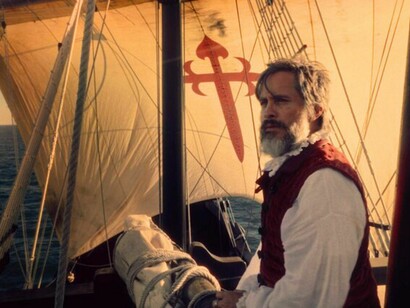
It seems like the acclaimed Filipino director Lav Diaz cannot quite make up his mind on where he wants to go with the story of the Portuguese explorer Magellan’s epic circumnavigation of the world in the 16th century. Will Magellan be a biopic? Will it be a cautionary tale about Western hubris like Werner Herzog’s Aguirre, the Wrath of God?
Magellan takes us from the early experience of conquest in Malacca to his convincing the Spanish King Carlos I to finance his expedition, his marriage and brief family life, the unending voyage across the Atlantic, then across the Pacific from the tip of South America with its share of misfortunes and mutinies, his arrival in what is now the Philippines, to his death on the island of Mactan.
Diaz seems determined to make the story one of watching the grass grow, even to the point of eliminating the depiction of epic events that could have provided scenes that could have propelled the story forward with some action, like the Battle of Mactan, where Magellan’s death in battle was described in gory detail by the expedition’s chronicler, the Venetian Antonio Pigafetta. (Or did the epic battle—of which only the aftermath is shown—fall victim to the editor’s scissors to make a long film commercially viable?)
In any event, this bypassing of the action on the beach in favor of lingering on the final flicker of Magellan’s imagined stream of consciousness is, in my view, unfortunate, and not only in a dramatic sense. The significance of the Battle of Mactan was transcendental: it was one of the two epic encounters between the West and the non-West at the dawn of the Age of Colonialism, and they took place within months of each other in the same year, 1521. The other is better known: the capture of the Aztec capital of Tenochtitlan in the New World by Cortez. In one, the West won, owing to its monopoly of firepower. In the other, the non-West prevailed owing to Lapu Lapu’s superior generalship, which is attested to by Pigafetta’s detailed account.
The choice of Gael Garcia Bernal to play Magellan is likewise unfortunate for Bernal, while terrific in other roles, projects none of the characteristics linked with the historical Magellan: the thirst for conquest, hubris, tyrannical leadership, and reckless courage. In fact, his portrayal of the Portuguese captain borders on projecting the guy as “sensitive,” though meek is probably a better word. But to be fair to Bernal, it may not be a question of his ability to assume a persona but the director’s idea of how he should play Magellan.
The cinematography partly makes up for these failings. Few come close to Diaz in distilling the wild beauty of the tropics, with its lush vegetation, unending monsoon rain, and an untamed ocean perpetually breaking on unending coastlines. These scenes, like that of the aftermath of the massacre at the end of the film, are mesmerizing.
One comes away from the film with a sense of opportunity wasted. In its depiction of the interactions between the indigenous people and the European crew, there lay an opportunity for an accomplished non-Western filmmaker to reverse subjectivity, to portray the non-Westerner as subjective consciousness, with its daily intimacies and familiarities, with its perception of the Westerner as an invasive species disrupting the natural order. Instead, we are given another film with the European as subject, with the non-European in its familiar role as the inscrutable, indeed, treacherous Other.
David versus a corporate Goliath
Ayala Corporation is one of the Philippines’ biggest developers, one that has either bulldozed or bought its way into acquiring agricultural land from common people and turning it into real estate for the elite and the upper middle class. One community that resisted was the people of Sicogon Island, a beautiful isle off the province of Iloilo in the central Philippines, whose farmer residents wanted to keep it as largely productive agricultural land. Still, Ayala wanted to transform into a resort for the rich and famous.
In a painstaking process that began almost 40 years ago, the community tried to use agrarian reform legislation to gain control of the land from the unproductive local elites who controlled the land before Ayala’s appearance, with limited success. But when Ayala entered the scene with its corporate war chest and its links to regional and national interests, the balance was tipped in favor of the landed interests.
Wash Out, a documentary produced by the talented Herbert Docena, Isabelle Matutina, Cris Sto Domingo, and Lirai Cordova, chronicles the dogged resistance of the community to the corporation, with its abusive security guards and slippery lawyers. The film shows how, bereft of resources and feeling deprived of government support. With their ranks depleted by Ayala’s divide-and-rule tactics, the remaining resisters felt themselves forced into a bad deal where, in return for a measly 63 hectares, they would give up their struggle for the remaining 344 hectares they had originally sought. It was a pill that was bitter to the holdouts, but one that the film sympathetically portrays as one they felt they had no choice but to swallow.
A controversial point made by one of those interviewed was the sense that the community was betrayed by the national government, a claim that is hotly disputed by a representative of the administration in power at the time the deal was negotiated.
Though the film does not touch on it, the splintering of the peasant movement stemming from the loss of momentum of the left and its subsequent splits was the broader national picture that probably influenced the decision of the holdouts to accept Ayala’s terms. By the middle of the second decade of the 21st century, concessions to demands for land redistribution had disappeared from the agenda of the dynastic elites that ruled the country.
Wash Out is not technically flashy and does not move at a breath-taking pace, preferring unstructured interviews that allow participants in the struggle to give their accounts of the battle with a corporate Goliath. This slows down the documentary but provides viewers with a deeper appreciation of the issues involved. In a particularly poignant scene, long-time community organizer Lirai Cordova visits the graves of the leaders of the four-decade-long fight of peasants for their land.
While an agreement was reached over a decade ago, Ayala dragged its feet and formalized the so-called donation of land to the farmer residents just recently. One cannot help but think that the appearance of Wash Out, with its damaging recounting of Ayala’s actions, finally got the corporate conglomerate to move its fat ass, as the saying goes.
Nostalgia
Disclosure Day is really about Steven Spielberg, that is, his effort to regain creative juices that were in full display in E.T., which was released over forty years ago. This exercise in nostalgia comes up short. Both films are about the interaction of extraterrestrials and humans.
But Disclosure Day lacks what made E.T. a smashing success at the box office: the warm glow surrounding a tale about a friendship between an extraterrestrial marooned on Earth and a boy. The story of extraterrestrial bonding won people’s hearts across demographics. In contrast, the center of Disclosure Day is the chase, and there have been many better chase movies, many more suspenseful chase scenes than an AI-generated Emily Blunt waiting to be pulled from a burning car that is about to be hit by a train.
What the chase is all about can’t be revealed without me being branded a spoiler. But there’s no harm in describing how the movie’s ending hit me: it’s one of the most mawkish I’ve seen in a long time. Emily Blunt retains some of her magnetic screen presence, but the film is otherwise a waste of her talents, and Colin Firth deserves a nomination for the Razzies as worst actor of the year. Spielberg apparently hasn’t learned a lesson that other superannuated folks in Hollywood have: to quit while they’re ahead.