English
 Español
 Français
 Deutsch
 Italiano
 Português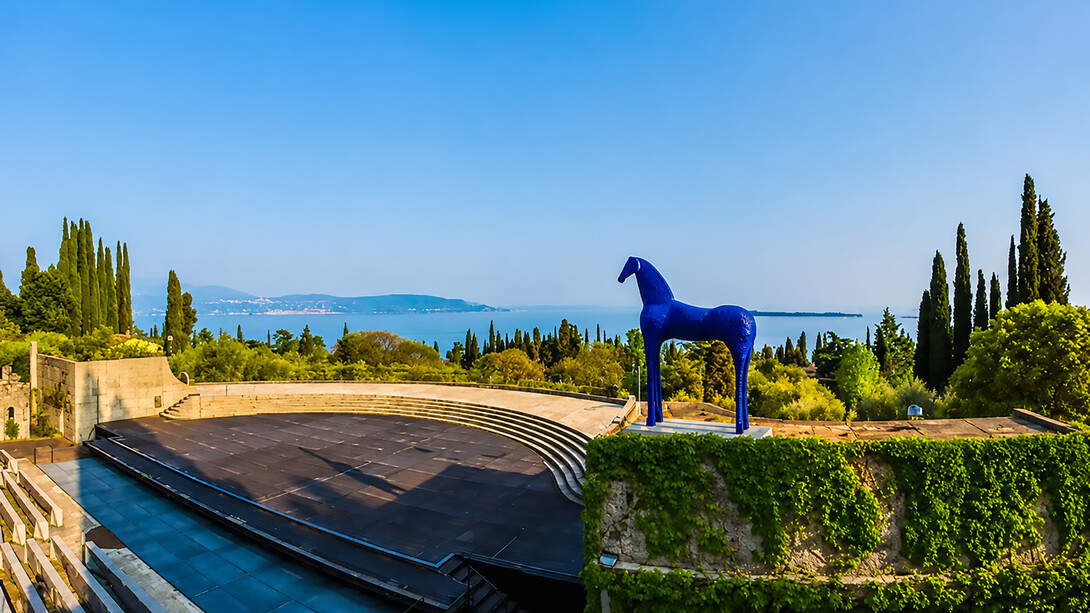
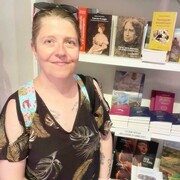
From the great dreams of theatrical renewal at the end of the nineteenth century to contemporary open-air performance practices, this interview offers a broad and timely perspective on a surprisingly vibrant subject. Through the OATI project, dedicated to open-air theatres in Italy, academic research, education, and the promotion of cultural heritage are closely intertwined. Guiding this journey is Maria Pia Pagani, theatre scholar and lecturer at the University of Naples Federico II, who has long been engaged in the study of modern theatre and its leading figures. At the heart of this discussion lies the visionary legacy of Gabriele d'Annunzio and Eleonora Duse, now reconsidered in light of new social and artistic needs. It is a journey through history, places, and ideas that restores open-air theatre to its role as a shared cultural space.
I would begin the interview with a brief description of the OATI project. How did you become involved, and what events accompanied the project?
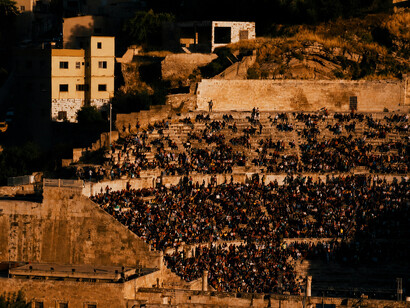
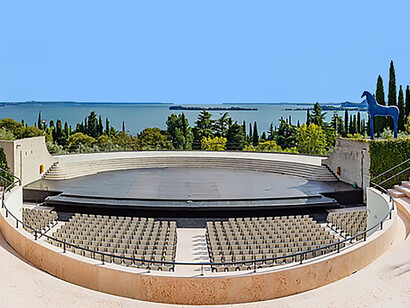
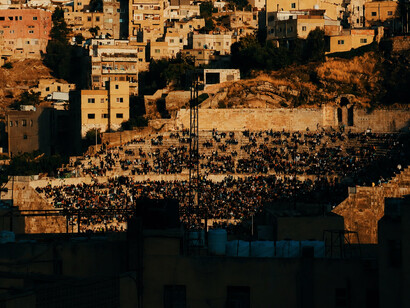
OATI is the acronym for “Open Air Theatres in Italy", which I chose together with my colleagues Professor Paolo Quazzolo (University of Trieste) and Professor Anna Sica (University of Palermo) to present an academic PRIN PNRR 2022 research project that successfully passed the ministerial selection process and ran from late November 2023 until the end of February 2026. The aim was to catalogue the various types of Italian open-air theatres and their artistic history: the website Home – Teatri all’aperto in Italia allows visitors to access the atlas and discover fascinating venues, many of which are still fully active with festivals and summer seasons.
The research unit for which I served as scientific coordinator was at the University of Naples Federico II, where I teach and where an intense period of research took place. This included, among other initiatives, the “Conversazioni Dannunziane” and the seminar cycle “I sogni delle stagioni.” I wanted to give students the opportunity to deepen their understanding of théâtre en plein air both in the classroom and at the Real Orto Botanico in Naples, where they also demonstrated their performative skills under the artistic coordination of actor Salvatore Iermano.
For the Federico II research unit, I chose as the guiding thread the dream of creating an open-air theatre that characterised the partnership between Gabriele d'Annunzio and Eleonora Duse. For their era, it was a visionary idea; yet today, we are reaping its fruits. If we think about it carefully, even large outdoor concerts and stadium performances ultimately derive from that dream of theirs.
What do you believe were the aspects of open-air theatre creation that fascinated Gabriele d'Annunzio throughout his life? And how did Eleonora Duse become involved?
D’Annunzio wanted to modernise Italian theatre, and to do so, he looked back to classical antiquity. His was an idea rooted in an avant-garde vision, aiming to renew the contemporary stage through a recovery of the past. In his view, the future of Italian theatre lay in restoring the form of theatre practised at the dawn of Western civilisation — namely, the en plein air dimension. Theatre therefore had to be based on ritual foundations and complete social openness, including free performances for the entire population. It was a way of bringing culture to the most disadvantaged and uneducated sectors of society, to those who had never set foot inside a theatre because of poverty and lack of familiarity with such spaces.
He identified Eleonora Duse as the ideal actress for this project. Her already established fame and her equally passionate desire to transform contemporary Italian theatre made her the perfect collaborator. Even before it became a romantic relationship, their partnership was born out of a profound communion of artistic ideals. Though they came from completely different social worlds, Gabriele d'Annunzio and Eleonora Duse were looking in the same direction: theatre brought them together, theatre later divided them, and ultimately theatre brought them closer again in their final years.
Which aspects of this enduring fascination are explored in particular within the monographic volume?
Within the framework of the OATI project, the monographic volume D’Annunzio e il teatro all’aperto. Estetica, luoghi, protagonisti, which I edited for the “Officina del Vittoriale” series (Silvana Editoriale, 2025), examines in chronological and thematic order the fundamental aspects of the en plein air dream shared by the Poet and the Divine Actress.
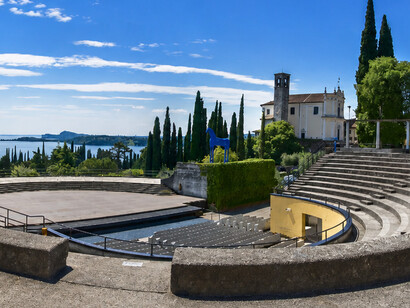
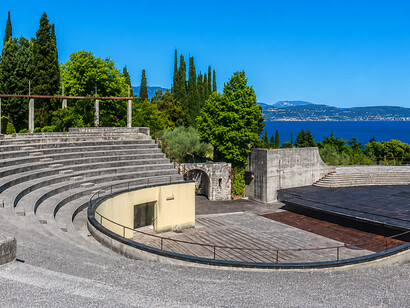
To develop the narrative structure underlying the entire story, I chose to involve specialists who reconstructed each individual segment: outdoor scenes in Abruzzese ritual traditions and in the paintings of Michetti (Daniela Garofalo), the collaboration with Mariano Fortuny (Giovanni Isgrò), the very young Eleonora Duse at the Arena di Verona as described in the novel Il Fuoco (Roberto Cuppone), the project for the rebirth of the Roman Theatre of Fiesole (Caterina Del Vivo), the creation of the Parlaggio at the Vittoriale and the work of architect Gian Carlo Maroni (Chiara Arnaudi), the creation of the open-air theatre in the courtyard of the Castle of Queen Cornaro in Asolo and D’Annunzian stage productions (my contribution), the aesthetic and political implications of the en plein air stage in the twentieth century (Paolo Puppa), as well as the archaeological recovery of the classical model (afterword by Maurizio Harari).
I can say that this collective work currently represents the most comprehensive survey of the subject, and I am grateful to all the contributors who participated. Through this synergy, one can perceive the unexpected development of that dream: impracticable between the late nineteenth and early twentieth centuries, increasingly achievable throughout the twentieth century, and of vital importance after the pandemic.
After years devoted to Eleonora Duse, Gabriele d'Annunzio, and Carlo Goldoni, what literary projects await you?
In truth, this trio remains the central axis of my research activity: they are absolute protagonists in the history of modern theatre and still have much to say to contemporary audiences. At present, I am working on the critical edition of the novel Un’attrice by Ofelia Mazzoni (1883–1935). In my opinion, it is a work that absolutely deserves re-evaluation because it offers an unconventional perspective on the crises that can arise in an artist’s career and on the strength required to begin a new creative phase.
I also believe it is important to study Mazzoni in greater depth. She is now a largely forgotten figure, yet one worth rediscovering, not least because she represents an exemplary case of an actress-writer endowed with uncommon sensitivity. Naturally, the presence of Eleonora Duse remains the key to everything…