English
 Español
 Français
 Deutsch
 Italiano
 Português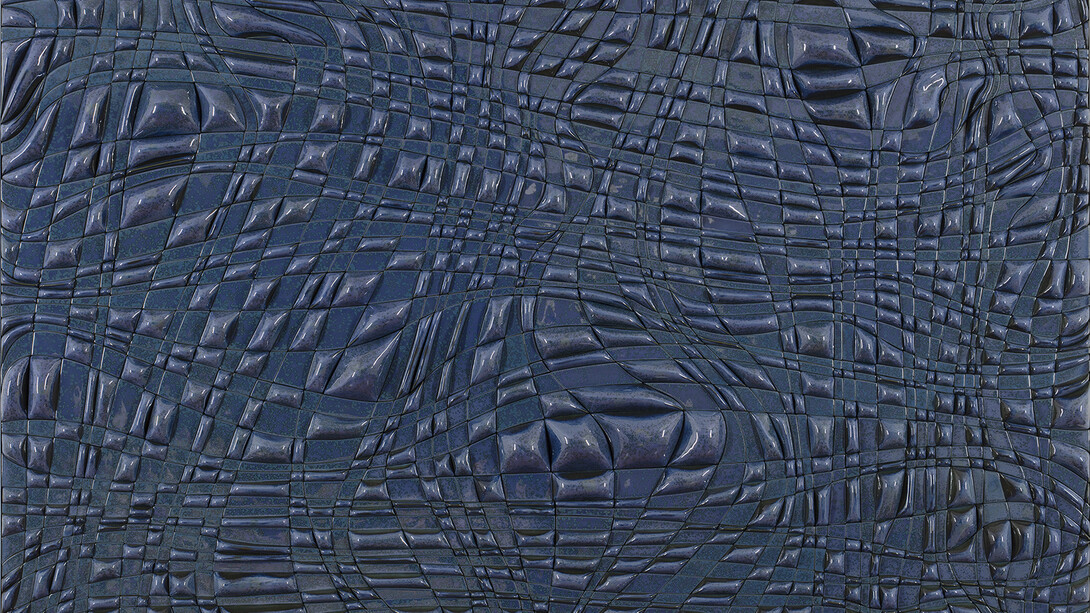
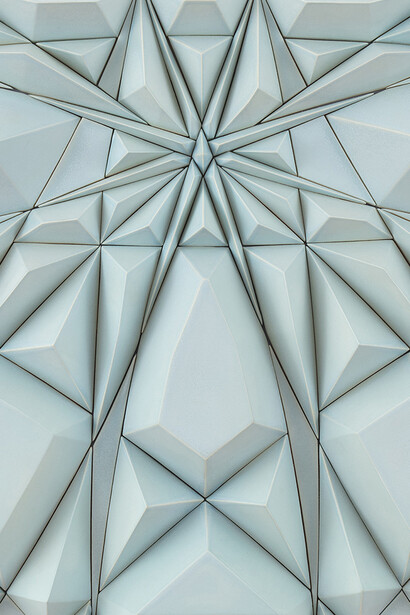
Since 2003, Juan Parada’s work has focused on ceramics and on different ways of redefining its limits as a contemporary artistic practice. To that end, the Brazilian artist has developed pieces in the form of installations as well as interventions intended to affect public space. Since 2015, Parada has devoted much of his attention to producing a body of work characterized by ceramic reliefs with a pronounced geometric solution. This graphic meaning is inseparable from the volumetric resolution involved in working with reliefs, reconciling the pictorial with the sculptural. These three-dimensional pieces can be perceived as landscapes or topographies; moreover, they interact with the exhibition space, opening a dialogue with its architecture and a relationship with viewers. Parada continually seeks to erase assumed or established boundaries. In the case of these geometric reliefs, this erasure occurs between two-dimensionality and three-dimensionality, as well as between the categories of the pictorial, the sculptural, and the architectural.
Juan Parada’s series of geometric reliefs also aims to question limits of a technical and material order. His methods of production reconcile archaic processes with those proper to contemporary technologies. In his pieces, traditional materials and techniques coexist with a design obtained through digital software. Aided by this technology, Parada generates vector drawings that are then used to create a kind of framework that guides the shaping of his reliefs. Their volume, however, is interpreted by the artist and executed manually. Although the reliefs look industrial, or like 3-D prints, as if they were made out of plastic or metal, each component was fabricated by the artist himself, demonstrating a mastery of precise modelling that stems from a manual practice he has cultivated since childhood. This erasure of gesture in the production of each module alters the perception of its materiality and demands a certain attention from the viewer. In the same way, it points toward the way Parada defines a portion of his output as “anti-ceramics,” based on how such pieces eliminate both gesture and a certain pictorial quest associated with the use of glazes.
The articulation of these reliefs, through individual pieces, might recall the work of another Brazilian artist, Sérgio de Camargo. Parada’s work reflects on different artistic legacies from which he extracts and continues investigations such as the definition of a “sensitive geometry” or the production of art with perceptual intentions. Both issues are present in and can be related to Camargo’s modern work. In addition to updating certain interests close to Neo-Concrete art, Parada’s geometric reliefs seem to be designed with various kinetic considerations in mind. As noted above, part of this is to be found in their finish, which obscures the materiality of the piece. Likewise, one could consider how the vitrification of the glaze on the relief interacts with the light and conditions in the exhibition space. This convergence of factors causes the reliefs to function as a kind of shifting landscape—a field of forces that transforms depending on the conditions at the site, the passage of time, and spectator’s movement while looking at it.
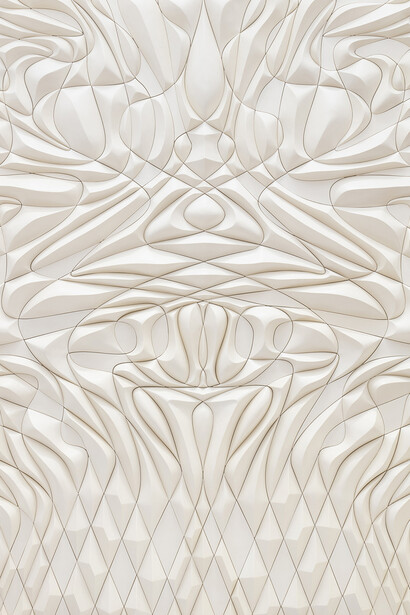
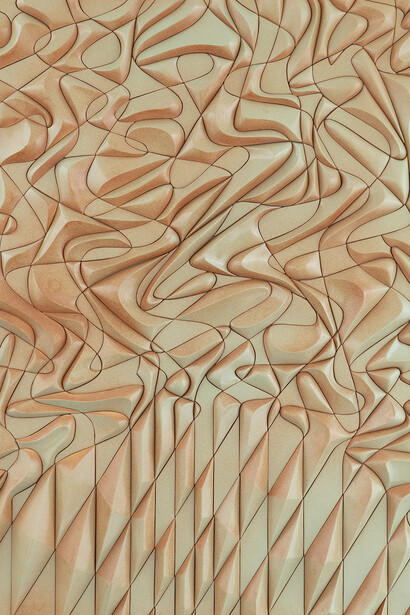
For this exhibition at Proyectos Monclova, Juan Parada has made a selection of recently produced geometric reliefs. Smoky room, for example, might illustrate one of the contradictory processes that his practice tends to reconcile: the almost mathematical calculation of certain procedures with factors that are impossible to predetermine during the firing of the ceramic. This becomes evident in the piece through the transformation of a linear, rigid design into a fluid mechanics that multiplies its lines, resembling smoke. In addition to this piece, the exhibition Geometry in Resonance includes several works belonging to the series Random Rhythmic Psychogeometry—a set of reliefs that exemplify Parada’s more graphic and pictorial interests. Moreover, the show also features a pair of pieces that constitute a new series titled Volumetric Refraction, made up of irregular reliefs that stress and emphasize a more sculptural solution over their more regular, graphic definition. Collectively, these works underscore the artist’s intention to turn ceramics into a “universal language capable of joining together science, history, architecture, and abstract thought.”
(Text by Daniel Garza Usabiaga)