English
 Español
 Français
 Deutsch
 Italiano
 Português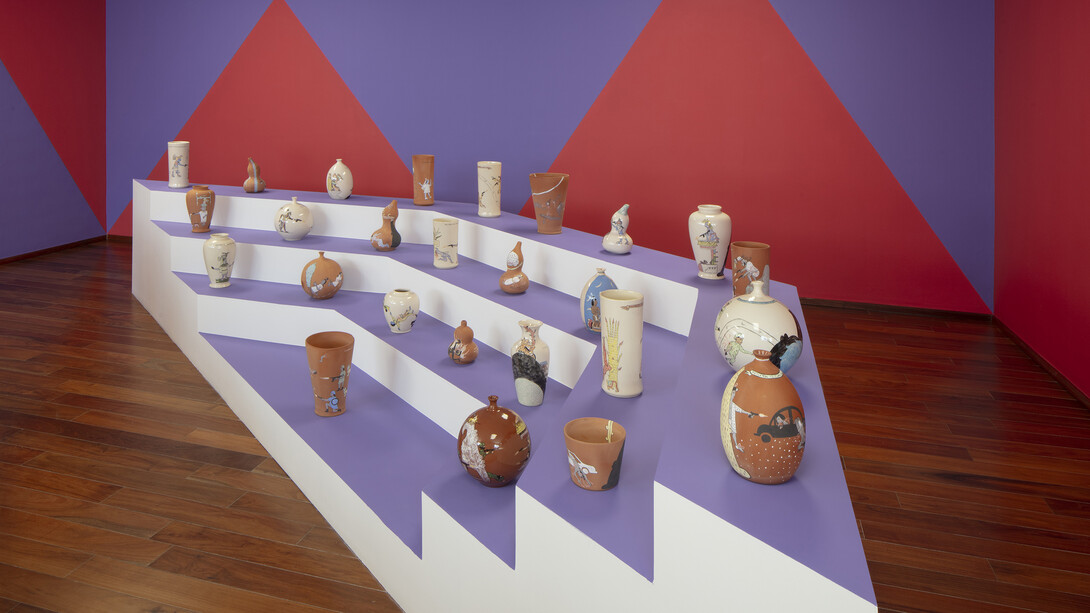
The documentary sources that come to us from viceregal codices, as well as other historical and iconographic materials that recount everyday life in pre-Hispanic Mexico and during the Conquest, constitute the raw material for the Mexican artist Gabriel Garcilazo’s creative practice. He studies the nation’s past with the aim of putting it in dialogue with the country’s present political and social reality. On the one hand, the artist appropriates pictograms and ideograms from codices produced by tlacuilos in the sixteenth century and reinterprets them through a contemporary lens, expressing himself through drawing, painting, and sculpture on a variety of physical media. On the other hand, he reviews newspapers and other media outlets for reports linked to drug trafficking in Mexico, as well as the collateral damage generated by the violence surrounding this illegal trade. Garcilazo thus calls up a twofold memory: one that grounds ancient Mexico and another that reflects upon its contemporaneity.
In this exhibition, Archive of the persistent narrative, Gabriel Garcilazo continues an artistic project he began a decade ago, titled Códice váquero (2015). In that earlier work, he meticulously reviewed the Codex Azcatitlan, which narrates the founding myth of Tenochtitlán and the Mexica people’s pilgrimage from Aztlán to new lands, now known as the Valley of Mexico. Garcilazo reinterpreted that document through ink drawings on paper with the intention of depicting the trafficking of weapons and human beings, as well as the transport of drugs from Mexico to the border with the U.S. With this project the artist inaugurated his approach to political themes related to violence and drug trafficking.
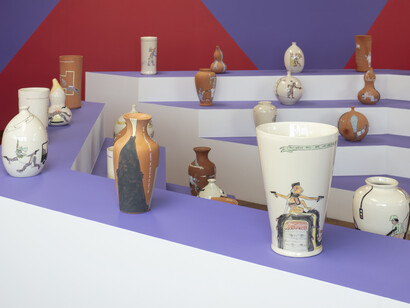
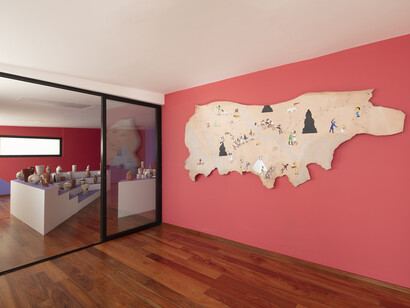
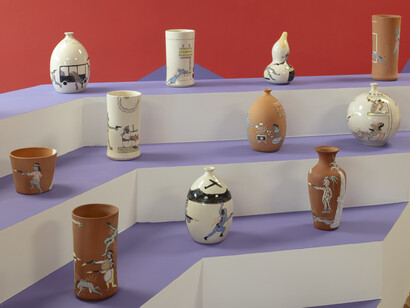
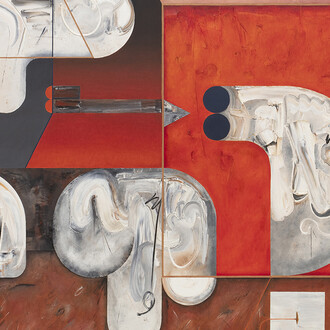
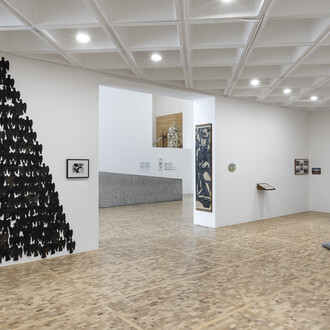
The itinerary of Archive of the persistent narrative begins with a painting in which Garcilazo addresses the flow of arms trafficking from the United States into Mexico—a problem that has fueled violence by supplying weapons to drug cartels in the country. Along the same thematic lines, the artist presents fifty ceramic sculptures that, from a humorous perspective, reflect on the consequences of the so-called “War on Drugs” and the ensuing violence unleashed since 2006. He achieves this by means of a strategy of iconographic reinterpretation based on visual documents from the viceregal period.
To this end, the artist makes use of the stylistic features of the Codex Azcatitlan, the Codex Vaticanus, and the Codex Borgia, selecting only certain elements so as to underscore social problems that have arisen in various Mexican cities from 2007 to the present. Each ceramic piece establishes a close relationship with drawing. Garcilazo thus approximates the work of mid- sixteenth-century tlacuilos by writing ideographically in the manner traditionally taught in the Calmecac, while also considering the knowledge these scribes/illustrators were had to have about the social and supernatural events of their time. Even though Garcilazo’s intention is not to recreate the tlacuilos’ work, he does take up their brushstrokes, black delineation, and the use of particular colors used in different codices, which adds a degree of complexity when carrying certain tones over to ceramic technique.
Like the ideographic writing of viceregal codices, characterized by scenes linked to past Mesoamerican military campaigns, the works of Garcilazo do not present complete narratives of events1. Rather, they depict just a few hints that provide fragments of information about violent deeds. At the same time, we can observe images that allude to brutal episodes by way of transposing ideograms found in the codices. As occurs in those documents, Garcilazo’s pieces require a narrator to complement the story, encouraging each work to call upon oral tradition.
One salient aspect of the exhibition is the reference to the souvenir, evident in the legends accompanying each piece. Garcilazo revisits reflections on the souvenir, an invention of the Italian Giovanni Volpato, whose archaeological explorations included reproducing miniature Roman sculptures that would overcome the impossibility of selling original antiquities. How would one keep a fragment of the history of violence that has become so normalized in our country? Perhaps by creating a souvenir that depicts a painful story, one can contribute to problematizing the ongoing social violence experienced on a daily basis across the nation. In this exhibition, each piece presents images that refer to violent events including land disputes in the State of Guerrero, the murder of one of the children of the former leader of the Sinaloa Cartel, and the confrontation between the Mexican Army and a former leader of the Beltrán Leyva Cartel in Cuernavaca, Morelos, in 2009.
It was precisely this last event that was the turning point in Gabriel Garcilazo’s body of work dealing with the problems brought about by drug and arms trafficking in Mexico, and it constitutes the central focus of his artistic production. The incident erupted in the Garcilazo’s hometown of Cuernavaca, and was followed by a wave of violence that generated insecurity and a profound sense of constant danger among residents. Garcilazo has noted how this context influenced his reflection on these social conflicts, as well as its connection to political and economic dimensions. Living and working in Cuernavaca during that period was fundamental to his engagement with the dynamics of violence that are reflected in the thematic core of his work. In this way, Gabriel Garcilazo’s practice appeals to collective memory and to the perennial need for storytelling, narrating a history visually and orally, while establishing a relationship among drawing, painting, and sculpture through ceramics.
(Text by Vera Castillo)
Notes
1 Pablo Gonzálbo Escalante, Los códices (Consejo Nacional para la Cultura y las Artes, 1997), 7.