English
 Español
 Français
 Deutsch
 Italiano
 Português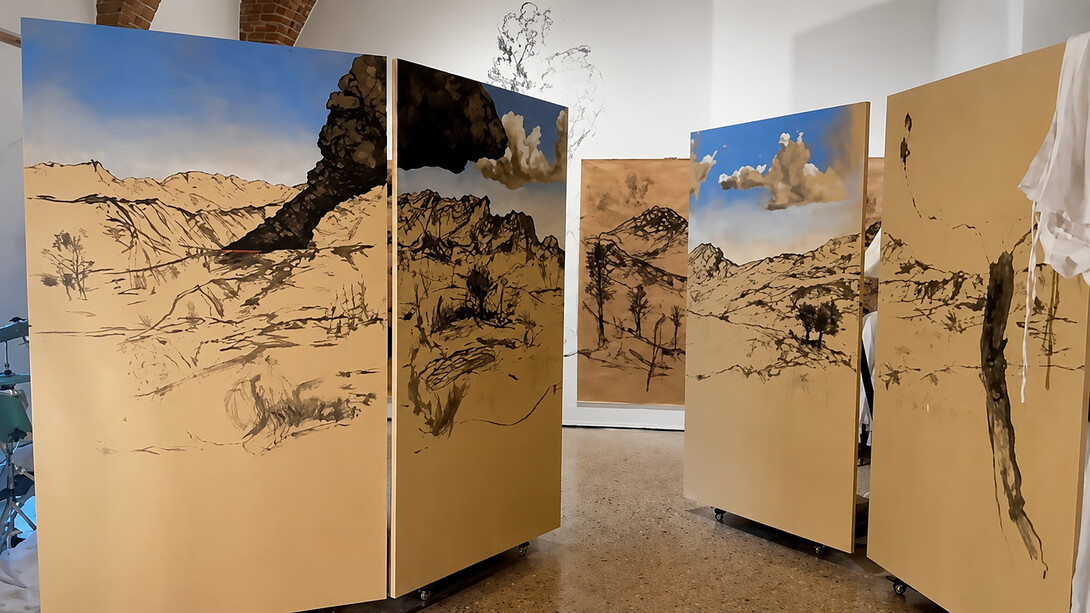
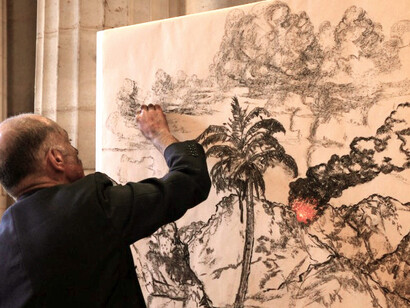
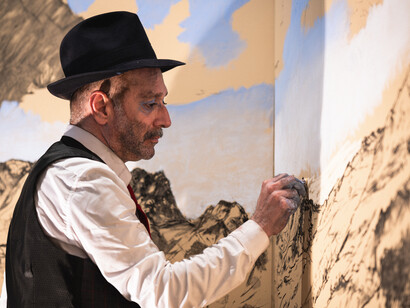
At Galleria Continua in San Gimignano, Embers / Braci by Nikhil Chopra and Uriel Barthélémi unfolds less as an exhibition than as the continuation of a living process. Developed from the durational performances Fire x Fire – Ignition and Fire x Fire – Combustion, first presented at La Pop and Monnaie de Paris in 2024, the project transforms traces of performance into a suspended landscape where drawing, rhythm, memory, and combustion coexist. Installed in the evocative setting of Arco dei Becci, the exhibition reactivates the monumental drawings produced by Chopra during those earlier performances. Yet these works do not appear as static relics of past actions. Instead, they retain the volatility of their making. Charcoal marks, layered surfaces, and scorched tonalities seem to preserve the pulse of the body that generated them, as though the works continue to breathe after the event itself has ended.
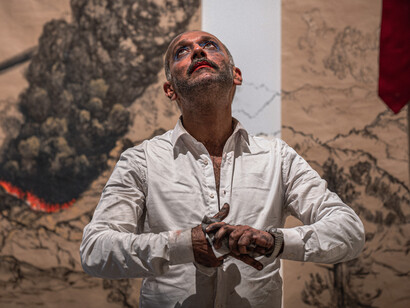
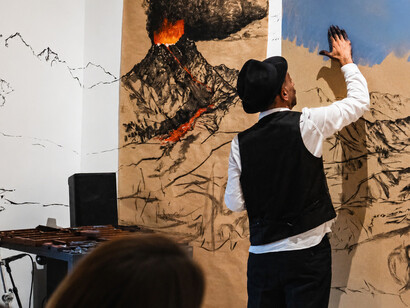
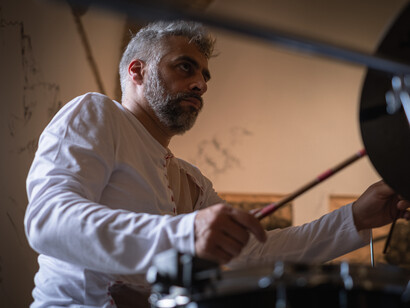
The opening performance — a powerful three-hour live intervention with Barthélémi on drums and sound — became the emotional and conceptual core of the exhibition. It was an extraordinarily intense experience, capable of immersing the audience in a suspended temporal dimension where gesture, rhythm, and breath merged into a single continuous flow. Sound and drawing did not accompany one another; they became mutually dependent forces. The drumbeat acted almost like a tectonic pressure shaping the image in real time, while the emerging landscape responded to rhythm as if it were a living organism.
What emerged most strongly during the performance was the sensation of inhabiting a threshold. Everything seemed suspended between construction and collapse, presence and disappearance, control and surrender. Fire — even when not materially visible — traversed the work as a symbolic force: something capable of wounding, warming, destroying, and transforming simultaneously. The title itself, Embers / Braci, evokes precisely this unstable condition: what remains after combustion but also what continues to burn beneath the surface. The durational aspect of the work proved essential. Over the course of three hours, the audience gradually entered a different perception of time.
At a certain point, one no longer simply watched a performance unfold but rather inhabited a shared rhythm, almost ritualistic in nature. There was something deeply ancestral in the continuous dialogue between percussion, movement, and drawing, as if sound and gesture were activating a collective state of attention. The performance seemed to oscillate between contemporary live art and an ancient ceremonial practice. At the same time, the work resonated strongly with the fragility of the present. The vast landscapes drawn in real time — constantly interrupted, expanded, erased, and transformed through sound — evoked unstable territories, suspended between ruin and regeneration. Ecological and political precarity were never represented directly or rhetorically; instead, they emerged atmospherically, through tension, vibration, and accumulation. The performance conveyed the sensation of living within a world shaped by permanent crisis while still preserving the possibility of renewal. The embers continue to glow even after the fire appears extinguished.
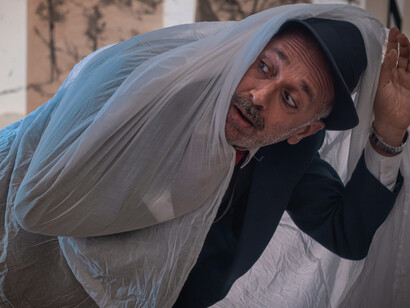
What makes Chopra’s practice particularly compelling is the way it resists disciplinary boundaries. His work exists simultaneously as drawing, theatre, performance, installation, and autobiography, yet never settles into any of these categories completely. The body functions as an archive, medium, and site of negotiation. Identity in his performances is constantly shifting through personas that appear historically distant yet psychologically intimate. Time itself becomes one of his primary materials. Duration is not simply an aspect of the work; it is the condition through which meaning slowly emerges.
In Embers / Braci, drawing itself becomes corporeal. Chopra does not simply produce images; he constructs them through physical endurance, repetition, and presence. Every mark appears as the residue of a bodily crossing. Barthélémi’s sonic environment amplifies this physical dimension further. His drums and electronic textures do not accompany the action from the outside; they penetrate it, destabilise it, and push it forward. Sound becomes vibration, pressure, atmosphere — something felt as much physically as acoustically. The collaboration between the two artists deepens this condition of instability and openness. Barthélémi’s practice — situated between percussion, electronic composition, immersive installation, and sound experimentation — shares with Chopra an interest in transformation and the physicality of experience. Together, they construct environments where sound becomes spatial architecture and drawing becomes performative memory.
Their collaboration began in 2016 with Floating Cities and Loaded Dice at Paris’ Gare du Nord, a project reflecting on migration and refugee conditions in Europe. That same political undercurrent persists in Embers / Braci, though here it becomes more elemental and existential. Fire operates not only as a metaphor but also as a shared condition of contemporary existence: intimate and planetary at once. The exhibition also arrives at a transitional moment in Chopra’s trajectory. Following his role as curator of the 6th Kochi-Muziris Biennale, For the Time Being, this project feels like both a return and a threshold. It stands as both echo and transformation – a final combustion before another beginning.
Perhaps one of the most compelling aspects of the performance was its refusal to produce a definitive image or stable conclusion. What remained was not resolution, but process: the tension of becoming. In this sense, Embers / Braci ultimately speaks about vulnerability — about accepting that identities, landscapes, memories, and histories are never fixed but constantly shifting, incomplete, and exposed to transformation.
In San Gimignano, Chopra and Barthélémi do not offer answers to ecological or political crises. Instead, they create a space where fragility can be experienced physically, where sound and drawing become acts of collective listening. What remains after the fire is not silence, but resonance.