English
 Español
 Français
 Deutsch
 Italiano
 Português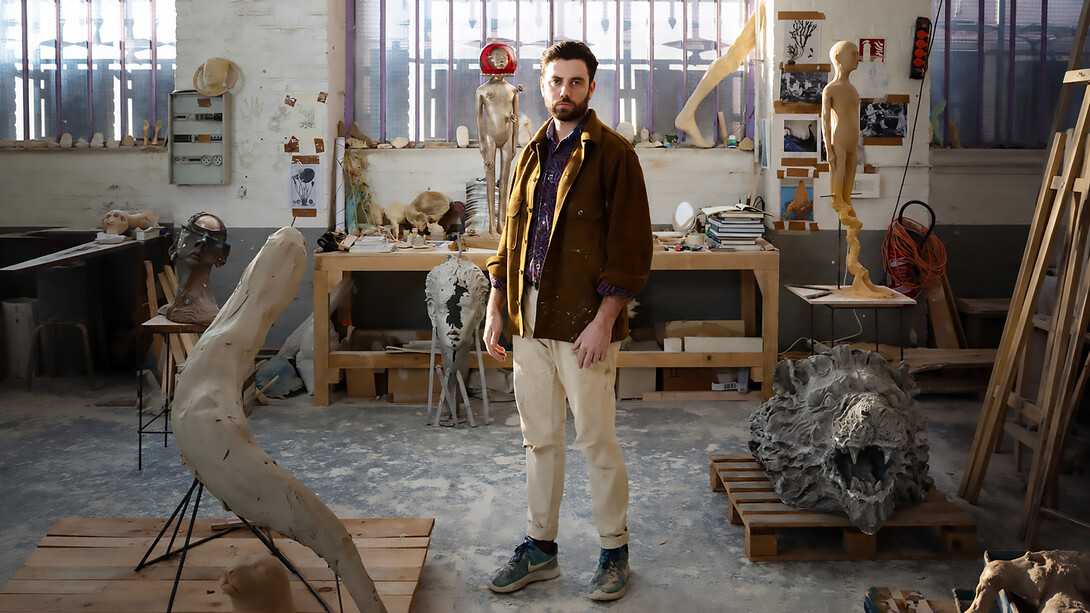
Presented at Palazzo Strozzi’s Project Space, Canto Infinito marks Jean-Marie Appriou’s first solo exhibition in Florence — a city that, as he reveals in this conversation, occupies a deeply personal place within his artistic imagination. Curated by Arturo Galansino, the exhibition unfolds as an initiatory journey shaped by thresholds, metamorphoses and symbolic passages, drawing inspiration from Dante’s Divine Comedy while extending toward a broader constellation of literary, mythological and historical references. Working across bronze, glass, clay and metal, Appriou creates sculptures that inhabit unstable territories between the human and the animal, the archaic and the contemporary, the terrestrial and the otherworldly. Yet Canto Infinito is not conceived as an illustration of literary sources. Rather, it proposes sculpture as a living space of transformation – one in which matter retains the memory of its making and meaning remains deliberately open.
In this conversation with Raffaele Quattrone, Appriou reflects on Florence and Ghiberti, Dante and William Blake, Egyptian cosmologies and alchemical fire, while revealing how his practice seeks to dissolve fixed oppositions – between paradise and hell, function and metaphor, and body and spirit – in favour of a more fluid and uncertain terrain. What emerges is a vision of sculpture not as a static form but as a passage: a threshold through which histories, materials and imaginaries continue to move.
Florence seems to play a central role in this project. Could you tell me how it began?
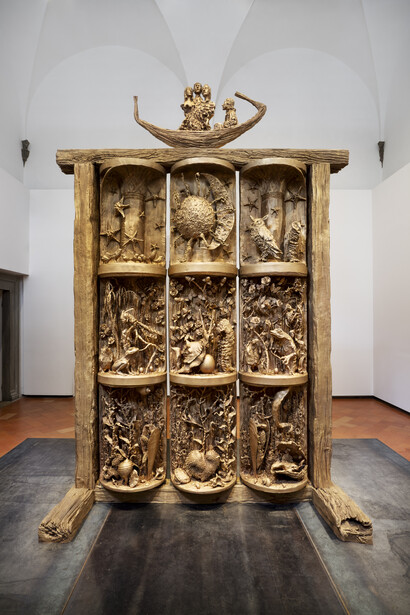
Florence has always been very important to me. When I was studying in Brittany, I had an Italian professor, Alberto Mecarelli, who told me very early on: “Go to Florence. If you truly want to understand sculpture, you have to go there.” So I made this almost initiatory journey, much like so many artists before me since the Renaissance. Of course, there is Ghiberti’s Baptistery door, which Michelangelo famously called the Gates of Paradise. And then, centuries later, Rodin created his Gates of Hell. When Arturo Galansino invited me, I felt it was the right moment to speak about Florence — about my relationship with the city, but also with literature, especially Dante and the Divine Comedy, which later inspired extraordinary works by John Milton and William Blake. That is when I began thinking about creating a gate of my own. But I did not want it to belong solely to paradise or to hell. I wanted it to exist in a kind of third dimension.
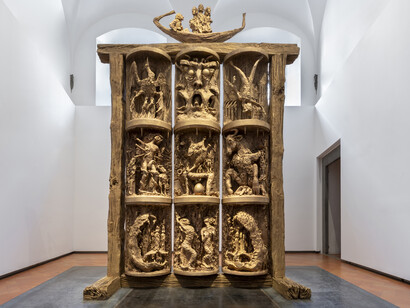
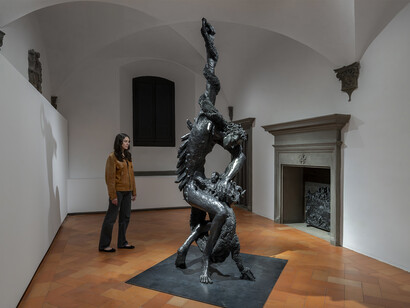
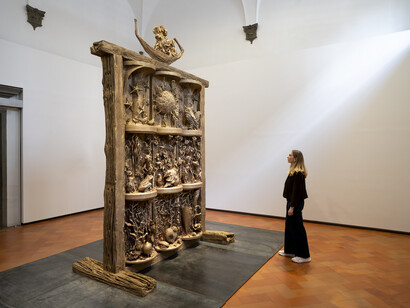
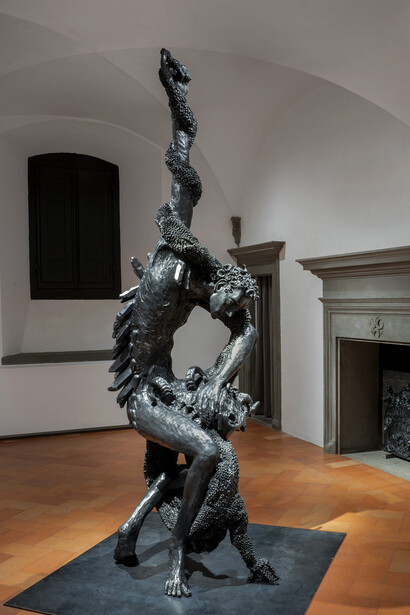
The rotating cylinders recall Japanese torii — spiritual gates that mark a passage. But here I wanted visitors to be able to compose their own relationship between paradise and hell. Life is more complex than black and white. It is made of compositions and nuances, and we create those compositions through action – through what some Asian traditions would call 'karma'. It is through action that we shape our own balance. In a way, it is a sculpture for thinking. Then there is the other work — the stove — which stages the struggle between the angel Gabriel and the dragon. It can actually be opened and used to light a fire. The entire exhibition revolves around this duality between good and evil. But I wanted to show how deeply intertwined these opposites are. The angel and the fallen angel are almost brothers; theirs is a fraternal struggle.
What interests me is movement — both formal and conceptual. I think of the torsion in Giambologna’s sculpture, that tension twisting back onto itself. That is precisely what fascinates me in sculpture. This is why I wanted the work to function as a real object, capable of holding fire. Imagine a sculpture that can genuinely be touched and used. For me, this is about creating a direct, physical and immediate relationship with sculpture.
I had not realised these works could actually be touched.
Yes — especially this one. They are functional sculptures.
The one involving paradise and hell?
Exactly. From the beginning I did not want these works to be merely objects to contemplate. Their functional dimension matters. I am very interested in Egyptian art and sculpture. I travel regularly to Egypt to confront ancient monumental sculpture – a world that predates the Greeks. What fascinates me about Egyptian sculpture is that the notion of art was completely different from ours. Today we tend to think of art as an object to look at and reflect upon. In Egypt, sculpture always had a function. Sometimes it was magical — intended to accompany the dead through a process of passage. And this is interesting because Dante, in the Divine Comedy, is also speaking about an initiatory journey. In many ways, that is what this exhibition is about: passage. Dante draws indirectly from Greek culture, which itself inherited much from Egypt. Everything becomes an initiatory path.
There are also references here to the Apocalypse. Dante was deeply influenced not only by the Book of Revelation but also by apocryphal visions attributed to Saint Paul. Again, we encounter the idea of crossing, of transition. Then Dante writes the Divine Comedy, which later inspires Milton’s Paradise Lost, and then William Blake. Each time we encounter the same question: how do we imagine what comes after death? But perhaps it is not really about death itself. It is about what lies beyond — or what remains hidden. That is also what interests me in objects. At first you see a sculpture, and then suddenly you discover that it possesses another function. This is what I find so beautiful in Egyptian art. Sarcophagi are sculptures, certainly, but they are also layers of understanding — instruments for moving through a journey.
Are these functions intrinsic to the works, or are they primarily metaphorical?
In the case of the gate, it is mostly metaphorical. It is similar to Tibetan prayer wheels — it is the act itself that generates concentration. Something happens through movement. Japanese torii work in a similar way. They are not doors in a practical sense; they represent a mental and spiritual passage.
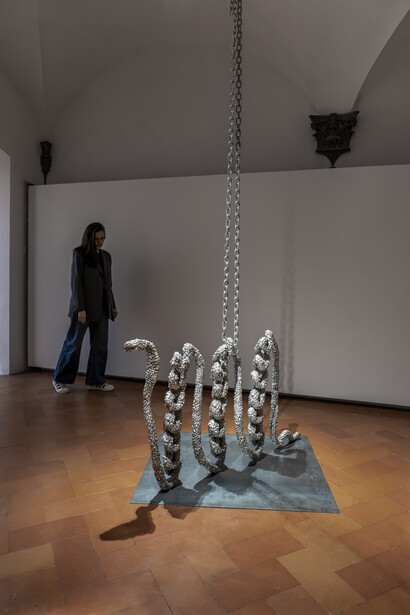
Here, however, I wanted the function to become real. There was a fireplace in the exhibition space, and I thought, I will create fireplace plates and also a stove. There is an aspect of my work that is rarely discussed but is essential. If I work with bronze, glass or ceramics, it is because there is something fundamentally alchemical in these materials. There is the crucible where metal melts, the duration of firing, and the transformation of matter itself. I wanted fire to become a subject in its own right — almost a character within the work. The possibility that someone might imagine lighting the fire inside the serpent and that the sculpture might genuinely become a source of warmth interests me enormously. It means bringing the work into everyday life, into intimacy, into the home. At that moment, the viewer becomes the alchemist.
So it becomes a kind of ritual?
Yes. I would like sculpture to become something ritual for the viewer, rather than remaining only a contemplative object placed on a pedestal – something people look at and say, “It’s in a museum; we cannot touch it.” What interests me is precisely the possibility of creating another kind of relationship with the work.
I was also thinking about the idea of boundaries. In the gate, paradise and hell rotate, so there is no fixed border between them. And here too, these two figures are intertwined. Beyond these specific works, is your practice also concerned with identities that transform, shift, and resist clear definitions?
Yes, very much so. The angel’s hair, for example, is made from horns. The horns, the hair, even the eyes — they belong to the same material, the same nature. The horns represent the fallen angel, the devil, while the hair belongs to the angel himself. I wanted to suggest that Satan was originally an angel, and perhaps that an angel, too, might become Satan. It is an endless movement. We carry both good and evil within us. And this is always something that must be chosen.
If we look at the world today, we can feel this tension very clearly. I made this exhibition in a particularly tense historical moment, and I wanted that atmosphere to be present within the works themselves. The two figures are fighting over a key. The key — whose shadow appears on the wall — raises an open question: the key to what? The title is The Key, but I wanted the meaning to remain unresolved. At first glance the serpent seems defeated by the angel. Yet the serpent still holds the key. It almost breaks the angel’s arm and remains locked in tension with him. In the end, we do not know who is winning.
Another aspect intrigued me. The exhibition evokes Dante’s canti, and the very idea of canto suggests music and rhythm. Sculpture, on the other hand, is often perceived as silent. How did you think about this exhibition in relation to the idea of song or canto?
People often say sculpture is silent. But for a sculptor, form has its own scores and rhythms. Think of Giambologna and the torsion of the Rape of the Sabine Women. Or Michelangelo’s Prisoners at the Accademia — there are always tensions, spirals, internal movements. Sculpture has its own visual partitions, its own way of composing movement. My professor used to speak about the Möbius strip: it passes in front and behind and returns onto itself. There is a sense of infinity. I think canto works in much the same way. It is repetition, return — almost a mantra. And sculpture can function like that too. To make figurative sculpture today is, in a sense, to create a mantra — to enter into dialogue with the past and with what is still to come, to remain within a continuity, and to continue questioning the world. Through that repetition, sculpture becomes almost spiritual. I do not know if I have answered your question…
Absolutely. It makes me think of literary works such as The Songs of Maldoror.
What interests me is precisely the deep connection between sculpture and literature.
This exhibition is also a way of speaking about literature.
And what draws you to literature in particular?
For this exhibition, the Divine Comedy is naturally the starting point. But I also love Milton, and that is why his presence runs throughout the exhibition. Recently I have been returning to writers for whom Dante was essential — John Milton, William Blake, … And I love Shakespeare as well. In fact, my next exhibition will once again revolve around Shakespeare.
So your language is profoundly symbolic.
Yes. Absolutely.
Is there a connection between the materials you use and these symbolic references?
Yes, very much so. This piece, for instance, is a kind of radiator. In a way, it recalls Apophis, the serpent from Egyptian mythology — a figure that lies at the origin of many ancient narratives and indirectly contributed to the biblical imagination surrounding Satan and the serpent. Its origins are far older.
And how does this connect to Dante?
Ancient Egyptian texts have only been translated relatively recently, but what interests me is understanding how ideas travel from one civilisation to another. When you truly engage with ancient Egypt — and I am deeply fascinated by it — you encounter the Book of Gates. It is a fundamental text. The sun, travelling through the night in its barque, must pass through a sequence of gates. Each hour corresponds to a gate, and to cross it, one must pronounce formulas and move through circles and thresholds. We find similar structures later in religious and eschatological texts that eventually influenced Dante.
In this sense, Dante belongs to a much longer continuity. The nine circles of the Inferno, for example, can be understood within this symbolic genealogy. The Book of Gates is therefore essential not only for understanding ancient Egypt but also certain continuities within the Western imagination. And then, after Dante, comes William Blake. There is a famous line in Blake: “If the doors of perception were cleansed, everything would appear to man as it is – infinite.” That sentence had enormous influence. Later Huxley wrote The Doors of Perception, reflecting on expanded consciousness and LSD. And Jim Morrison took the name of his band from that very source: The Doors. When I was a teenager listening to The Doors, I asked myself why they had chosen that name. From Morrison I arrived at Huxley, from Huxley to Blake, and from Blake to Dante. And then, continuing to move upstream, I discovered that before Dante there were the Greeks and the Romans — and before them, the Egyptians. Eventually I understood that all of this forms one great continuity.
The same current. Even today we remain deeply connected to this cultural inheritance, although we often fail to recognise it. If we look, for instance, at architectural columns, we see a lineage moving from Rome to Greece and back to Egypt. And yet we tend to forget these connections. Perhaps this is ultimately what interests me: weaving those threads together again.
Rebuilding, through sculpture, connections with forgotten worlds.
Exactly.
Let’s talk about materials. The exhibition seems to present very different surfaces and textures.
In reality, the entire exhibition is made of bronze, except for one sculpture in stainless steel. That piece had to be stainless steel because it can hold water and function as an actual object. Everything else — the gate, the stove, the sculptures — is bronze. It is the patinas that create the impression of different materials.
They almost look unrelated. At first I even thought some parts were wood.
The gate’s patina refers directly to Ghiberti and the Baptistery doors. It is a luminous, gilded bronze. The stove, by contrast, is more closely inspired by Rodin’s Gates of Hell. I realised that if I treated the gate with a patina similar to Rodin’s inferno, it would become too dark. And I did not want an inferno that was excessively sombre or overloaded with pathos. When we look at hell, we do not encounter darkness alone.
There can also be light. I think of Hieronymus Bosch or Gothic church art — not simply darkness, but matter capable of receiving light and transforming itself. Today we are fortunate because the weather has opened, and details appear that otherwise remain hidden. There are butterflies scattered throughout the works — in paradise as well as in hell. I include them because in Dante’s Inferno flies constantly surround the damned. But in Greek and Roman culture – and we find similar meanings among the Maya and Aztecs – the butterfly, especially the nocturnal butterfly, moves between worlds. It passes from the world of the living to what lies beyond. That is why I wanted butterflies to inhabit both paradise and hell. They can appear as demons but also as travellers. And this is precisely what Dante does with Virgil. He moves across different worlds. That was the allegory I wanted to create.
It is also incredibly beautiful — especially the colour, this bronze-gold tonality.
Yes. On one side there is the moon and nocturnal life; on the other, the sun and diurnal creatures. I researched these symbols extensively. In a sense, the compositions function almost like tarot cards. As the cylinders rotate, unexpected constellations emerge. There are benevolent images, and then suddenly another figure appears — perhaps death, or something more unsettling. That interested me very much: the possibility that someone might look at an animal and think, “What a beautiful turtle,” and then, a moment later, encounter a demon appearing unexpectedly. This figure, for example, is inspired by Canto XXV. It refers to one of Dante’s enemies. In that passage Dante is, in some sense, settling accounts with his contemporaries. The figure is devoured by a six-legged serpent. What fascinates me is how clearly Dante uses literature not only as poetry but also as a political and personal instrument. He transforms conflict into imagery.
Yes, Dante was profoundly political. His enemies often reappear throughout the comedy.
Exactly. And here there is also a small reference to Michelangelo. I gave this figure horns so that it would almost become Moses. Michelangelo’s Moses is, of course, one of the most celebrated sculptures in history. I wanted references to be scattered throughout the exhibition, almost like a labyrinthine game.
Like encountering a Minotaur at the centre of the labyrinth.
Precisely. Here we arrive at the realm of water. In a sense, the four elements are all present: water, earth, air… and fire, which corresponds to the infernal dimension. But fire exists everywhere in my work. Bronze has passed through fire. The serpent has passed through fire. The stove itself is fire. So there is also an alchemical dimension tied to the transformation of matter. There is a beautiful scene in John Milton’s Paradise Lost about creation. God creates the animals, but as they emerge from the earth, they seem to ask, "What are we doing here? Why have we been created?” I find this image extraordinary. Some creatures hesitate, which is why I placed a shell on the snail’s back. Milton writes magnificently about beings unable to decide whether they belong to land or water. They remain suspended between worlds. Some move toward the sea, while others remain on earth. The lions in Paradise Lost emerge from the ground like moles — which is why there is also a mole here. There is something almost ironic in Milton’s description of creation.
It is as though God himself were slightly naïve in bringing all this into existence. And the creatures seem to ask: “We never asked to be here.” I find that idea deeply poetic. All of this inhabits the exhibition.
Fire, in particular, seems to carry a special meaning for you. Is there something about it that draws you in?
Yes, absolutely. Since the beginning of time, human beings have gathered around fire.
There is something profoundly fascinating about it. I remember my first bronzes – seeing metal become liquid. Or my first ceramics, when soft earth suddenly hardens. There is something almost magical in that transformation. We live in an intensely electrical and artificial world, yet the moment a fire is lit in a fireplace, we suddenly feel at peace. For me, that feeling remains fundamental. I made my own bronzes for five years in my parents’ garden in Brittany. I built my own casting system and worked alone before collaborating with professional foundries. That experience allowed me to understand the transformation of matter from within — the patinas, the techniques, the limits and possibilities of sculpture itself. Not every sculptor has that kind of technical intimacy with the material. And when you truly know matter, you understand how far it can be pushed. That is precisely when you begin trying to go beyond it.