English
 Español
 Français
 Deutsch
 Italiano
 Português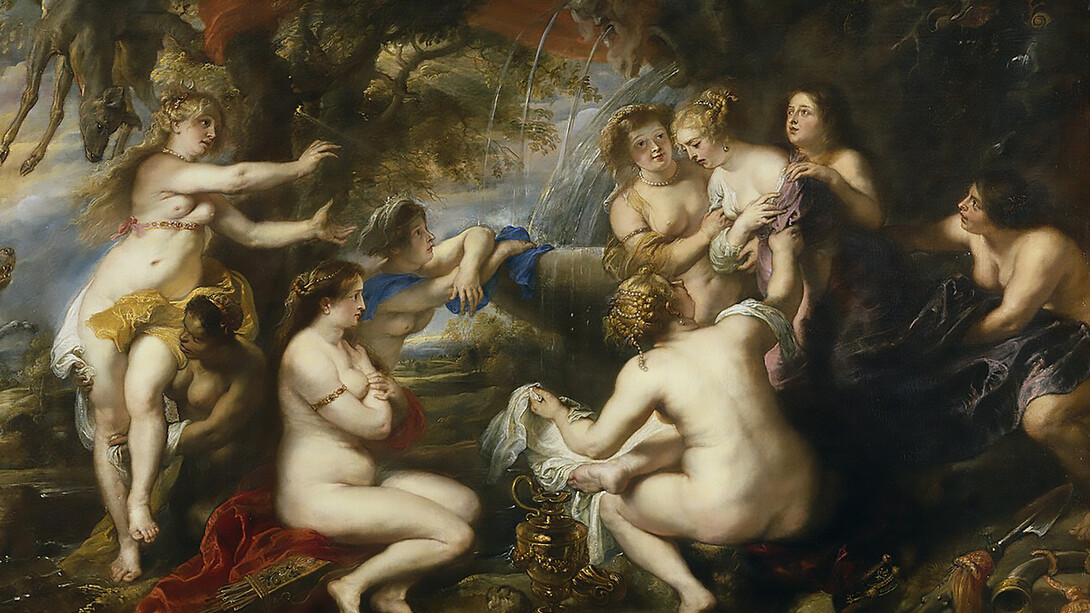
The light of love, the purity of grace,
The mind, the Music breathing from her face.(Lord Byron)
A flexible concept in art, as in other aspects of life, purity has been used as a metaphor for other qualities. Sometimes sacred, sometimes moral, sometimes physical, purity has mostly been considered in relation to women. Female purity has been represented in art throughout centuries, reflecting changes in social values and beliefs, as well as style. Mythology, religion and folk tradition created a rich vocabulary of visual symbols to represent physical and spiritual purity: the colour white, the lily, pearls, the dove, the lamb, symmetry of composition, and children.
The virtuous goddess
Emerging fully formed, fully armed and helmeted from Zeus’ forehead, Athena was destined to become a strong symbol of women's empowerment and wisdom. The feminine attributes of compassion, foresight and practicality won her the right to name the city of Athens and become its protector in a contest with Poseidon. As god of the oceans, Poseidon had the power to create earthquakes. He struck a mighty blow to the ground and offered the citizens of the yet unnamed city an underground sea. For a city with access to several rivers, the gift of salt water, although impressive, was of little practical use. Athena planted an olive tree, giving the citizens of Athens a source of food, oil and timber. (Another myth suggests that Poseidon’s gift was a horse, while Athena invented the bridle.) A symbol of peace, prosperity and purification, the olive tree is Athena’s most famous gift and a vital link with divinity.
Born of immaculate conception, Athena was one of the three virgin goddesses, along with Artemis and Hestia. Her virginity (Parthenos) – which gave name to the temple dedicated to her, the Parthenon – was not necessarily about a physical relationship. It symbolised freedom from desire or passion and the ability for rational thought and impartial judgement. Wisdom, often symbolised by an owl, was one of her most admired qualities. Like her Roman equivalent, Minerva, moral and intellectual purity is the source of power and authority; her sagacity enables her to successfully be the goddess of both peace and warfare.
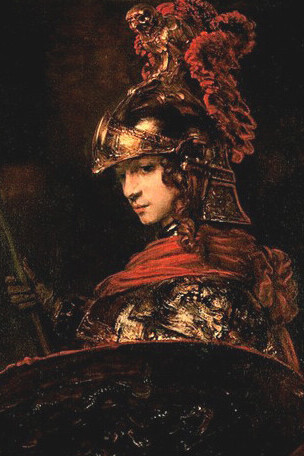
In one of the most recognisable sculptures, Athena Lemnia by 5th-century BC artist Phidias, the goddess appears calm and thoughtful but impassive. Her beauty is classical: a symmetrical face, full lips, eyes downcast as befits her modesty. Later artists were inspired by the richness of her armour, with Baroque painting representing Athena in action, a powerful and dynamic figure adorned with a shining helmet, holding a decorated shield. Pallas Athene by Rembrandt depicts the goddess clad in black armour, a red cloak around her neck and red feathers on her helmet. She holds a spear and shield, but these masculine accessories are balanced by the softness of her features and the curls cascading over her shoulder. The bust is a beautiful showcase of Rembrandt’s talent for detail and theatrical use of colour.
The virgin warriors
Other goddesses are more belligerent: Artemis (Diana, in Roman mythology), virgin goddess of the hunt, is often portrayed with a bow and arrow. Patron and protector of children, especially young girls, Artemis’s domain extended from forests and wild animals to childbirth and midwifery.
The first Amazon queen, Otrera, was the daughter of the nymph Harmonia and Ares, the god of war and courage. Amazons are often portrayed as embodying their parents’ attributes, combining beauty with fearlessness. According to Greek mythology, they lived a pure life, without men, raising their female offspring. The Amazons’ way of life, their courage and independence, and their focus and skill in warfare gave them an aura of moral purity, discipline and incorruptibility.
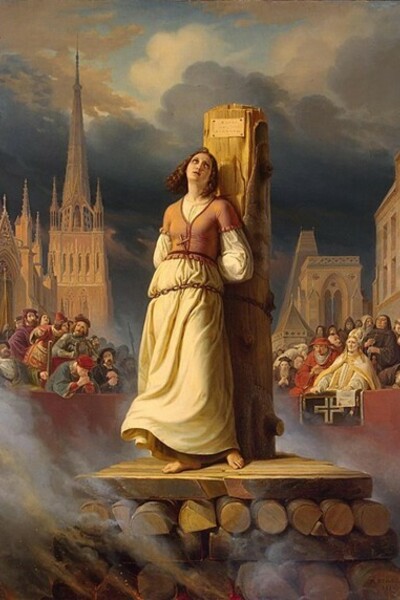
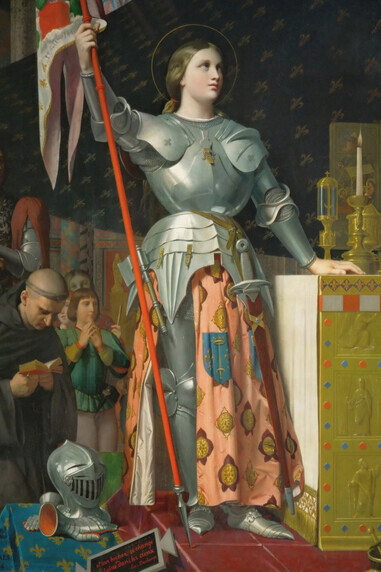
Virginity seemed to constitute a useful attribute in battle. Joan of Arc fulfilled a prophecy from her youth stating that a virgin carrying a banner will save France. The image of young Joan inspired many 15th-century epic poems, a play by Schiller (The Maid of Orleans 1801) and 82 further dramatic works, as well as songs, films, operatic adaptations and hundreds of paintings.
Joan was only 19 years old in 1431 when she was burnt at the stake for blasphemy, heresy, and cross-dressing. When the verdict was overturned on appeal 25 years later, she became a martyr and, after the French Revolution, the national symbol of France. Over the centuries, she has been represented in prayer as well as in battle. The picture of the maiden covered in her specially commissioned plate armour, carrying the banner she designed herself, represents a combined symbol of freedom, independence and virginity. In Jeanne d’Arc at the Coronation of Charles VII Ingres adds to these attributes a sense of style (just look at her shoes!) as she poses confidently, bathed in splendid light.
The mother
Reflecting the rise of Christianity, mediaeval art created the most powerful symbol of female purity: the Virgin Mary. The worship of mother and child was already four thousand years old: statuettes and amulets dating from the 7th century BCE feature the goddess Isis suckling her infant Horus, who was magically conceived. While earlier artists attempted to emphasise the human qualities of powerful goddesses, Byzantine icons show a real mortal woman in a rigid, frozen pose, lacking physical warmth. Purity acquired a moral and spiritual meaning, more important than human characteristics.
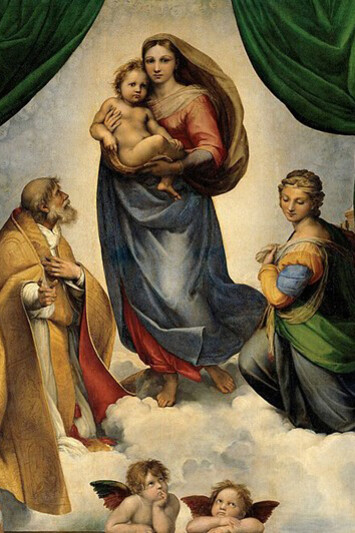
The Renaissance brought humanity and beauty back into purity. In the work of Raphael, Leonardo and Michelangelo, the Madonna is a mortal woman and a mother, yet she is flawless. The embodiment of moral and physical innocence, the Virgin is wrapped in soft blue drapes, sitting on the ground or on a rock against a stark landscape, a naked baby on her lap. Throughout the centuries, hundreds of versions of this image carried a message of compassion, purity and devotion and became familiar to most people on Earth.
Today, this image still embodies the purest form of unconditional love, the unbreakable link between a mother and her child. For many, the Madonna is also the tender mother and protector of all humanity.
The Virgin Queen
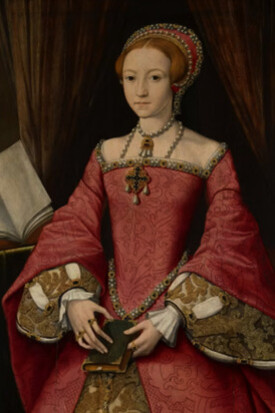
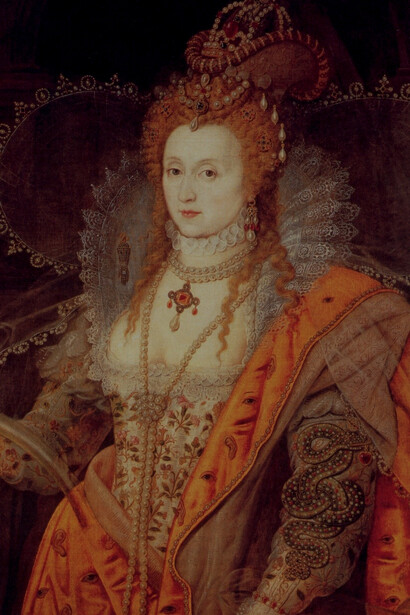
Elisabeth I was the daughter of famous parents Henry VIII and Ann Boleyn, both executed during Elisabeth’s early childhood. She became Queen of England and Ireland at the age of 25 and reigned until her death in 1603. Although it was expected of her to marry and produce an heir, Elisabeth remained celibate and used her unwed state for political manipulation throughout her 45-year sovereignty. In her youth she was celebrated for her beauty, as she grew older it was her virginity that defined her. In portraits she appears confident and strong: dressed in luxurious layers of clothes and adorned with lace, ribbons and opulent jewellery. In particular, she wears cascades of pearls, symbols of purity, virginity and tenacity. Her authority and virginity are interlinked. In Shakespeare’s Henry VIII, Elisabeth’s long reign and era of prosperity for England is prophesised:
She must; the saints must have her — yet a virgin;
A most unspotted lily shall she pass.
To the ground, and all the world shall mourn her.