English
 Español
 Français
 Deutsch
 Italiano
 Português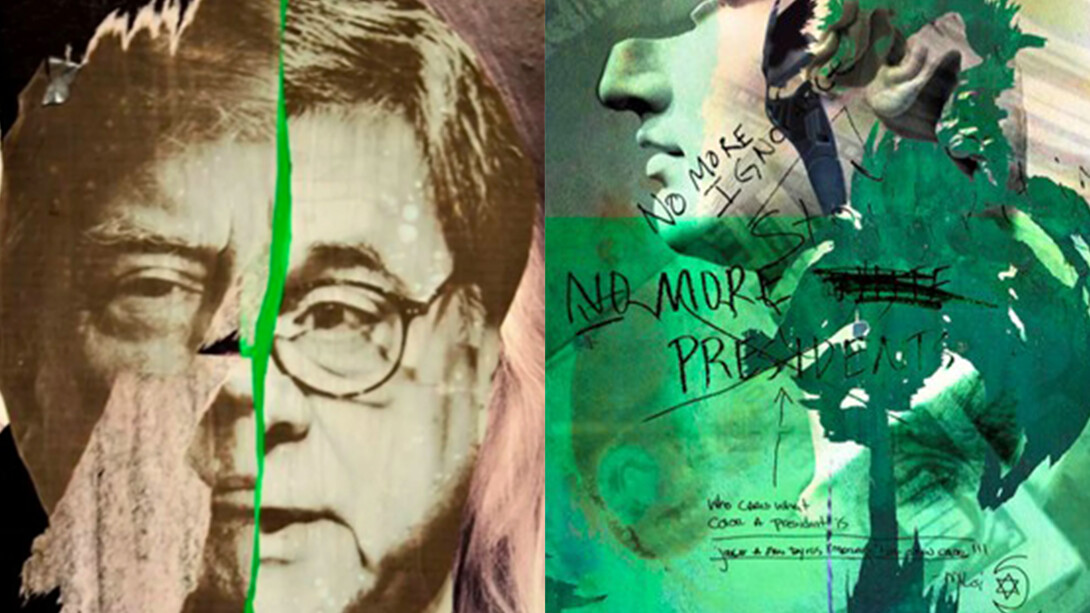
The kingdom of art has seen many kings and queens. Throughout history, movements rose, transformed culture, and eventually gave way to something new. The Renaissance gave way to Baroque; Romanticism’s emotional depth yielded to the precision of Realism, which later fractured into Impressionism’s fleeting light and color. The early 20th century brought Cubism, Dada, and Surrealism, which questioned not only how we depict reality but what reality itself means. Each transition reflected broader social and technological changes: printing, photography, industrialization, and the digital revolution.
Yet, many gems have remained hidden, undiscovered by the masses, quietly withering in the shadow of time. In the past, this was often due to a lack of technology or logistics. Artists were limited by geography, resources, or the slow pace of communication. Reaching people was difficult; exposure was a privilege.
In our current age, the art world has undergone another metamorphosis. The canvas has expanded beyond walls into pixels and screens, and the artist’s presence often feels both immediate and invisible. We scroll, we like, we forget. What is art now: a physical expression, a digital echo, or the documentation of a fleeting moment?
Today, paradoxically, the same idea has reversed. Technology has made it easier than ever to reach the world, yet harder to be truly seen. There’s so much online content that real art often gets lost. Artists now compete not only with each other but also with algorithms, trends, and the endless scroll of distraction. A photograph that took days to compose may vanish in seconds within a social feed. Emerging painters showcase their work on platforms where popularity can depend more on engagement metrics than on artistic depth. Digital illustrators face AI-generated art flooding online marketplaces. What once felt sacred, we now swipe past.
In this fast-changing digital world, Kendell Kerwin creates art that joins the spirit of the streets with the focus of the lens and the honesty of lived experience. Based in New York City since 1987, Kendell Kerwin (Kerwin K. Williamson) has spent decades documenting the pulse of urban life. His photography, often described as cinematic and introspective, transforms the city’s industrial landscape into a stage of quiet revelations.
Trained initially as a painter and illustrator, Kerwin began his creative journey by drawing cartoons and comic-book characters before moving into abstract painting in oil and acrylic. Between 2008 and 2010, he held nine solo exhibitions, collaborated with visual artist Irina Sarnetskaya on Ode 2 Muse, and participated in an international project titled In the Shadow of the Young Ones. His background in drawing, design concept, and critical writing continues to inform his visual language today.1
Kerwin transitioned to photography in the late 2000s, studying both film and digital formats and discovering in the medium a new way to frame perception. He now works primarily with fine art archival prints and digital originals, producing images that merge a cinematic touch with the raw energy of street art, vandalism, and late modern aesthetics. His art reveals a personal perspective that transcends gender or ethnic boundaries, instead focusing on how urban life shapes the way we see and feel.
Urban photography forms the core of his portfolio, though nature and people also hold an important place in his body of work. His photographs deal with composition, framing, pattern, balance, and chiaroscuro, using natural light to explore the dialogue between chaos and order, light and shadow. Within a primarily linear, industrialized, and techno-centric society, Kerwin captures fragments of its spirit. The unintended aspects of postmodern life permeate his photographs, creating a sense of alternate reality, as if each image were a reflection of both the world and its distortion.
Kerwin’s lens doesn’t merely capture; it recontextualizes. Each image is a silent story, a fragment of perception reframed outside its usual context. Through this process, he cuts through the inertia, ignorance, and apathy that often lurk throughout our urban environment. His visual storytelling invites us to pause, observe, and rediscover rhythm in the overlooked, beauty in the unintended, and humanity within the machinery of the metropolis.
To provide a glimpse from his lens, the image below represents how Kerwin draws from street art, vandalism, and late modern abstraction, merging them into a digital palimpsest. The surface feels alive, torn, rewritten, and overwritten. This mixed-media composition is an explosion of color, typography, and overlapping forms. A chaotic yet deliberate layering of visual and textual fragments.
The human profile, partially concealed under paint and graffiti-like marks, becomes a symbol of the fragmented posthuman identity: one that exists both in the physical and digital realms. The scrawled phrases (“No more presidents” and “Who cares what color a president is”) echo a sense of socio-political fatigue, a rebellion against systems of control and representation.
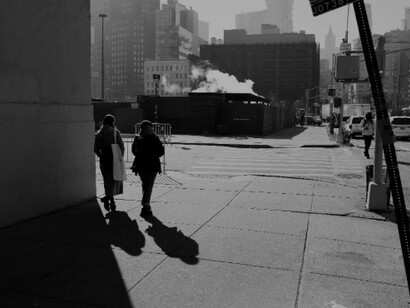
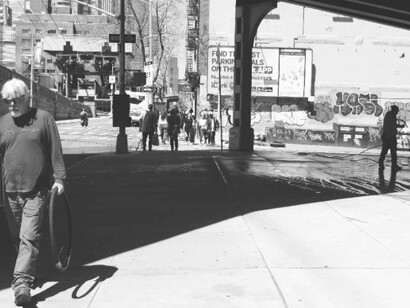
In contrast, his black-and-white street photography embraces minimalism and restraint. “The City” captures a crosswalk in midday, yet transforms this ordinary scene into something cinematic. The sharp angles of light and shadow carve geometry into the urban landscape, turning pedestrians into silhouettes that seem to move between dimensions: physical and abstract. Kerwin’s mastery of composition and chiaroscuro recalls both classical painting and modernist photography. But beyond formalism, the work reflects the alienation and rhythm of city life. The human figures are both part of and separate from their environment, absorbed by architecture, by movement, and by the quiet machinery of daily existence.
In another work of his, the image juxtaposes a homeless man and his dog with an advertisement reading “Beauty is between you and you.” The composition captures the cruel irony of late capitalism, where commercial messages of self-love and empowerment coexist with visible human suffering. Kerwin’s framing is deliberate and compassionate. The camera doesn’t exploit; it witnesses. The power of this photograph lies in its ethical awareness; the contrast between image and reality becomes a critique of how modern society aestheticizes everything, even poverty.

The posthuman theme emerges here again, as humanity is caught between digital idealism and physical vulnerability. By placing the corporate slogan against the raw truth of the street, Kerwin forces the viewer to confront the gap between constructed beauty and lived experience. The result is both poetic and unsettling, a silent protest against indifference.
Kendell Kerwin’s art compels us to stop, to look again, and to truly see. In a culture where everything is consumed and discarded within seconds, his work reclaims time, attention, and depth. His photographs and digital compositions ask us to engage with the unseen to find meaning in fragments, humanity in machinery, and truth in the overlooked.
Supporting artists like Kerwin is not just about celebrating talent; it’s about preserving the act of seeing itself. In a world ruled by algorithms and instant gratification, artists who confront, question, and reframe reality are vital. Their work reminds us that art is not a product to scroll past, but a mirror held up to our shared existence.
To appreciate art today means to slow down, to resist the speed of consumption, and to rediscover wonder in the ordinary. In doing so, we not only honor artists like Kendell Kerwin but also reclaim something profoundly human: the ability to feel, to question, and to truly see.