English
 Español
 Français
 Deutsch
 Italiano
 Português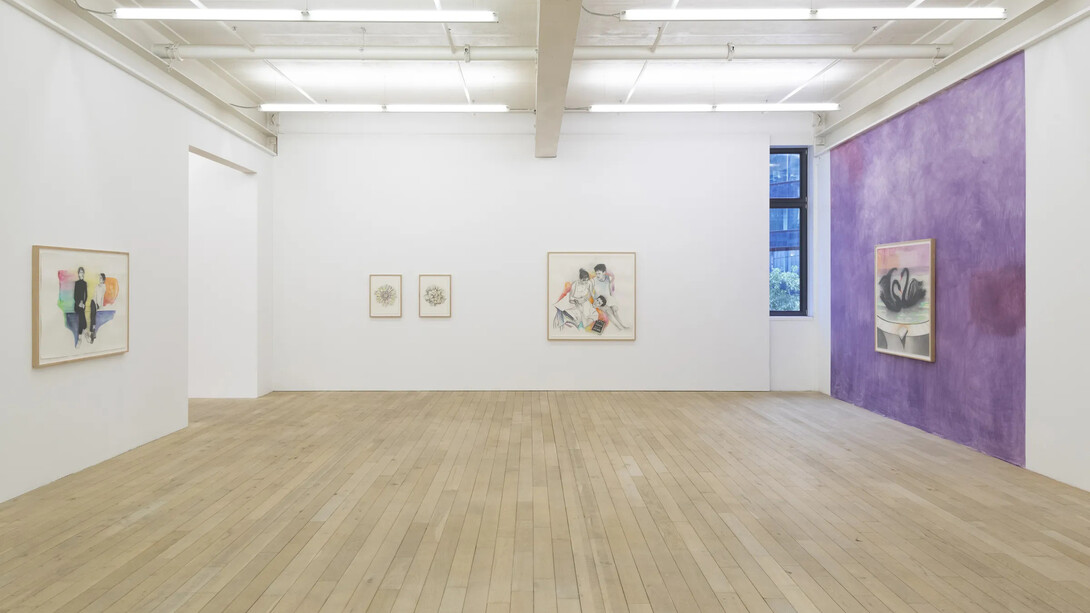
Galerie Peter Kilchmann is pleased to present Side by side, a new solo exhibition by Swiss artist Marc Bauer (b. 1975, Geneva; lives and works in Berlin and Zurich). The presentation in the gallery at Zahnradstrasse 21 reflects Bauer’s own queer perspective on friendship, passion, and intimacy. At its core, the exhibition explores not only the shared experience of closeness, freedom, and a carefree period of life, but also the social and personal significance of such moments of togetherness. New works on paper and canvas, as well as wall paintings unfold throughout the space. The wall paintings were created by Marc Bauer in collaboration with Samuel Obst. Specially for the exhibition, Berlin-based artists Sin Maldita (Tim Roth) and Philipp Hülsenbeck developed a soundtrack: a remix of anthems from the contemporary gay scene. Side by side is closely connected to Bauer’s current solo exhibition, Marc Bauer. Fear rage desire, still standing, at the Kunstmuseum Basel. While it similarly engages with the construction of masculinity, it does so in a deliberately lighter, more playful manner.
Upon entering the exhibition, visitors encounter a black-and-white wall drawing. It depicts a figure wearing an elaborate feathered headdress and a theatrical costume—a variety-show dancer—who gazes confidently outward with a welcoming smile. The mural is based on an archival photograph from the Der kreis balls of the 1950s. Der kreis Club in Zurich emerged in connection with the magazine Der kreis and hosted annual international balls that attracted hundreds of gay men from across Europe. Over time, the Swiss periodical, which was aimed at a homosexual readership, developed into a highly influential cultural and social institution. Published in Zurich between 1943 and 1967 in German, English, and French, Der Kreis was, for several years, the only magazine of its kind. It evolved into a significant voice within the international movement for homosexual emancipation and exerted a far-reaching cultural influence beyond Switzerland. At the center of the room, a display case presents the artist’s hand-drawn reproductions of selected covers and pages from the magazine. Through these works, Bauer reconstructs and reinterprets fragments of the publication’s history, offering insight into its role as a pioneering platform for queer community, visibility, and cultural exchange.
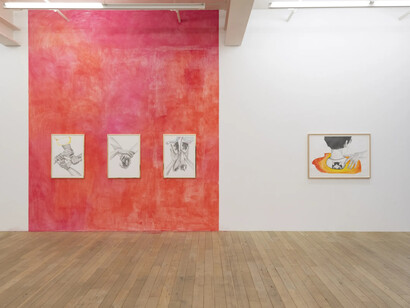
Emerging against a red pastel background, the three works on paper Solace and joy (Pink and blue), Solace and joy (Together), and Solace and joy (Yellow) (all 2026, 70 × 50 cm; pencil or pencil and watercolour on paper) focus on the delicate and intimate gestures of hands in contact. In one of the works, for example, Marc Bauer depicts a composition of four hands arranged to form a square. A thumb gently presses the skin beside a little finger, subtly shifting its surface. With remarkable precision and sensitivity, the artist renders veins, fingernails, folds of skin, tonal variations, and rings in pencil. Through a nuanced interplay of light and shadow, Bauer achieves an extraordinary sense of tactility and presence. A shirt sleeve, accented with fresh washes of yellow and orange watercolour, introduces a vivid chromatic counterpoint to the otherwise restrained composition. The frames of the works are crafted from brass. When touched without gloves, the metal gradually develops dark traces through oxidation.
These marks serve as a metaphor for the fragility of friendship: if not tended to with care, encounters and experiences may leave lasting impressions that cannot easily be erased or reversed. Another work from the new Solace and Joy series presented in this room is Solace and joy, your hand on my neck (100 × 70 cm). The drawing depicts a cropped side profile set against a background composed of subtle gradations of yellow, green, and blue. The portrayed figure has their eyes closed; one hand rests gently against their cheek, while their own hand firmly clasps it in return. The figure’s skin appears at once soft and full, conveying a palpable sense of corporeal presence. Bauer’s meticulous rendering of the folds of the T-shirt further suggests the traces of a life lived within the body it envelops. Through these intimate gestures and carefully observed details, the work evokes a profound sense of tenderness, trust, and emotional closeness.
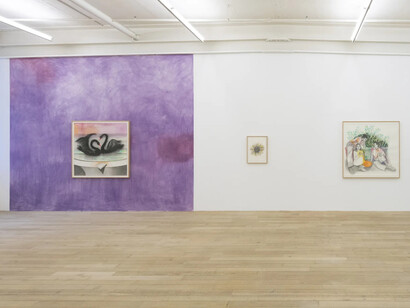
In the second room, the work on paper Je sors ce soir (2026, 119.5 × 115 cm) is mounted on a violet-painted wall. Depicting two black swans, the drawing employs a visual language that oscillates between intimacy, estrangement, and symbolic resonance. Bauer derives the motif from a historical image featured in the exhibition The first homosexuals: the birth of a new identity, 1869–1939, currently on view at the Kunstmuseum Basel. The two swans incline towards one another beneath a sky glowing in soft shades of red, orange, and magenta. Along the lower edge of the composition, Bauer has rendered a drawn copy of Guillaume Dustan’s Je sors ce soir. This autobiographical queer novel chronicles a night within the Parisian gay scene of the 1990s—a world of techno music, pleasure, excess, and sex. With the largescale work on paper Self portrait, fou de Vincent, Hervé Guibert, 1989 (2026, 210 × 150 cm), Bauer depicts a dog gazing with loyal eyes towards a copy of Hervé Guibert’s Fou de Vincent (1989). The book recounts a passionate and obsessive love affair between two men. The wall behind the work is painted in a gradient of turquoise blue and mint green, creating a chromatic environment that heightens the drawing’s emotional atmosphere.
Throughout these works, books become silent companions to the depicted figures, opening associative spaces between desire, vulnerability, and memory, while simultaneously pointing to Bauer’s research-driven and archive-based artistic practice. Renowned for his meticulous, hyper-realistic drawing technique in pencil and graphite, Bauer develops his works through a laborious process of drawing, erasing, smudging, and reworking. In the rendering of the dog’s fur, for instance, he achieves a remarkable tactile presence, creating the illusion of individual hairs and evoking an almost irresistible desire to touch the surface. The room is further complemented by works depicting groups of figures seated in close proximity and engaged in conversation.
Like the portraits and hand compositions in the first room, these drawings are based on photographic studies produced by the artist in his studio. Among the additional works presented are The friends (Long talks) (82.5 × 115 cm), the series Side by side (all 36 × 51 cm), and Less than zero (2026, 121 × 115 cm). In the latter, three figures recline together on a meadow, leaning against one another as communication gradually recedes into the background. By incorporating Brett Easton Ellis’s Less than zero into the composition, Bauer once again introduces a literary reference into the drawing. The novel’s themes of alienation, excess, and emotional emptiness within a privileged youth culture resonate subtly with the work’s atmosphere of intimacy and detachment.
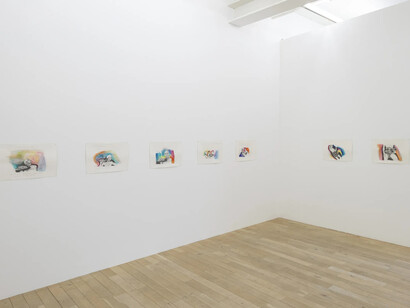
The third room is an ode to the queer club culture of the 1990s. In a large-scale painting on canvas, Bauer depicts a waiter serving grapes at the club Labyrinth in Zurich. The work is inspired by a sequence from a video documenting the Labyrinth schutzraumparty held on October 22–23, 1994. Prompted by this archival footage, Bauer created a series of additional works on paper in watercolour, charcoal, and pencil, which are installed on the opposing wall. Reflecting the aesthetic qualities of the historical video material, these drawings are rendered in a blurred and deliberately indistinct manner, evoking the fleeting nature of memory and mediated images. With Side by side, Marc Bauer constructs a multilayered constellation of memory, archival material, and contemporary image-making. Bringing together reflections on intimacy, desire, and queer forms of sociability and celebration, the exhibition juxtaposes historical moments from a period when queer identities could rarely be lived openly with the artist’s contemporary perspective. In doing so, Bauer creates a space for collective reflection on the continuities and transformations of queer experience across time.