English
 Español
 Français
 Deutsch
 Italiano
 Português
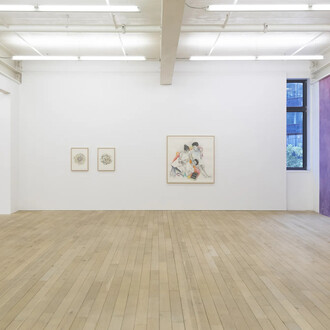
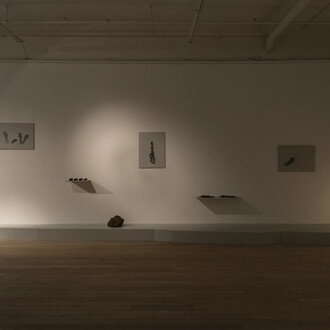
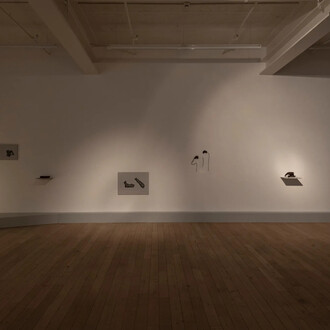
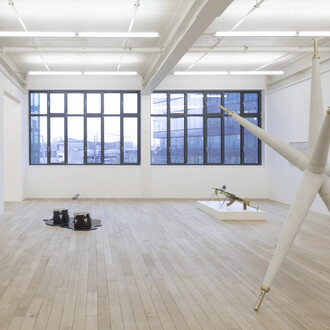
Galerie Peter Kilchmann is pleased to present Erledigt (Done), the second solo exhibition by Swiss artist Christoph Hänsli (b. 1963 in Zürich, where he lives and works) at the gallery and his first at our Rämistrasse premises. Hänsli is renowned for depicting found or collected everyday objects—often easily overlooked— at a 1:1 scale in his figurative painting. He subtly incorporates a quiet, understated humor, which endows his work with its irresistible, effortless charm. In Erledigt, new paintings in small and medium formats, executed in acrylic on canvas or MDF, as well as acrylic on canvas mounted on MDF, from the years 2024 and 2025, fill the gallery spaces on Rämistrasse. At the center of the exhibition is a new series of works: painted lists in various forms, such as checked-off or crossed-out to-do lists and shopping notes. Occasionally, the artist interrupts this new repertoire with familiar motifs from his oeuvre.
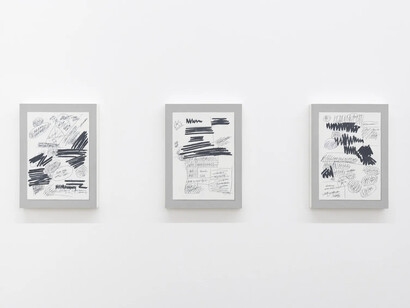
Lists are a familiar tool that accompanies us in everyday life. We often create them daily, and as soon as the tasks noted are completed, new ones emerge. In this way, a seemingly endless cycle unfolds: noting, completing, checking off, and recording anew—a continual interplay of remembering and forgetting. Hänsli presents these lists at the moment when they have lost their practical utility. Through painting, the artist transforms them into poetic, sensual objects, effectuating a shift from reading to viewing. The human figure is absent in these works—as is often the case in Hänsli’s oeuvre—but reappears through traces of everyday activity, such as handwritten tasks. In the work Erledigt, diner (Done, diner 2024, 18 x 12 cm), for example, a to-do list is depicted, with words and sentence fragments highlighted in yellow and orange fluorescent marker. Subsequently, some entries have been emphatically crossed out. One can still decipher: Wandfolie, E-karte machen, rechnung, diner/preview (“Wall foil, make e-card, invoice, dinner/preview’’). A large scribble in the center of the sheet indicates that it was later used to test a pen. Hänsli develops his works through numerous layers of paint, from the background to the final brushstroke in the foreground. In Erledigt, diner, this practice is particularly evident, describing a chain of moments, all of which belong to the past.
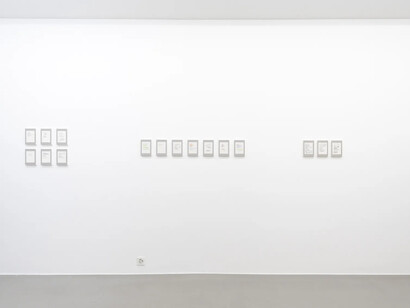
A sheet of paper, whose emptiness is broken by a sweeping scribble in the upper left corner, is depicted in the work Erledigt, test (2024, 18 x 12 cm). Upon closer inspection, the layered, dynamic gesture of the painting process becomes visible, from which the white sheet of paper takes shape. From this series, works composed of one, three, four, six, seven, twelve, or even twenty-four parts will be exhibited. Through the often firmly crossed-out tasks or keywords, the works are gradually transformed into abstraction; the eye perceives shapes and patterns, leaving viewers with the question of what was originally written.
Another work on view is Kein speck (No bacon, 2025, 14 × 18 cm), a sky-blue Post-it painted on canvas, bearing the inscription Im moment kein speck! (Currently no bacon!). The Post-it signals what is temporarily unavailable or sold out. The work Alles entsorgen (Dispose everything, 2025, 14 × 18 cm) similarly depicts a painted Post-it. The artist found it on the street: the items to be disposed of were already gone, leaving only the Post-it behind. The artist’s long-standing interest in typography and language has accompanied his practice for many years, as is also evident in Heisses fleischkäseweckle (2025, 19 × 26 cm), executed in a light gray and white color palette. It depicts a white paper plate featuring a hand-written, cursive advertisement for a “hot meatloaf roll” priced at 2.90 euros. In this work, Hänsli refers to an object without actually showing it.
With Wurstzipfel (Sausage tip, each 22 x 30 cm), the artist depicts three sausage ends, positioned differently against a white, layered background. Hänsli presents them as small, brown and flesh-colored sculptures that, with confidence and self-assurance, take center stage. In this way, the artist highlights what typically persists: the leftovers. The sausage in its various forms—such as the sausage slice (publication cf. Christoph Hänsli, Mortadella, 2008), the folded slices (Dreifaltigkeit (Trinity), 2024/25)—as well as its absence, constitutes a recurring motif in Hänsli’s work.
Abdeckung sicherungen (Fuse cover, 2025, 47 x 37 cm), Geschlossene lucke (Closed hatch, 2025, 31 x 40 cm) and Spind (Locker, 2024, triptych, each 85.5 x 55.5 cm) engage with a familiar motif in Hänsli’s work: closed coverings that prevent viewers from seeing what lies behind them, compelling them to experience the surface brushstroke by brushstroke while never knowing what is concealed behind the closed door. At first glance, the three-part work Spind presents three identical dark green locker doors. Over time, however, they have developed patinas reminiscent of wet reeds or forests at dusk. Earlier labels, which might have provided clues as to the lockers’ contents, are deliberately absent; only their holders remain. This ensures that what lies behind the doors remains uncertain.
Finally, there is the small black beetle in the work Blattkäfer (Leaf beetle, 2025, 20 × 29 cm). Delicate and painted in an almost calligraphic manner against a white ground, the beetle is, quite literally, terminated. It has been impaled by a small silver pin that rises from its back like a pearl, like a piece of jewellery. Its body is gently accompanied by a light gray shadow. With his solo presentation Erledigt, hänsli invites viewers into a cosmos in which he assigns meaning to everyday, human traces—meanings that, in an increasingly loud and hectic world, allow us to come to rest and offer a sense of belonging.