English
 Español
 Français
 Deutsch
 Italiano
 Português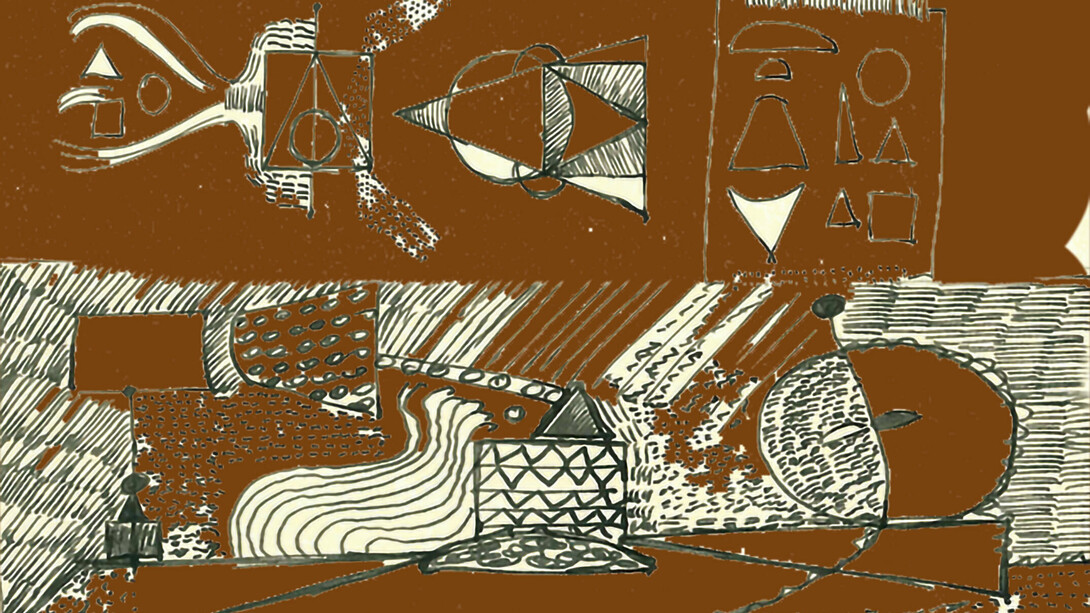
When we talk about art and artists, we often place the artist in a futuristic sphere—expecting them to indulge us, awaken our souls, touch our senses, and reveal the invisible nature of things. Yes, the artist approaches aspects of life (all things) through a unique and personal perception—themes, objects, events, and life itself—in ways that unsettle the familiar.
In this regard, the others—the non-artists—often feel both fascinated by the arts and estranged from them, as if lacking the lens to see beyond the visible. Though this may be true, I believe such perception is not exclusive. We can only be certain of the element inborn in the artist’s psyche: the invoking need to create. But all the rest is about cultivation—through study, devotion, and slow attunement to outer form and energy. Therefore, seeing as what the artist does is an ability that can be achieved by everyone.
While the way a theme is brought forth relates to the distinct inner element—the one that makes us different from each other—at a macrocosmic level, we are all part of the same recreative process of life and death.
There are many moments when I enter into self-reflection after a creative process has ended. In these moments of meditation, I become an observer of my own imagining process. It is not a simple thing to do, but I try—and I believe anyone can do this too.
In this article, I would like to step away from referring to someone known or to known literature. My intention in writing is to reveal a raw passage of this observation. The only source I am using is my own notes.
However, there are people who, through their works, have influenced and helped me cultivate a kind of individual perspective on visual art and its philosophy—to find my inner distinct ingredient that makes me unique as a human-artist. In seeking that distinct element, I often undergo periods of self-observation, trying to understand what it is and how it might become a guide to my artistic practice.
So far, I think that an individual’s uniqueness relates to one’s perception, which includes seeing, feeling, and acting—the way of being. For some years now, I have practiced recording the meditative process that begins after concluding an artwork. My self-reflective practice includes remembering, observing, and then analyzing the mind itself—apart from the artwork I create.
So here, I would like to talk about something that I find often appearing in my written notes.
The starting thought and its plasticity
This is the process of a single thought operating in silence, echoing from the invisible, engaging the mind in a creative encounter. It happens unconsciously, through an autonomic response to the moment I feel the urge to create—it can be anything, but it mainly arises from an emotional inner state.
As far as I can understand, through my observations, I am aware of its point of arising, but I do not engage with it rationally—I simply follow its percussion. The reason I do not rationally engage relates to the free-flowing nature of this thought. When an interruption occurs, I become stagnant in the act of creating, and thus no artwork can begin on the horizon.
Still, I am aware when it begins within, and this understanding came much later in my art practice. It is fair to admit that I do not possess the knowledge to explain this phenomenon clearly. Yet I remain faithful to the idea of being a doer of visual art, and I continue writing as an expansion of the creative work.
Therefore, I see the starting thought as an object to be observed and artistically analyzed—and then, intentionally, I allow this moment to unfold as a conversation with myself, or a monologue plastique.
Intentionally, I use plasticity to define the nature of a meditative process directed toward this particular inner thought. Plasticity gives us the opportunity to relate simultaneously to the inner world of phenomena and psyche and to the outer world of occurring things.
The question arising from within each time I engage in a creative endeavor pertains to the very nature of the explorative curiosity emerging from the artist’s psyche—also a cultivated mechanism. The wandering into the why, searching beyond the visible, can only be honored by the statement that in art practice, the subject and the object are destined to intermingle constantly with one another.
Thus, in such a way, bearing both worlds within, a single thought can evoke an entire process of exploration and creativity.
The opening thought: Monologue Plastique
A form—a visible one—emerges:
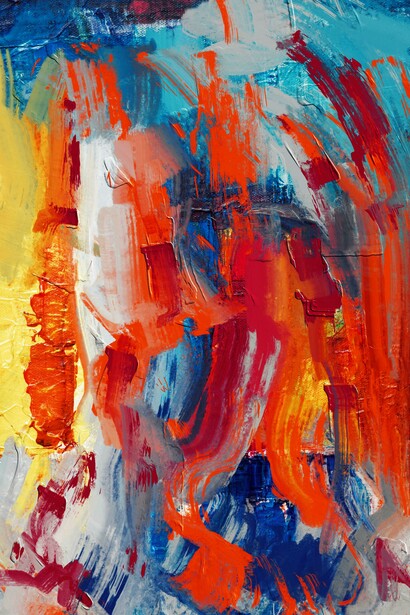
The human head, seemingly remembered.
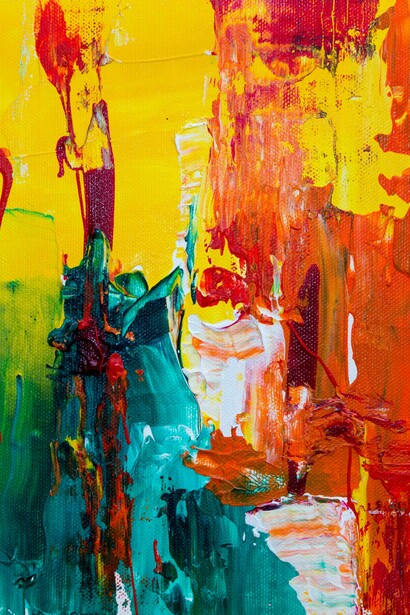
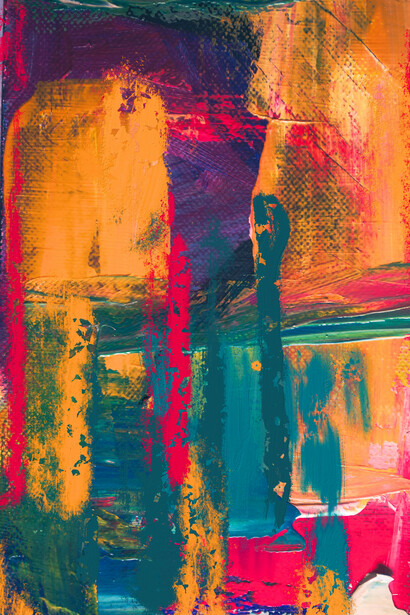
Thoughts within thoughts begin to move in all directions, infused with color and qualitative tones: blue, red, green, and others.
Often, one encounters a moment of determination:
Which color to choose, and which to leave behind?
Is there one that dominates the rest?
Or perhaps a constellation of two or three?
Here, now, fear arises within the question itself.
—You see it?
It is clothed in grey and tones of black, scattered here and there, trying to stop the rhythm of this thinking thought.
—But it cannot be a flaw in the rhythm. Determination is the way.
Behind this veiled moment, another voice arises.
The voice seems to take shape, pushing for more certainty.
Then, all thoughts begin to expand their nuances, subsequently breathing within the form.
What resonates more vividly than the others?
And what is there, building harmony?
A remembering pain surfaces, and colors begin to vanish.
The form itself, now, has become transparent.
In the most isolated point of this thought—where the heavy breath does not suffocate the flow—there is a resting time.
Chronos, appearing in black.
All things begin to move onerously around the entire space.
Everything transforms into a noisy, playful movement.
In some other part of this chaotic performance, thought stands alone.
Alone, it takes some time (Chronos) for itself.
It stops thinking, just observing its own stillness.
Then, it transforms into another figure:
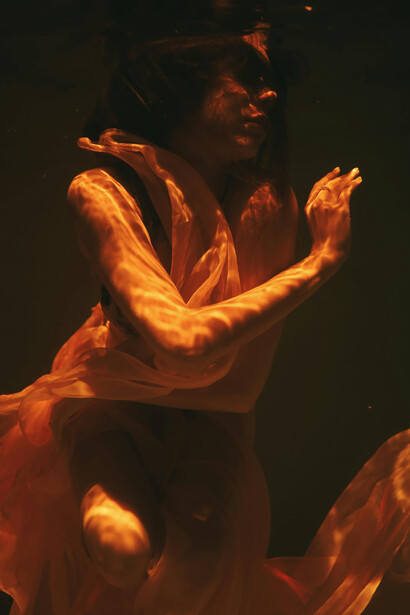
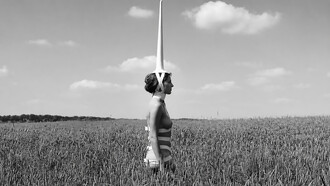
A human profile—standing alike.
Now, the form seems immersed in the abstraction of its own curiosity.
It stands in-between worlds and decisions, for everything is turned into wonder at oneself.
Meanwhile, a thin ray of light expands throughout the entire form.
It covers even lines and shades—the veiled ones, visible and invisible—in the field where thought’s thinking had been dispersed.
Light directs the path of the seeing mind through its courage-driven vision.
At this moment, everything is transforming into a becoming—
A new figure, a new form of oneself.
Although new, this form remembers the one before.
The one who was trying not to fear the fear within,
Not to stop its flow of transformation,
The one that was staring at itself in the midst of abstraction.
In the end-process, harmony and unity arise on the surface.
Giving life to the new coming —
A visible vibration of the thought that was just a hint
In the realm of thing-creation.