English
 Español
 Français
 Deutsch
 Italiano
 Português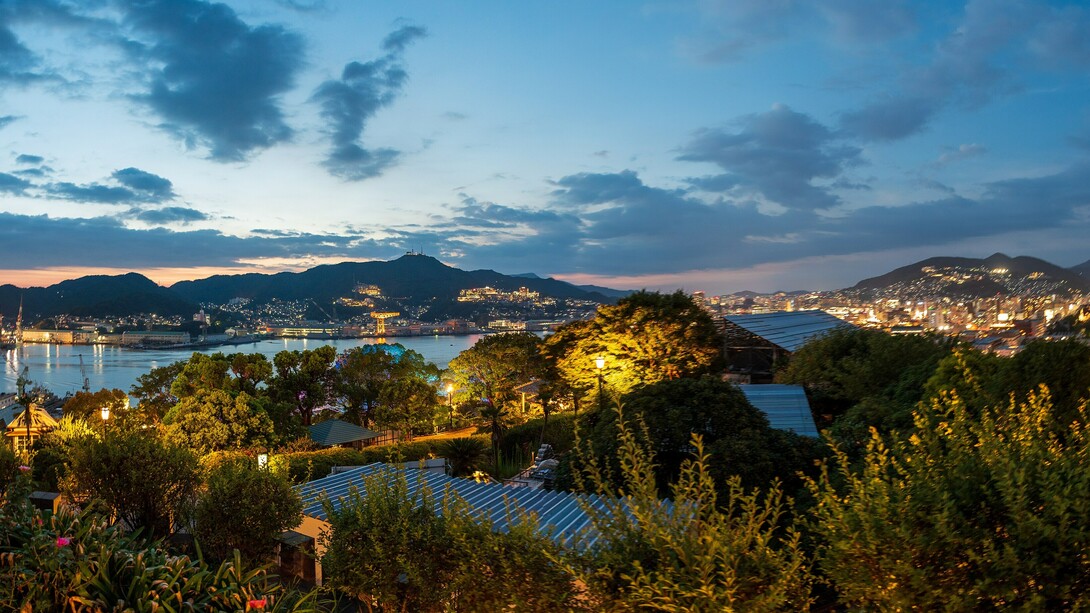
“Does this train go in this direction?”
I wasn’t quite sure myself which way the train from Hakata was heading, but I somehow understood what the elderly lady meant.
“If facing backwards makes you feel unwell, shall I sit opposite you? If the train is going the wrong way, I’ll switch seats.”
That’s what I offered her.
We sat facing each other, and a gentle conversation began.
“I’m from Nagasaki, now on the way back.”
“Is that so? I’m from Nagasaki as well.”
With that, memories of my childhood in Nagasaki came flooding back—the rain-soaked stone slopes, the clanging bell of the streetcar, and the faintly salty breeze drifting up from the harbour.
Beyond the scent of the sea, you could always sense a trace of distant foreign lands.
Travellers often call Nagasaki “a city of exotic charm”.
But to those who live here, Nagasaki is quieter, softer.
In the bustle of everyday life, moments appear that feel oddly like being on a journey.
And in the midst of travel, you find moments that feel like home.
Nagasaki breathes in that delicate in-between space.
Thinking of that “everyday Nagasaki”, I decided to walk through three places in my mind.
In this city where past and present blend gently together, let us set off to seek out its “unchanging beauty”.
Travelling with your palate — Tsuruchan
Getting off the tram at Shianbashi and walking along the stone pavement, an old sign catches the eye.
“Tsuruchan.” There isn’t a single Nagasaki local who doesn’t know the name. Founded in 1925, it is said to be the oldest café in Kyushu.
Across the ages, the same comfortable rhythm still flows here.
Many people notice its rather curious name. When I once asked about its origin, the owner explained with a laugh:
“Seen from above, Nagasaki Bay looks like a crane spreading its wings. That’s why we’re called Tsuruchan.”
A playful and charming story—very Nagasaki indeed.
The café’s signature dish is, of course, Toruko Rice (Turkish rice).
On a single plate sit golden cutlet, sweet-and-tangy ketchup-scented Neapolitan pasta, and butter rice—
all crowned with a smooth cascade of curry sauce.
Three dishes in one. It’s practically an adult’s version of a children’s lunch plate.
As you scoop a bite, the crisp sound of the cutlet’s coating meets the sweetness of the pasta and the savoury aroma of butter rice.
Each mouthful feels like being pulled back into the warm nostalgia of the Shōwa era.
My father adored this dish.
Whenever he had the chance, he would order “Turkish rice and milkshake”.
Nagasaki’s milkshake, however, isn’t a drink—it’s something you eat with a spoon, cold and comforting, soaked in nostalgia.
Inside the café, an old clock ticks steadily, and the polished wooden tables hold the warmth of decades of visitors. Students chat after school, office workers take a breath after work, elderly couples share the gentle aroma of curry.
Tsuruchan isn’t for “special occasions”—it’s an “everyday place”.
Nagasaki’s café culture began here, and continues to breathe here.
Walking through a story — Dutch Slope
Leaving Tsuruchan and riding the tram toward the harbour, you reach the hillside of Higashiyamate.
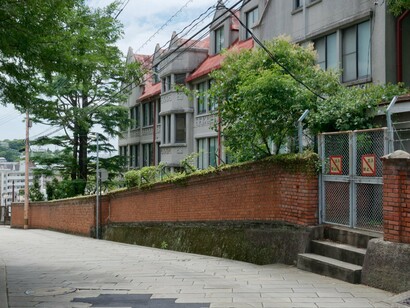
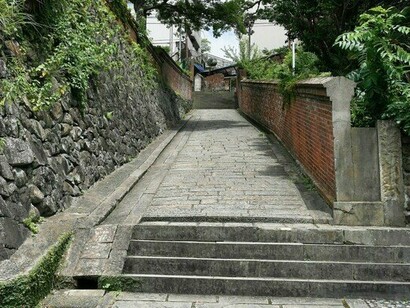
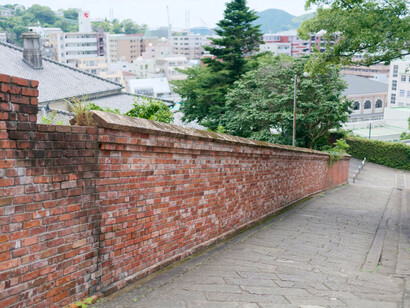
There, a gentle stone slope appears—Dutch Slope.
After Japan opened its doors to the world, this area became a foreign settlement, home to many Westerners.
Back then, the people of Nagasaki referred to all Europeans as “Oranda-san” (the Dutch), and so the slope naturally became known as Dutch Slope.
This was actually my school route.
Every morning I would stop halfway up the hill, look back, and see the harbour glittering beneath the sunlight.
The grandmother of the lady I met earlier on the train had married a foreign man in the Meiji era, she told me.
Crossing boundaries of culture and social standing, the two walked this slope together many times.
A romance in the Meiji era between a foreign man and a Japanese woman—
At dusk, she climbs the stone slope.
She pauses, turns back, and sees him standing at the foot of the hill.
The wind blows up from the sea, ivy leaves tremble,
and the light striking the brick wall wraps gently around the pair.
Such scenes still suit this slope perfectly.
While tourist couples take photos, local students run past, laughing.
Past and present overlap on the same incline.
At the top, Western-style residences from that era still stand.
Open a window, and sea breeze stirs the curtains, while a distant church bell rings.
Listening to it, you feel as if you’ve touched the heartbeat of someone from another time.
Love and life are much like a slope—
steep, breath-stealing, yet always leading to light at the top.
Dutch Slope is a small theatre reflecting the drama of human life.
As a side note, this spot is often used for filming dramas and commercials featuring the famously handsome actor Masaharu Fukuyama from Nagasaki.
One can easily imagine local women and tourists alike swooning whenever he appeared.
A view that reaches the night sky — Mount Inasa
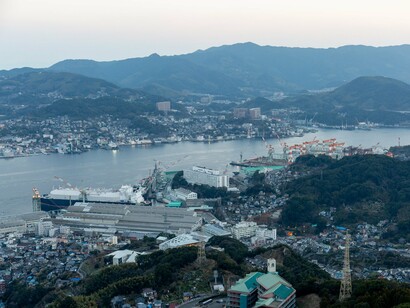
When the sun begins to set, Nagasaki slowly starts to glow.
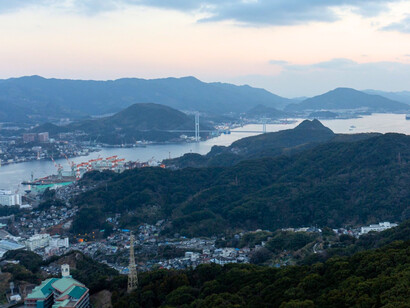
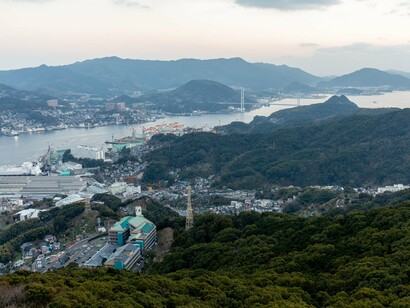
The most beautiful place to see those lights is Mount Inasa.
At 333 metres above sea level, it can be reached by ropeway, car, or—if you’re determined—on foot.
I rather like walking up, even if it’s quite a challenge.
As you climb the mountain path, the town below grows smaller and smaller.
Sometimes you meet elderly women resting on their verandas who laugh, “Oh my, you’re walking up? How tough!”
Honestly, I think their everyday life on this hillside might be tougher.
By the time you reach the summit, the sky has turned a deep indigo.
Lights begin to sparkle one by one around the harbour, until the whole city becomes a sea of shimmering light.
With Nagasaki’s bowl-shaped landscape, the layers of light look like stars falling to earth.
It's known as the “Ten-Million-Dollar Night View”, and is listed as one of Japan's top three nightscapes.
But its true charm isn’t the fully-formed night view.
It’s the brief moment before the sky turns completely dark—
that instant when sunset and night gently overlap.
There lies Nagasaki’s real magic.
Leaning on the railing of the observatory, I breathe deeply.
The city lights and the stars above seem to hold hands and twinkle together.
Within that glow, memories of my own life surface—
people working, laughing, waiting for someone, children sleeping.
Each light represents someone’s life, the heartbeat of the city.
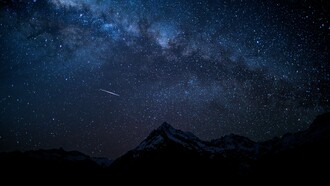
As night deepens, countless stars fill the sky, joining the lights below.
Look up: the universe.
Look down: the city.
Standing in the middle of it all is enough to make your chest ache.
Mount Inasa is a real-life planetarium connecting past and future, earth and sky.
What I hope you feel in Nagasaki
Nagasaki is not merely a “tourist spot”, but a city where stories live.
A café that records people’s histories, a slope like a black-and-white romance film, and a starry sky layered with thousands of lives—all of these play the rhythm of the city.
Here, past, present, and future all exist side by side.
I hope you’ll feel closely to that rhythm.
It brings an uncanny, almost timeless feeling.
Nagasaki welcomes visitors not as tourists, but as travellers through time.
Each time you walk this city, a small light will surely be kindled in your heart.
And in that moment, you too become a character in Nagasaki’s story.
As I left the train, I told the elderly lady, “Please live a long life.”
We had spent only thirty minutes together.
Yet simply because we shared the same hometown, our hearts drew close.
I wrote this piece in the hope of preserving that encounter as a precious story.