English
 Español
 Français
 Deutsch
 Italiano
 Português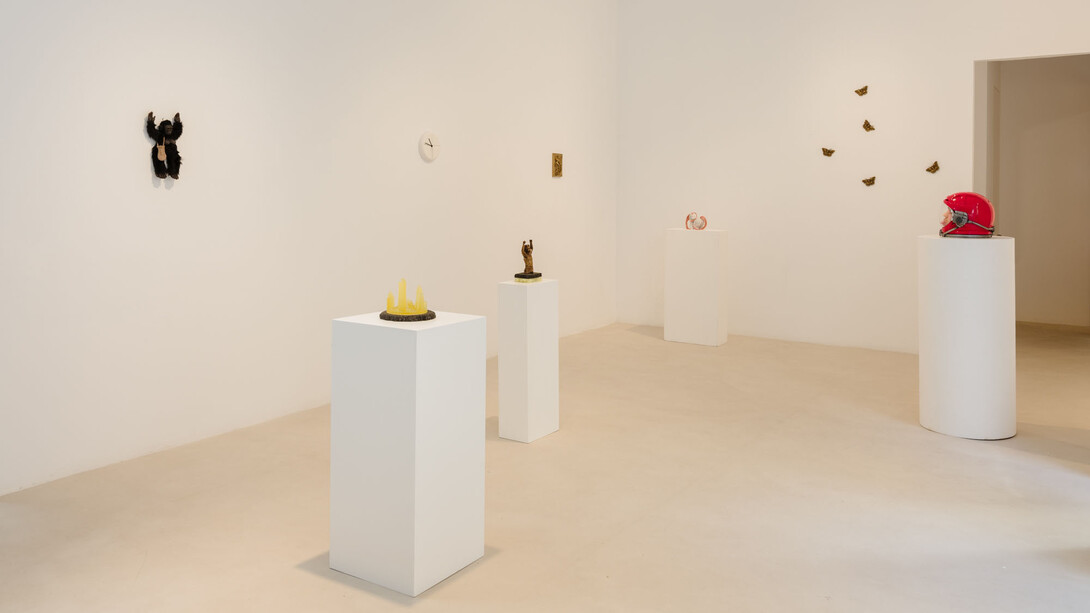
Throughout his career, Romeo Gómez López has drawn on a world of references and phenomena from mass media culture—global celebrities, characters from Hollywood films, toys, and action figures—in order to subvert their original meaning. In his work, these elements or figures are turned upside down, so to speak, in order to articulate unconventional or critical narratives that touch on various interests or themes, ranging from sexuality to the institution of art. On this occasion, his works move in a different direction and play with the possibility of articulating scenes with a certain tenderness and reconciliation—as a last refuge for coping with this shitty reality, with its indecent corruption and its systematic campaigns of disappearance, war, and extermination.
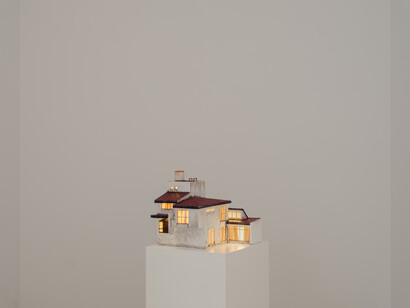
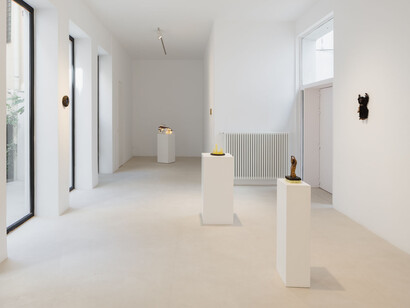
Looking at the works that make up Tierno es el día que los demonios se alejan, it feels as though you’re stepping into a children’s playroom. One of the most iconic works in this type of playful space is the dollhouse. Gómez López has built one for this exhibition based on the house where he lived as a child—a precise model featuring the textured concrete that was characteristic of middle-class residential architecture in 1980s Mexico. Like other artists who have explored the motif of the dollhouse, in this case the artist presents it as a model of interiority. It seems to suggest that, in some instances, the home fails to be a refuge. In her classic study on miniatures and dollhouses, Susan Stewart notes that the practical value of this scaled-down object lies in its ability to foster a process of daydreaming or imagination. The miniature concrete house, with its ornate door and an audio track emanating from within, may bring to mind horror films and encourages viewers to approach the object in order to peek inside and see what is happening. The piece encapsulates one of the theses that Gómez López revisits for this project: the origin of tragedy stemming from a lack of affection, love, or empathy. Several works in this exhibition address this issue by exploring different ways to alleviate or lessen such distress or pain. Clocknazempam is eloquent in this regard—it alludes to a sedative and lends itself to various interpretations by linking the art world to the pharmaceutical industry.
Other works featured in this exhibition draw on various products of the cultural industry, ranging from the classic film Metropolis (1927) to toys from the 2010 animated series My little pony. In the first case, Gómez López reinterprets the year 2026—the setting of Fritz Lang’s classic film—and updates it in light of the current global conflict. In a detailed bronze relief, he depicts the robot Maria against a backdrop of an urban landscape in ruins. Regarding the second animated series, the artist carved a marble sculpture of one of the ponies, in line with the fan art created by adult fans of the animation and its merchandise, who identify with the term “Brony.” The delicate carving of this little pony, almost like an idol or fetish, refers to the figure’s potential to inspire the gathering of communities around its themes of friendship and positive attitudes, while also satisfying that need for identity.
Cuando los demonios se alejan is a self-portrait that depicts the artist’s face inside a space helmet reminiscent of numerous science fiction films set in outer space—from 2001: a space odyssey (1968) to Project hail Mary (2021)—but also of the suits worn by some astronauts, such as the one worn by Yuri Gagarin. By sticking out his tongue and licking the inside of the helmet’s visor, Gómez López superimposes a comical, childlike, or erotic gesture onto the heroism, bellicosity, solemnity, and asceticism that characterize these science fiction narratives—not to mention the actual technological races that have taken place between various superpowers to conquer space at different times since the middle of the last century. In every lick there is a touch of self-indulgence. Understood as acceptance, it is also represented in the image of reconciliation in the bronze work Amor prehistoric (Prehistoric love). In this relief, a male figure tenderly embraces a menacing-looking Jurassic creature—in what could be seen as a reconciliation with what the past may signify.
(Text by Daniel Garza Usabiaga)

![Various artists, El lado caliente [The warm side], exhibition view. Courtesy of Travesía Cuatro](/attachments/9e461736d4173e61813478d40c123fe4286f2231/store/fill/330/330/c723f24f391b905508810f019aa9f3359fe01b06910c916d52200a570a76/Various-artists-El-lado-caliente-The-warm-side-exhibition-view-Courtesy-of-Travesia-Cuatro.jpg)