English
 Español
 Français
 Deutsch
 Italiano
 Português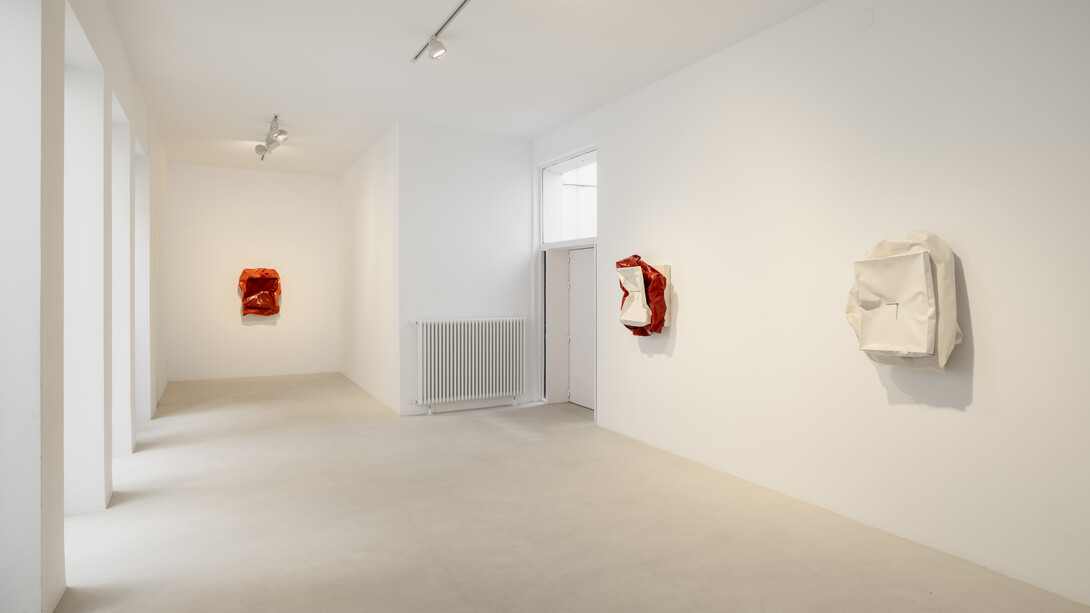
I like the title Bulto (Bulge). It’s intentionally ambiguous. It can be sexual, dangerous, or innocent. The word suggests that something is happening beneath the surface, something hidden. This idea is present throughout the series.
(Ángela de la Cruz)
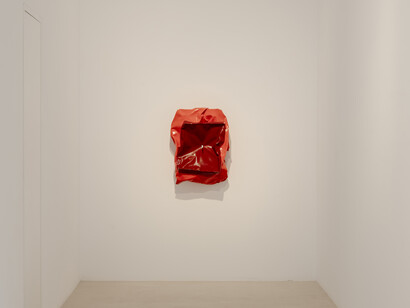
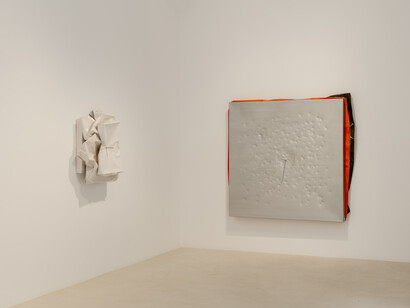
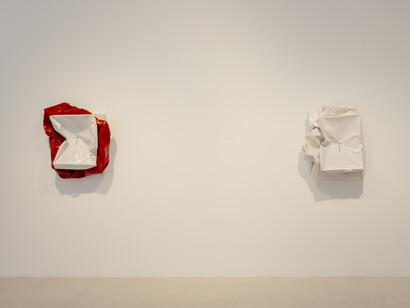
Super bulto is Ángela De la Cruz’s first exhibition at Travesía Cuatro Madrid following the recent announcement of her representation. This exhibition is the second chapter of a first presentation titled Bulto in Mexico in 2025. Super bulto invites the public to immerse themselves in a profound reflection on the essence of painting and its relationship to three-dimensional space. The concept Bulto, laden with meaning, evokes everything from the anthropomorphic to the mysterious, suggesting a hidden presence, a truth revealed through the surface of the canvas. In a contemporary art scene often dominated by straightforward narratives, De la Cruz’s subtle and evocative approach proposes a layered experience, challenging the viewer to discover the artwork’s own life.
Ángela de la Cruz (A Coruña, 1965) is one of the most prominent figures in contemporary art. Her move to London in her youth, inspired by the vibrant post-punk music scene, marked the beginning of a career that challenges the boundaries between painting and sculpture, creating a unique visual language. A pivotal moment in her career occurred in her London studio when, in a fit of frustration, she struck a canvas, deforming it. Far from being a destructive act, this gesture revealed a new dimension: the canvas acquired a physical form, opening a three-dimensional path for painting. Her innovative vision earned her a nomination for the prestigious Turner Prize in 2010, solidifying her status as an internationally renowned artist.
From the beginning of her career, De la Cruz has dedicated herself to thoroughly investigating what painting is. What defines painting? What are its material limits? And, crucially, when does it cease to be painting and transform into something else? Her creations have evolved from experimenting with canvases that collapse when released from their stretchers—a gesture that humanized abstraction—to developing a fully consolidated and unique artistic language. With Bulto, her most recent work, the artist marks a key shift: she leaves behind the idea of the accidental to focus on the explicit construction of the work.
While iconic series like Homeless (1996) and Clutter (2002-2005) presented the work as the result of a traumatic event—a fallen, broken, abandoned body—the Bulto series offers the viewer an almost defiant material honesty. Formally, the artist continues to engage with the legacy of minimalism, using the form of the canvas and the power of monochrome as starting points. However, here deconstruction is not an act of violence, but of assembly. The works are composed of visible layers: a rigid support that functions as a chassis, upon which meticulously painted layers of acrylic are superimposed. Tension, a perennial element in her work, is no longer a mysterious, internal force pushing from a hidden depths. On the contrary, it is the explicit result of an act of engineering: a metallic bolt, industrial and foreign to the pictorial tradition, pierces the layers and compresses them. This gesture of constriction centralizes the force, pulling the material inward and generating a topography of folds and wrinkles. The work does not conceal its anatomy; it exposes it. The bolt is not merely a functional element, but the focal point that articulates the relationship between the support, the material, and the force.
Conceptually, this shift is radical. De la Cruz transcends the metaphor of the wounded body to investigate the logic of the assembled body. The artist not only continues to blur the boundary between painting and sculpture, but also ventures into a territory where the art object reflects on its own condition as an artifact. These works demand a close gaze, one that appreciates both the conceptual genealogy from which they originate and the audacity of their new approach. Bulto is the affirmation of an artist in full command of her language, capable of finding a new and powerful eloquence, not in collapse, but in the deliberate tension of assemblage.
(Text by Luz Massot)

![Various artists, El lado caliente [The warm side], exhibition view. Courtesy of Travesía Cuatro](/attachments/9e461736d4173e61813478d40c123fe4286f2231/store/fill/330/330/c723f24f391b905508810f019aa9f3359fe01b06910c916d52200a570a76/Various-artists-El-lado-caliente-The-warm-side-exhibition-view-Courtesy-of-Travesia-Cuatro.jpg)