English
 Español
 Français
 Deutsch
 Italiano
 Português
![Various artists, El lado caliente [The warm side], exhibition view. Courtesy of Travesía Cuatro](/attachments/82fbe5b6d6137d9bd16deca413fe904b96faceb8/store/fill/1090/613/c723f24f391b905508810f019aa9f3359fe01b06910c916d52200a570a76/Various-artists-El-lado-caliente-The-warm-side-exhibition-view-Courtesy-of-Travesia-Cuatro.jpg)
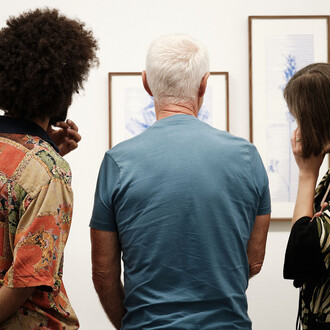
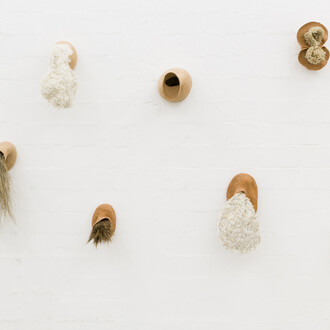
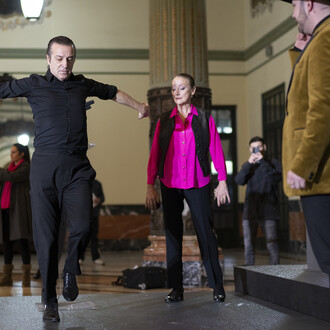
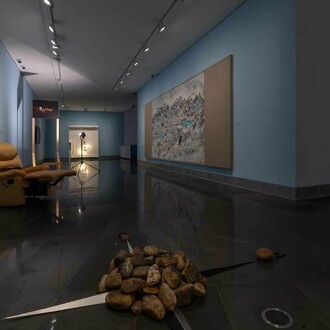
El lado caliente [The warm side] proposes an intervention, an intentional action that seeks to provoke a change in the situation. The title emerges from a text by Alana S. Portero, in which the author refers to the world of the living as “the side of the world where things are still warm”, in relation to the loss of a lover to HIV. In this sense, El lado caliente questions how we inhabit what still endures in the world, and the ways in which we choose to live with it.
The practices brought together here propose alternative ways of engaging with imposed realities, opening cracks from which to imagine other ways of being, remembering, and recognising one another. In this sense, they are gestures that do not adapt to such realities, nor do they accept the world as it presents itself as having exhausted the possibilities of world-making. On this side, where things are still warm, there is pain and there is affirmation, and there is an immense desire for openness towards the unknown, and towards other narratives capable of protecting and sustaining life.
Speaking of what remains warm is also to name what has lost its warmth; it is to honour those bodies that are no longer among us and to assume responsibility for their memory. Emissaries of amnesia (2025), by Felix Shumba (Bulawayo, 1989), is a multisensory installation of mourning and celebration that reflects on the Chimoio massacre, one of the main training bases and refuge sites of the Zimbabwean liberation movement in Mozambique. The work, composed of a charcoal mural on burial cloth, paintings, and a sound sculpture, examines the role of spiritual healers in the fight. The spiritual entities at the centre of this story, called emissaries, emerge through sound and arrive to offer accompaniment and a safe passage towards the world of the ancestors. Through their presence, the site of the massacre is reimagined as a space of care and convalescence.
Felix Shumba works around the conceptual framework and alternate universe which he terms Fold Field Space (FFS), an imagined site without fixed geographical or temporal references. It is a parallel rendering of the real world, a scene governed by a language of incoherence that the artist generates in opposition to the predictive logic of the contemporary world. Through exercises of distortion and theatricality, historical remnants are reactivated, acquiring a new interpretive charge. In this way, we are led into an unknown territory, somehow familiar, which destabilises our learned histories and inherited norms.
The struggle for liberation in Zimbabwe cannot be understood without the historical and spiritual bond between land and people. Within this worldview, land is not merely an economic resource but a territory inhabited by the ancestors, where an active relationship between the living and the dead is sustained. Felix Shumba produces his own charcoal using the burnt wood of trees from the places referenced in his works. In this sense, both the trees in the background and the sound emanating from the box operate as witnesses to history, revealing what is no longer present and conveying the tensions between the political and the spiritual in a liberation process that was also a reclaiming of territory as a space of collective memory and historical continuity.
Facing the incommeasurable suffering of experiences of violence, Gabrielle Goliath (Kimberley, 1983) develops the notion of a “radical familiarity”, understanding the familiar not as something natural or given, but as a relational core that offers bearing. Thus, she constructs spaces of listening where the audience does not consume the pain of others, but instead becomes an agent responsible for its presence. In Personal accounts (2024–ongoing), she addresses the normativity of patriarchal violence and the multiple ways in which Black, racialised, femme and queer people survive by affirming life and the possibility of cultivating conditions in which to thrive.
In cycles produced in different cities around the world, collaborators share their personal accounts of survival. El lado caliente presents an iteration of the project composed of four cycles that function as a sonic entanglement of wounds and presences. In a decision made together with the collaborators, the spoken words of each account are withheld to give way to sighs, songs, sobs, inhalations, and deglutitions, forming a chorus of the unspoken, “or if said, not heard”. By suspending verbal language, this gesture is conceived as an act of care and recognition, deactivating the prior conditions of “credibility” that so often shape and undermine the experiences of survivors.
To challenge narratives that define and destabilise the relationship between communities and their environments, Amol K Patil (Mumbai, 1987) constructs counter-memories through poetic yet precise reflections onlabour and visibility. In A forest of remembrance (2025), Patil draws inspiration from Mumbai’s iconic housing cooperatives (India), known as chawls: low-cost, multi-storey collective dwellings built for industrial workers between the 18th and 20th centuries, with rooms of less than 11 square metres shared by multiple family members. Originally built as prisons and later converted into housing, these structures contain thememory of histories linked to the workforce and everyday life. The artist focuses on a specific chawl, which he documented in 2017 through interviews with its residents. Now on the verge of demolition, the site stillholds traces of lived experience.
The works emerge as exercises of memory. Everyday objects such as a belt, a rope, gloves, or a box bear witness to what is left behind in these small spaces after long working hours. The uniform shirt and trousers, with hands and feet cast in bronze in a resting position and overlaid with a script written by the artist, evoke the lives of working-class individuals whose bodies become instruments of labour. The hands and feet, central to work in sanitation or factory settings, suggest a skin hardened by harsh conditions, while also introducing a performative dimension that narrates everyday gestures of labour and movement.
Amol K Patil, son and grandson of activist playwrights, finds in his father’s scripts archival material that shows how these artistic forms helped the inhabitants of the chawls navigate, build connections, and share theirexperiences. The work represents a moment of pause, a period of rest in which labour is suspended, giving way to the recognition of the body, its needs, and its desires.
In the practice of Vivian Caccuri (São Paulo, 1986), sound also operates as a living structure of transmission: a gesture of call and return that activates listening, bodies, and collective memory, understanding the sonicnot as representation but as relation, as a medium for entangling what we perceive with what still remains to be understood.
Caccuri attends to what unfolds at close and seemingly minor scales. It is through attentive listening, through what happens in concentrated ways, that a new reading of the world is revealed: a subtle disorientation ofthe everyday that allows us to rehearse a reconfiguration of our relationship with space and with what inhabits it. Her sound waves, sewn into pedestrian safety screens commonly used in construction sites, unfold a critique of the modern Western conception of time as a continuous line oriented towards progress. Instead, they propose forms of existence and memory grounded in continuity between bodies, territories and temporalities.
The Lava series (2023) is produced in a gestural manner and at the scale of the artist’s body. In this work, Caccuri draws on sinusoidal sound waves to open possible fissures through a combination of embroidery and unraveling in specific areas of the fabric. In this context, the work operates as a guide, containing the invisible and disruptive force of sound, and proposing a structure for a world yet to be understood.
Through the transformative capacity of fabulation and orality as a method of knowledge and recognition, the works of Paula Santomé and Krizia Leon Porta configure a network of counter-mythologies that hold onto thespace of imagination as one of the last remaining territories yet to be inhabited.
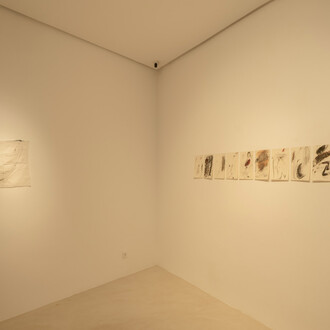
Krizia Leon Porta (Lima, 1996) explores our contemporary relationship with the sky, understood not only as a physical phenomenon but also as a site for the projection of meaning. Her charcoal drawings function as a mythological cartography of the sky, offering a symbolic space to reconsider fundamental questions and construct possible futures.
These works stem from an archive of photographs taken by her grandfather while he worked in a mine in the highlands of Peru, in Cerro de Pasco, where, to her surprise, she found images of the sky rather than oflabour, as if it offered a possibility of escape from the everyday. Drawing on colonial chronicles and ethnographic records from the Andean region, Leon Porta examines the abandonment of historical relationships withcelestial phenomena and turns her attention towards informal and ancestral knowledge as a space of possibility.
A critical reflection on the displacement of the symbolic as a tool for the construction of meaning and collective transmission is also present in the work of Paula Santomé (Vigo, 1994), through a re-examination of thepatriarchal imaginary and its channels of dissemination. The wall piece Before the equation (2026) questions the modes through which contemporary myths are transmitted and validated, revealing power structuresthat privilege control and rationality while silencing forms of knowledge rooted in intuition and orality. Santomé finds in the instability and permeability of oral transmission an opportunity to open fissures within dominantnarratives and to rehearse new fictions that incorporate forms of knowledge that have been historically discredited.
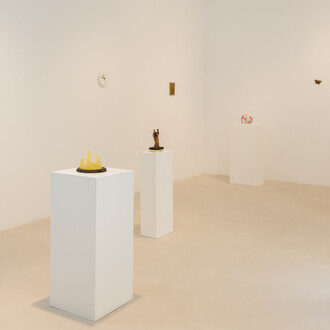
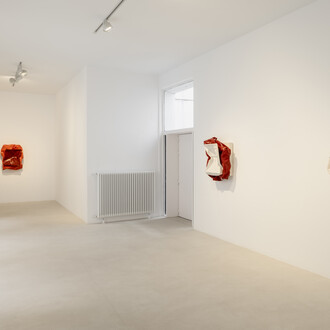
Moreover, Santomé traces the iconographic origins of the system by approaching mythology as an active structure that shapes our understanding of the environment and enables a rearticulation of the present. The aluminium cast sculpture included in the exhibition, Saved by a donkey (Aftermath) (2026), draws on the myth of the Roman gods Vesta and Priapus, recounted in various versions, including Ovid’s Fasti. It recounts Priapus’s attempted rape of Vesta while she sleeps, an assault that is prevented when the braying of a donkey awakens her before the god can fulfil his desire. In this way, the donkey becomes a sacred figure of protection, celebrated with flowers in festivals in honour of the goddess. However, in some later versions, Priapus attempts to punish or even sacrifice donkeys in retaliation.
This work condenses the force of patriarchal violence that underpins imaginaries of destruction, punishment, and desire, so present throughout history, in order to displace it and open up the possibility of rewriting theseseemingly fixed narratives that constitute the world, recognising their capacity to shift and mutate over time.

![Various artists, El lado caliente [The warm side], exhibition view. Courtesy of Travesía Cuatro](/attachments/93e8e1cea2ecf69d97f12ac5fcc830ce2a5f2283/store/fill/410/308/d0e5b45b30491e301baec8c739d88deba74626281f5672dd4032ee581a53/Various-artists-El-lado-caliente-The-warm-side-exhibition-view-Courtesy-of-Travesia-Cuatro.jpg)
![Various artists, El lado caliente [The warm side], exhibition view. Courtesy of Travesía Cuatro](/attachments/30d5ab63a489ccb7eed0bc0f78f5b9f19e77e32e/store/fill/410/308/6626080387fb2e6db1ac6877c798c15a25605ab3a75e94e1bc3e989743fb/Various-artists-El-lado-caliente-The-warm-side-exhibition-view-Courtesy-of-Travesia-Cuatro.jpg)
![Various artists, El lado caliente [The warm side], exhibition view. Courtesy of Travesía Cuatro](/attachments/2a7050e72acb1bd4b040c21793f0eb7fbee258ab/store/fill/410/308/bdca63ebbf91da6ba8be50d5ab1201c59f3092eab6e91564b03cb9156bb2/Various-artists-El-lado-caliente-The-warm-side-exhibition-view-Courtesy-of-Travesia-Cuatro.jpg)