English
 Español
 Français
 Deutsch
 Italiano
 Português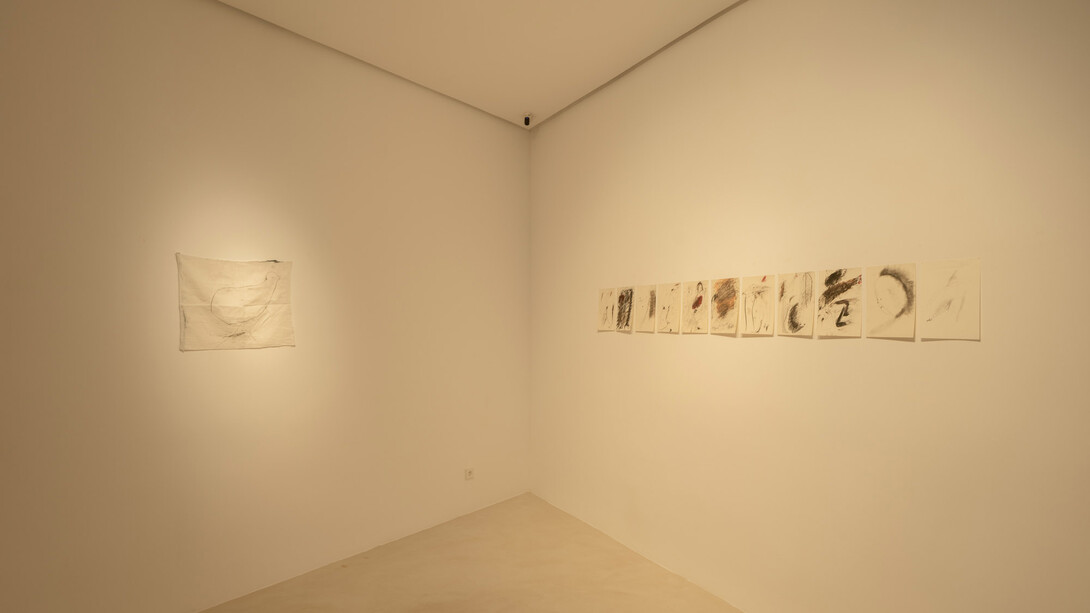
This exhibition is dedicated to Gisèle Pelicot, a woman who chose not to hide. Victim to one of the greatest sexual violence scandals ever known, Gisèle rejected anonymity to affirm something profoundly transformative: shame should not fall upon those who suffer, instead on those who harm. Her gesture, far from trying to appear grand, was the statement of someone who, despite being devastated, found the strength within to lend a hand to other women in her situation. Even after winning the court case, in which she endured months of viewing recordings of her own rapes, with her rapists in the room, she had the generosity to declare: “Victims, look around: you are not alone”.
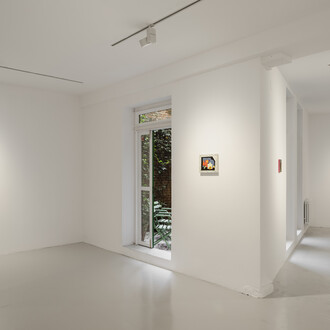
À Gisèle does not seek to illustrate nor represent directly the events of the Pelicot Case, nor does it want to translate them into closed narratives or points of view.
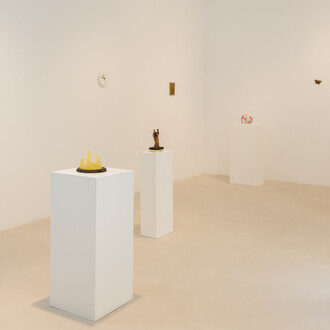
It is a dedication in an intimate sense: an act of profound attention, a respectful longing for closeness, and an attempt to unfold a landscape where the experience of the inconceivable can begin to take shape, albeit tentatively and inconclusively, without being reduced to a single narrative. Traumatic situations open up an ocean of thoughts and emotions, memories, echoes, projections, and whispers that overflow narrative language. Art, on the other hand, can sustain the ambiguous, the simultaneous, and the paradoxical; it can harbor meanings that cannot be ordered linearly, and give them existence without attempting to fix them. It is from this threshold that the practices of Armineh Negahdari, La Chola Poblete, Kiki Smith, and Maya Pita-Romero are situated, whose works are not located in the register of the discursive, but rather in that of a sensitive search: that of exploring, through art, that which resists language and remains open. This space of transition is not only aesthetic: it is also the place where a deeper rupture in the scaffolding on which our frames of meaning are constructed becomes visible.
In psychoanalytic terms, trauma bursts through when what occurs to us exceeds the symbolic configuration with which we interpret reality. The Real, as Slavoj Zizek explains, is that which resists symbolization and destabilizes our most basic certainties. In the Pelicot case, what is broken is not just an individual experience, it’s the coordinates that organize a shared idea of the world: the home as a refuge, the partner as a sphere of trust, the domestic as a safe zone. Violence does not act here like an isolated excess, instead it acts like a force that empties those referents of meaning from within, being enacted in a systematic and constant way in the heart of intimacy itself. When this occurs, what enters into a crisis is not just a story, but the very horizon from which it could be understood.
Beyond its judicial dimension, the Pelicot case manifests a structural fissure that crosses our contemporary societies. As the political philosopher Carole Pateman pointed out, the modern social contract, that proclaims liberty, equality and rights, was founded since its origin on top of a non-declared sexual contract, in which the subordination of women constitutes a silent condition of possibility. Although feminine autonomy has grown significantly in the legal and social sphere, this advancement has not been accompanied by an equivalent transformation of the symbolic, emotional and relational configurations that sustain that order. Formal equality thus coexists with private practices that contradict it.
Movements such as #MeToo have highlighted this gap between discourse and reality, exposing forms of violence and abuse that have long been normalized. However, far from being resolved, this tension persists in more opaque areas: a split between the public, socially correct face and a private sphere where fantasies of domination, possession, and rights over women’s bodies persist. Recent cases such as that of Robert Young in the UK, which bears disturbing parallels to that of Dominique Pelicot, reveal the extent to which these dynamics are not isolated anomalies, but a systemic problem.
The philosopher Manon Garcia, reflecting on the court case of Pelicot, returns to the notion of the “banality of evil” formulated by Hannah Arendt to propose the idea of a “banality of masculinity”: these monsieur Tout-le-monde are not exceptional monsters, instead they are vulgar men incapable (or unwilling) to interrogate the power automatisms that they embody. But the Pelicot case doesn’t just question the aggressors. It also exposes a much broader crisis, that affects women and the ties they have historically had. The documentary My husband raped Gisèle Pelicot (2025) demonstrates how wives, mothers and daughters of the accused continue defending them, refusing or reinterpreting the events in the name of love, family or the preservation of an emotional bond. In that very account, Gisele herself relates how, after the arrest of her husband, she discovered herself preparing his suitcase: an automatic act of care that reveals to what extent these habits persist even when the horror has already been plainly revealed. This is not a question of complicity, but rather of the structural and deep-rooted difficulty of abandoning roles of loyalty and devotion that have been built up over generations.
These episodes reveal to what extent the formal liberation of women still lives with impulses, affections and symbolic systems inherited from an earlier order. The sexual contract has been broken but still hasn’t been replaced by a new stable framework. What remains in suspense is not only the definition of categories like family, partner or intimacy, but also its own ontological entity: the way in which they exist, live and sustain themselves affectively and symbolically. The Pelicot case doesn’t just expose masculine violence, but also the fragility of the architectures through which we try today to give meaning to life, dedication, child-rearing, the identity of men and women and a way of coexisting which we have not yet found fully habitable.
In this context, the exhibition is conceived as a collective, almost ritualistic gesture. Not to close off meaning or offer answers, but to begin to weave it together. As in certain practices of public mourning or shared memory, art opens up a space where individual experience can be interwoven with a common elaboration, and where that which exceeded the thinkable can begin to take shape without being closed off. The works gathered here do not illustrate a story or propose a unified reading of the female experience, but rather configure an open and inconclusive field of resonances. It is in this dimension that the practices of Armineh Negahdari, La Chola Poblete, Kiki Smith, and Maya Pita Romero are integrated, through modes of work that operate on the liminality of that which has not yet found a stable form.
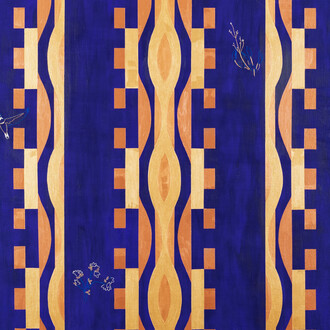
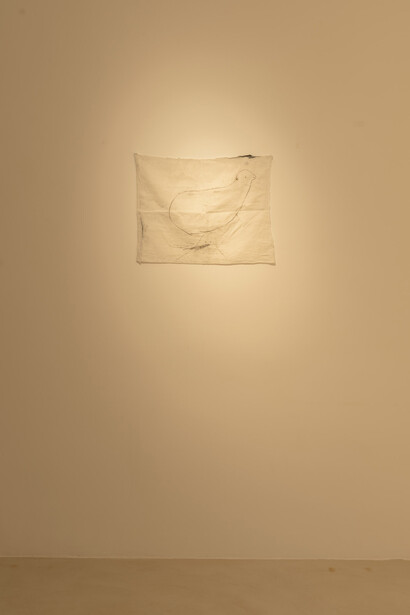
The collection of drawings exhibited by Armineh Negahdari, produced in 2025, appear to emerge from a place prior to language, before the polished social forces that transform emotion into narrative language. It has the immediacy of a scream, as if the very emotion had found a way of leaving a testimony of itself on the paper. The graphite, the smudges and the lines move with instinctive precision, revealing forms that do not describe, but rather incarnate: fear, tenderness, fragments of memory, contradictions that coexist without resolution.
Her process develops like a continuous flow, close to the experience of poetry: the meaning is felt, not explained. That early formation, anchored in a profound study of Persian poets, constitutes an essential dimension of her education and her being. Drawing for Nagahdari is a reiterated action, ritualized, a way of being in the world more than a strategy for expression. The drawing, dense and at the same time transparent, evoque something simultaneously cosmic and corporeal: the human touch as residue from a spiritual experiment. There is no attempt at virtuosity or seduction. Her works do not ask to be seen, they simply exist, austere, dignified, profoundly alive. In that absence of pretenses resides their strength. They reject the spectacle, in the same way that Gisèle did: both stand on their truth, unadorned, transforming what’s most private in a field of shared recognition. Through the most simple mediums, the work of Negahdari finds a language for that which has no words, tracing the outline of what trembles beneath speech.
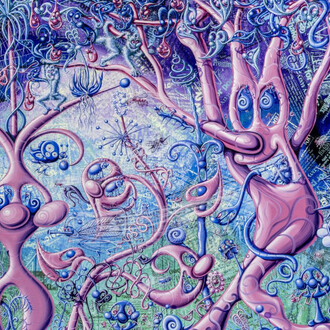
The work of Kiki Smith places itself in a sustained exploration of the human body as a place of experience rather than as a codified image. Her process does not begin from the position of discursive language, but rather from a radical curiosity for what it means to exist within a body, especially the feminine kind. In her works, the figurative appears and vanishes; the body is fragmented, opens up and becomes abstract. This is appreciated in Untitled (1992), five panels of drawing-sculpture on paper and tissue, in which fragments of a body appear that neither form a complete figure nor a stable anatomical order, but rather parts that float between the recognizable and the indeterminate: breasts, pubes, folds, bellybuttons, sexes or wounds.
Smith has affirmed that the history of the world is inscribed on the body. In her work that inscription is not formulated through discourse, but rather experience. The skin becomes a system in itself, a limit where gender, age, desire, fragility and resistance cross. The materials that she employs in her works like Untitled (1992) reinforce this ambiguous condition between the ephemeral and the persistent. Like skin, paper is fragile and resistant at the same time: it can tear, but also last.
In the work of Smith, the feminine body, historically sexualized and narrated from the masculine perspective, appears stripped of its forced neutralizations, but also of declarative emphases: it’s simply what it is. In this exhibition, her work allows you to inhabit the body like it belongs to you and is estranged from you, liberating itself, even if provisionally, from the narratives that have traditionally defined it from the outside.
In the work of La Chola Poblete, identity, body and memory are not announced as slogans, but rather as questions lived from the flesh. Her work, traversed by a political sensibility, is deployed in a tension between the spectacular and the intimate, between the artifice as affirmation and the shedding of the masque as a possibility of transformation. The character of “La Chola” with her braids, her ‘aguayo’ and her semblance of a indigenous and marrona diva, derive from a strategy of affirmation to confront the mechanisms of exclusion which leave marks on the bodies of the radicalized,feminised and different. But there are moments when that persona doesn’t do enough: the outfit loosens. The wig falls, and there emerges a voice that wants to speak from another place (less spectacular, more quiet) about what has hurt and hurts, about what doesn’t fit.
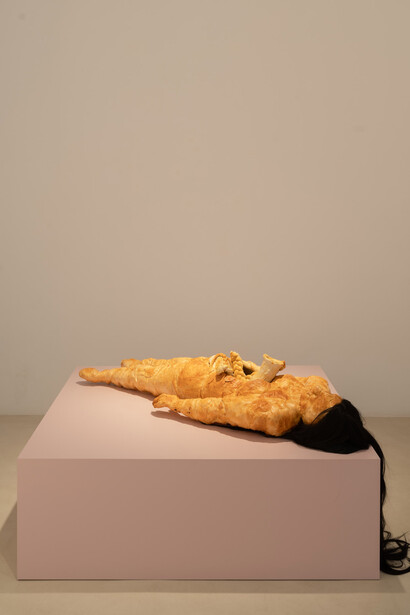
In the work Venus, marrona rajada (2023) a sculpture made of bread with an open womb, the symbolic and the material interlace: the indigenous body or the body of a woman as the invaded and devoured territory, like an offering or sacrifice, like open vases that no longer contain organs, brades, colonial remains or unviable offspring. The material, like the bread, grows and transforms by itself, like the bodies of La Chola, which are at once wound, limit and possibility. In her use of humble elements like the potato or raw dough, she draws genealogies that connect the collective and the personal: colonial history, family, language, abandonment, the divine. Like Gisèle, she removes the place of the icon to inhabit that of incarnate testimony. She also resignifies words which used to be insulting like “chola” or “travesti”. She also says: embarrassment is no longer mine.
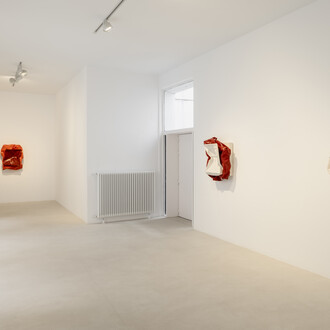
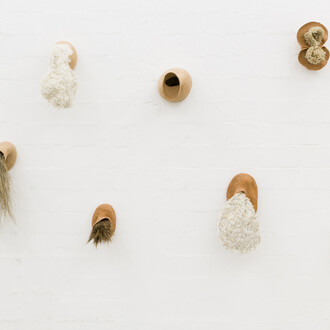
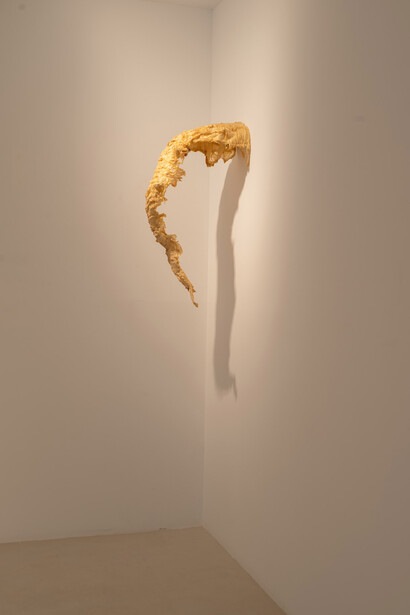
In the work of Maya Pita-Romero, the corporeal appears like an exposed organ: a terrain where the interior becomes independent without stabilizing into a recognizable form. The sculpture that she presents in À Gisèle evoques tongues, throats or cavities that oscillate between the erotic, the visceral and the disquieting, situating itself at the threshold between categories like inside and out, between what is articulated and what remains trapped in the body.
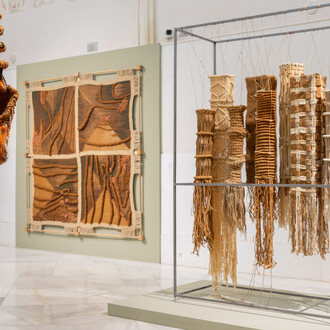
This work is integrated into a feminine lineage where artisanship stops being ornamentation and becomes knowledge incarnate. The inherited textiles and recycled plastics that she uses in her works refer to tranquil domestic habits, but that gentleness is pierced by monstrosity: veiny organs without bodies, disgusting yet attractive amber guts and membranes. In Maya that feminine lineage is not conciliatory: it is infected by historical contradictions, unresolved roles, forced slaveries. The tongues and throats try, they try to articulate until they tear, but they are confronted with their own limitations.
In the context of À Gisèle, these sculptures pose a sharp question: what happens when the feminine body, historically conceived as a place of availability, is revealed as a place of vulnerability yet irreducible. The work of Maya Pita-Romero maintains open that zone of indeterminacy where care, desire and silence coexist without resolution, forcing oneself to inhabit a regime of meaning which is no longer comfortable nor safe.
À Gisèle does not look to close a wound nor fix meaning. She unleashes a territory where what has been abused does not want to be reduced, explained or appropriated. The works here united remain there, without consolation nor spectacularization. Above all else, this is an exhibition dedicated to Gisèle. Now, after the impact, after the trial and victory, after the flashes and the multitudes. Now that the days grow quieter and the burden of an unfamiliar day to day presses down, Gisèle: you are not alone.
(Text by Laura López Paniagua)

![Various artists, El lado caliente [The warm side], exhibition view. Courtesy of Travesía Cuatro](/attachments/9e461736d4173e61813478d40c123fe4286f2231/store/fill/330/330/c723f24f391b905508810f019aa9f3359fe01b06910c916d52200a570a76/Various-artists-El-lado-caliente-The-warm-side-exhibition-view-Courtesy-of-Travesia-Cuatro.jpg)