English
 Español
 Français
 Deutsch
 Italiano
 Português
It is daybreak, and I have arrived at Diyasaru Park, across from the water-surrounded parliament complex in the suburbs of Colombo. Diyasaru Park, a wetland park, was created from land acquired for the newly built parliament building, which had been relocated from the Fort area of Colombo. Creating Diyasaru Park, an urban wetland, was an enlightened piece of city planning—sheer genius.
Colombo, the commercial capital of Sri Lanka, and much of its surroundings are, in fact, a matrix of naturally occurring wetlands further enhanced by a patchwork of rice fields which are supported by a man-made network of channels and lakes and ponds. All of this creates a vast wetland complex. A radio-collaring study several years ago identified no fewer than fourteen Fishing Cats occupying Diyasaru Park. Fishing Cats, Porcupines, Palm Civets and several other mammals present in the area are nocturnal. I was here to birdwatch, which is easier than mammal watching, as most birds are active during the day.
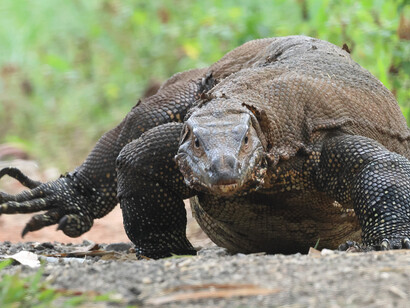
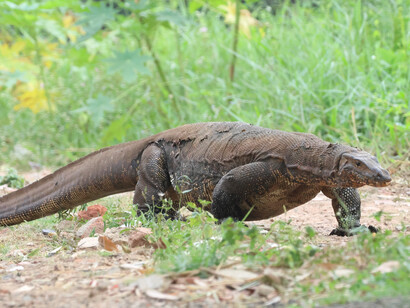
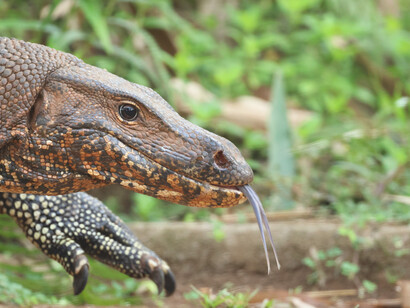
I entered the park to a rich array of bird calls. Common Ioras churred and whistled, White-bellied Drongos sang a varying medley of notes, interspersed with the mimicked calls and songs of other birds. A Stork-billed Kingfisher whinnied overhead. Lumbering towards me was a creature that looked like it was out of Jurassic Park. A large Water Monitor walked with a slow gait and a serpentine forked tongue flashing in and out. Old, dead skin on its body hung in patches that were peeling off. The Water Monitor is the second largest lizard in the world, second only to the Komodo Dragon found on the island of Komodo in Indonesia. Strong curved claws dug into the soil. The Water Monitor and the Komodo Dragon are closely related, with both in the genus Varanus.
The heavy tail furrowed the soil to show the giant lizard had walked the earth. The Water Monitor, as the name suggests, is partial to water. It is an adept hunter in the water, and I have seen them coming out of the water having caught some of the large fish in the wetland. It also scavenges, playing a useful role in the ecosystem. Fortunately, its flesh is poisonous, and it is not hunted, which results in some very large Water Monitors surviving in urban areas. Sadly, road kills do take their toll on Colombo’s busy roads. Less fortunate is the Land Monitor, which has tasty flesh. Individuals can still be found in urban Colombo, but large adults are rare. Perhaps those that do survive are the ones who have learnt to minimise contact with people.
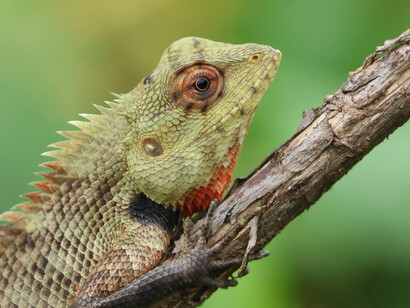
A Pscyhe, a small white butterfly, wafted past and settled down. I crept forward to take its picture. I stood up and was startled to find myself at eye level with a Common Garden Lizard. This is the commonest of the agamid lizards, or dragon lizards. 22 species are found in Sri Lanka, with an astonishing 19 of them endemic. This is one of the three which are not endemic, with an island-wide distribution. A line of spiky scales ran along the middle of its back to its crown. Up close, it did look like a miniature dragon.
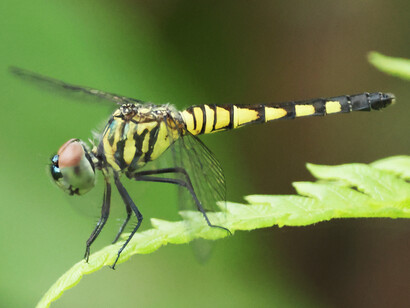
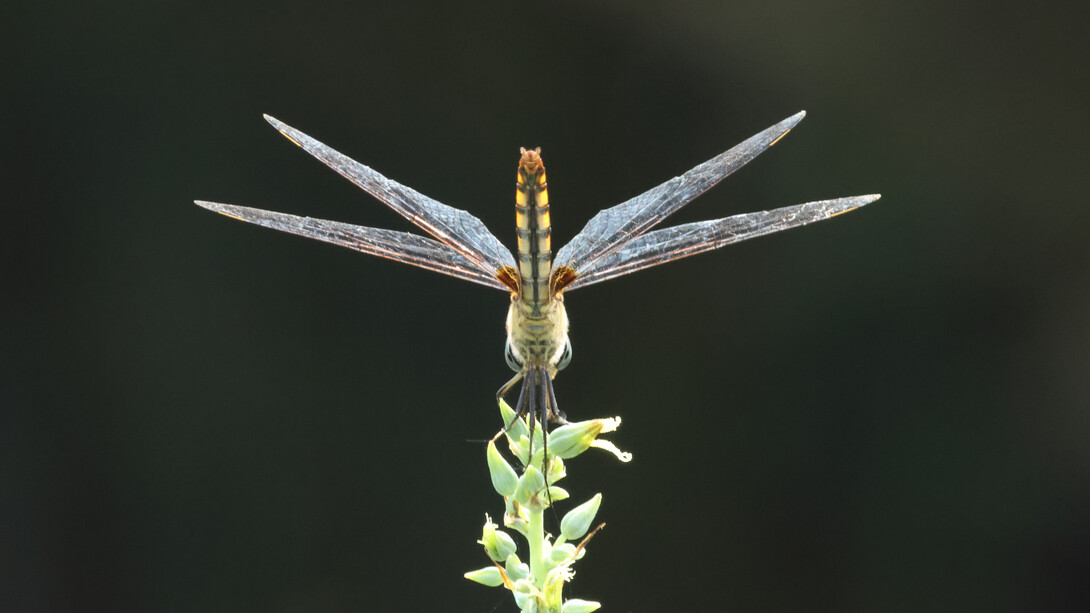
Other dragons were also in evidence. The dragonflies. Technically speaking, there are two sub-orders in the Odonata which comprise the dragonflies (Anisoptera) and the damselflies (Zygoptera). The dragonflies are robust aerial insects which are fearsome predators in their larval stage when they live underwater as a nymph. They are equally fearsome predators in their shorter life as a winged adult. The adult males are showy and bright and energetically patrol the waterways. Female dragonflies are often less conspicuously coloured and also less conspicuous in their behaviour. They often spend time feeding away from the water and come to the water when they are ready to mate, where they are immediately pounced on by males who are anxiously searching for females. I caught sight of a green and black female. I stalked it to take photographs. It was a Sombre Lieutenant. The males are highly visible and easy to photograph, but the females are harder to find.
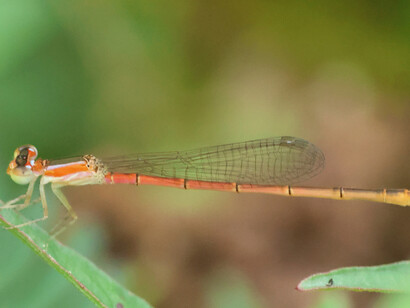
Lying spreadeagled on a fern was a Variable Flutterer. It lacks the high-octane dashing flight of typical dragonflies and instead flutters like a butterfly. Its females are also seen easily in and around open water. Little yellow sticks moved slowly over the vegetation like elongated drones being operated remotely. These were Yellow Waxtail damselflies. Some were in tandem with females. The Yellow Waxtail is another a species whose females are easy to see.
A little dash of orange flew past me, and I followed a Bush Hopper to where it perched. It was one of the 47 species of skippers found in Sri Lanka. The skippers are butterflies but different from typical butterflies, with their strong flight and habit when perched of folding the forewings over their body like a tent.
A troop of the endemic Purple-faced Leaf Monkeys whooped in the distance. Sometimes they break out into barks which startle people who have not heard them before. I looked at the plants around me. Most of the major groups of land plants were around me. The ferns (Pteridophytes), mosses (Bryophytes), and flowering plants (Angiosperms). Tens, perhaps hundreds, of Sri Lanka’s land plants are yet to be described to science. In the water was an interesting plant, the Golden Bladderwort. It is carnivorous. It has bladders underwater which trap aquatic invertebrates.
As the sun rose, I could hear the swelling of the muted rumble of distant traffic as the morning rush hour began. Nevertheless, it did not detract from the magic of this urban wetland park, which is a microcosm of Sri Lanka’s precious biodiversity.