English
 Español
 Français
 Deutsch
 Italiano
 Português
In the early years of spaceflight, every manoeuvre was a performance. Rooms full of engineers monitored telemetry screens. Flight directors issued commands. Propulsion specialists calculated burns. Communication delays demanded patience. Every decision passed through human hands.
Today, a single operator can supervise dozens of satellites. Tomorrow, even that will be too slow.
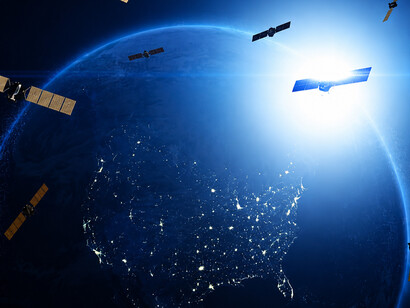
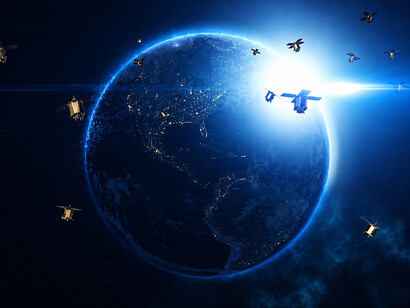
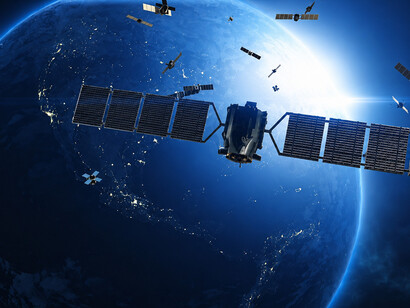
The number of active spacecraft is exploding. Communications constellations. Earth-observation fleets. Servicing robots. Manufacturing modules. Power stations. Fuel depots. Data centres. Lunar transports. Soon, thousands of independent machines will share orbital space. Human attention simply does not scale to that level of complexity.
The only viable solution is autonomy — not merely in spacecraft subsystems but in orchestration of entire orbital ecosystems.
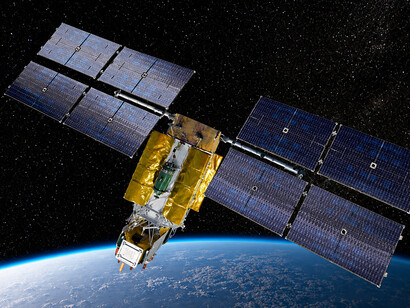
This evolution has already begun. AI collision-avoidance systems manage mega-constellations. Spacecraft detect anomalies and reconfigure without waiting for ground intervention. Autonomous rendezvous and docking are operational. Digital twins simulate spacecraft continuously on Earth, predicting failures before they occur.
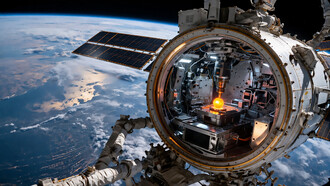
The next step is network-level governance. AI systems ingest telemetry from thousands of assets. They track power flows from orbital solar plants. They monitor thermal loads in data centres. They assess propellant inventories in depots. They map debris fields and traffic congestion. They predict maintenance needs weeks in advance. Then they coordinate responses: dispatch repair robots, reschedule docking, reroute data traffic, and rebalance energy distribution.
Human operators still define objectives and constraints. Prioritise national security assets. Maintain safety margins. Enforce regulatory compliance. Set service-level agreements. But AI decides how to achieve these goals minute by minute, continuously, across an environment no human team could manually control.
When a radiator panel degrades, a robot is dispatched automatically. When solar output drops during eclipse, compute workloads shift. When a tanker is delayed, mission schedules adjust. When debris risk rises, orbit plans change. All without waiting for human deliberation.
This is not optional. It is the only scalable operational model.
With autonomy comes the challenge of trust. How do you certify an AI system that controls critical infrastructure hundreds of kilometres above Earth? How do you audit decisions made without direct oversight? How do you assign liability when an autonomous system makes a wrong call?
Aviation offers precedent. Nuclear energy offers precedent. Safety-critical autonomy is not new. What is new is extending it into an environment where physical intervention is slow and expensive. Certification frameworks, explainable decision logs, deterministic safety constraints, and cryptographic security layers become mandatory.
Standards bodies are already drafting protocols for autonomous space traffic management. Insurers are modelling risk profiles for AI-governed spacecraft. Space agencies are defining “human-on-the-loop” governance structures — humans supervising policies while machines execute operations.
Commercial opportunity follows naturally. Companies will license orbital governance software. Traffic management AI. Depot logistics controllers. Power-dispatch optimisation engines. Manufacturing schedulers. Constellation orchestration suites. Nations will demand sovereign autonomy layers for strategic assets. Interoperability protocols will become as critical as propulsion technology.
Security will be paramount. Autonomous systems must resist hacking, spoofed telemetry, and adversarial interference. Orbital AI becomes critical infrastructure: hardened, redundant, encrypted, auditable. Whoever masters trustworthy autonomy gains not just efficiency, but strategic control.
By the late 2030s, most orbital infrastructure will operate semi-autonomously. By the 2040s, some networks may function for months with minimal human intervention. By mid-century, orbital industry may behave like a living system — sensing, adapting, repairing, and optimising continuously.
At that point, space no longer feels like a frontier commanded from control rooms. It becomes a managed industrial domain, quietly self-regulating above the atmosphere.
And the irony is elegant: as humanity expands into space, machines will live and work there on our behalf. Not because we cannot, but because complexity demands delegation.
When space runs itself, civilisation becomes multi-planetary in operation, even if most humans never leave Earth.
As orbital infrastructure scales, autonomy is no longer a convenience but a prerequisite for safety, efficiency, and growth. The nations and companies that master trustworthy, auditable, resilient autonomous governance will quietly control the operating system of near-Earth space. This will not be announced with ceremony. It will appear in smoother traffic flows, lower failure rates, and invisible optimisation working continuously above the atmosphere. And when space begins running itself, humanity’s expansion beyond Earth will cease to be episodic exploration and become a permanent industrial presence.
The strategic implication is clear: control of orbital autonomy is not merely a technical advantage but a governance advantage. Whoever defines the protocols, safety standards, and decision hierarchies of autonomous space operations will shape how access, security, liability, and commercial participation evolve. In the same way that operating systems once determined the structure of the digital economy, autonomous governance layers will determine the structure of the orbital economy. Those who build them first will not just operate space infrastructure — they will set the rules by which everyone else must operate. In this domain, leadership will be measured not in rockets launched, but in systems trusted to think and act beyond Earth.