English
 Español
 Français
 Deutsch
 Italiano
 Português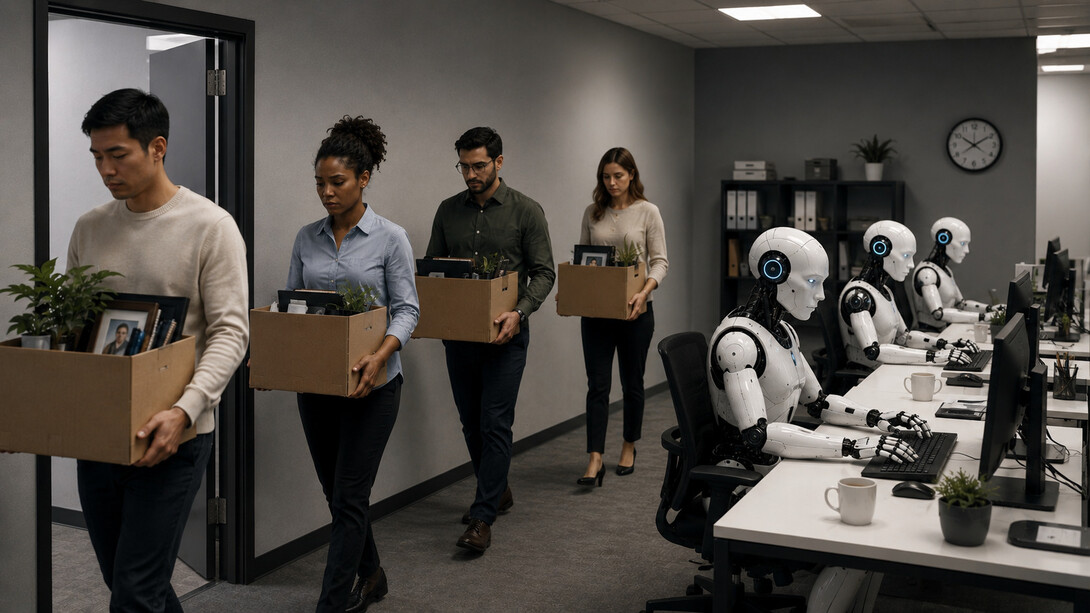
Unless you have deliberately tuned out the news cycle, it is hard to ignore the growing anxiety around artificial intelligence and jobs. From ChatGPT reshaping how people write and research to Google unveiling AI tools that can build presentations, analyse data, and automate workflows, the message is clear: work is changing, fast.
For some, this feels like the beginning of a golden age of productivity. For others, it looks like the start of widespread job displacement. The truth, as usual, sits somewhere in between.
Artificial intelligence will remove certain roles, transform many others, and create entirely new kinds of work. The real question is not whether jobs will be affected, but how, when, and who will feel the impact most between now and 2030.
AI’s economic promise and its disruption
Major research institutions largely agree that AI has the potential to significantly boost global economic output. According to the McKinsey Global Institute, AI could add around $13 trillion to global economic activity by 2030, representing roughly 1.2% additional GDP growth per year. Much of this growth is expected to come from productivity gains, automation, and faster innovation across products and services.
Forbes has gone further, describing AI as one of the most disruptive technologies global economies have ever developed. Bernard Marr & Co. similarly argue that AI’s impact will extend far beyond economics, reshaping legal systems, regulation, politics, and nearly every profession in some way.
However, disruption does not automatically translate to mass unemployment. Historically, general-purpose technologies, from electricity to the internet, have displaced certain jobs while creating new industries and opportunities. AI appears to be following a similar, though uneven, trajectory.
How many jobs are actually at risk?
Predictions vary widely, depending on assumptions and timelines. Goldman Sachs estimates that AI could eventually replace the equivalent of 300 million full-time jobs globally, particularly affecting routine cognitive tasks. The firm also suggests that AI could automate up to a quarter of work tasks in the U.S. and Europe while simultaneously increasing global output by about 7%.
Other studies are more conservative. The McKinsey Global Institute estimates that by 2030, around 14% of workers globally may need to change careers due to automation, robotics, and AI advancements. Meanwhile, the World Economic Forum projects that 85 million jobs could be displaced by AI by 2026 but also notes that many new roles will emerge alongside those losses.
This mixed outlook highlights a critical distinction: task automation is not the same as job elimination. In many cases, AI changes what people do rather than whether they are employed at all.
Roles most exposed to automation
Jobs built around repetitive, rules-based tasks are generally the most vulnerable. Customer service roles, for example, increasingly rely on AI chatbots to handle routine enquiries. Reception and front-desk duties are also being automated through voice assistants and robotic systems.
Bookkeeping and accounting functions are being streamlined by AI-powered financial tools, while sales and advertising roles have shifted heavily toward automated, data-driven digital platforms. Warehousing, insurance underwriting, retail checkout, and certain forms of data analysis are also seeing growing levels of automation.
These changes are not speculative. They are already happening, driven by cost pressures, scalability, and efficiency gains.
Jobs AI is unlikely to replace
At the same time, many professions remain difficult to automate because they rely on human judgement, emotional intelligence, ethical reasoning, or complex interpersonal interaction.
Teaching, for instance, extends far beyond content delivery. Lawyers, judges, and senior managers depend on experience, negotiation, and contextual decision-making. Psychologists, psychiatrists, and surgeons operate in deeply human, high-stakes environments where trust and empathy matter as much as technical skill.
Creative roles, such as artists and writers, are also more resilient than headlines suggest. While AI can assist with drafts and ideation, originality, cultural insight, and emotional resonance remain distinctly human strengths. (Talmage-Rostron)
Is AI really causing mass layoffs?
Despite alarming headlines, recent data challenges the idea that AI is already driving widespread unemployment. A research briefing from Oxford Economics argues that firms are not replacing workers with AI at scale. Instead, the report suggests some companies may be framing traditional layoffs as “AI-driven” to present a more positive narrative to investors (Lichtenberg).
According to data gathered from Challenger, Gray & Christmas, AI-related job cuts made up about 55,000 U.S. layoffs in the first 11 months of 2025, just 4.5% of total reported job losses. By contrast, layoffs attributed to general economic conditions were four times higher.
Oxford Economics also points to a key indicator: productivity. If AI were truly replacing workers en masse, output per worker should be rising sharply. So far, it is not. Productivity growth has remained sluggish, reinforcing the idea that AI adoption is still experimental rather than transformational at scale.
The skills question matters more than the jobs debate
What is becoming increasingly clear is that adaptability, not job title, will determine who thrives in the AI era. As LinkedIn notes, most workers already interact with AI daily, whether through voice assistants, recommendation systems, or workplace software.
To stay relevant, experts consistently highlight the importance of lifelong learning, soft skills, agility, and specialisation. Technical literacy matters, but so do communication, creativity, and the ability to work across disciplines.
As Talmage-Rostron observes, the future belongs less to those who resist change and more to those who build skills aligned with evolving market needs. This is partly why next-generation online universities and flexible training models are gaining traction, offering faster pathways into AI-adjacent careers.
A slower revolution than headlines suggest
Despite the noise, AI’s impact on employment appears to be evolutionary rather than revolutionary. Oxford Economics concludes that current labour market shifts reflect cyclical pressures more than structural collapse, with AI often used as a convenient explanation rather than a direct cause of job losses (Lichtenberg).
The technology will continue to reshape work, but not overnight, and not uniformly. For now, the greatest risk is not AI itself, but failing to adapt as it becomes embedded across industries.
The future of work is not about humans versus machines. It is about how effectively people learn to work with them.
Works cited
Lichtenberg, Nick. AI Layoffs Are Looking More and More like Corporate Fiction That’s Masking a Darker Reality, Oxford Economics Suggests.” Fortune, 7 Jan. 2026.
Talmage-Rostron, Mark. How artificial intelligence will change the world Nexford University, Nexford University, 29 June 2025.