English
 Español
 Français
 Deutsch
 Italiano
 Português
Universal Princonser Law proposes a new understanding of the legal phenomenon based on the universal essence, understood as the proportional unity between legal energy and legal matter. This approach holds that legal systems should not be analyzed solely from the perspective of norms, institutions, or particular facts, but rather from the universal principles and laws that explain their organization, transformation, and development.
This article identifies the energy and matter of the Universal Princonser Law, applies the ten universal foundations of the method, and formulates a scientific law aimed at explaining the stability and evolution of legal systems. The research concludes that legitimacy, stability, and legal integration depend on the proportionality between legal energy and legal matter, with this relationship constituting the central foundation of the new universal legal paradigm.
I. Material and method
Elements of the Princonser method
The research is based on the universal essence, the three universal principles, and the six universal laws applied to the legal phenomenon. The universal essence establishes the proportional unity between energy and matter. The universal principles explain the inseparability, conservation, and destruction of systems. The universal laws explain the dependence, interaction, integration, disintegration, temporality, and intemporality of all organized reality.
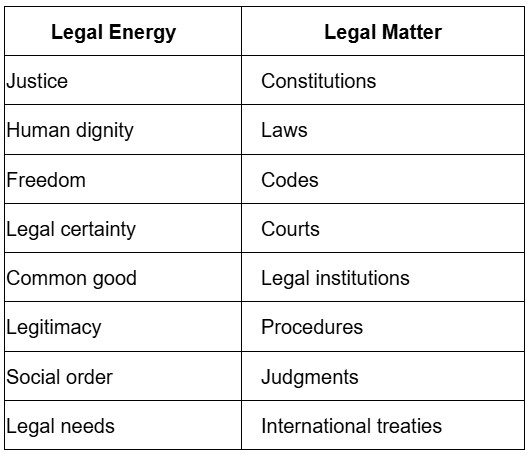
Energy and matter of Universal Princonser Law
II. Identification of the problem
Legal principle of destruction
All unstable material systems are destroyed, releasing energy. In Universal Princonser Law, legal structures that lose legitimacy in the face of social needs enter into processes of instability. This loss of coherence breaks the correspondence between legal energy and legal matter. As a consequence, the system generates conflicts that drive new forms of legal organization. For example, constitutions or institutions that cease to respond to social demands are often reformed or replaced to regain legitimacy.
Legal law of disintegration
In all unstable systems, the system's matter transforms into energy, generating descending qualitative changes. When legal norms and institutions drift away from the principles of justice, dignity, and security, a process of legal disintegration begins. This rupture diminishes social trust and weakens institutional cohesion. As a result, conflicts increase and the stability of the legal system deteriorates. An observable example is institutional corruption, which reduces the legitimacy of the legal order.
Legal law of temporality
All systems are temporary due to their disintegration. Legal systems are subject to historical processes of permanent transformation. Laws, constitutions, and institutions change as social needs evolve. This temporality demonstrates that no legal structure remains immutable. For example, constitutional reforms reflect the adaptation of legal matter to new historical and social conditions.
III. Solution to the problem
Legal principle of conservation
All forms of energy are conserved through transformation processes. In the legal sphere, the values of justice, freedom, and dignity are conserved by transforming into norms and institutions. This transformation allows legal needs to remain current over time. As a consequence, legal evolution does not imply the loss of principles, but rather new forms of materialization. For example, fundamental rights remain in force even though the legal mechanisms that protect them may change.
Legal law of integration
All legal energy oriented toward social order tends to integrate into stable legal structures. Collective needs generate norms, institutions, and procedures designed to guarantee coexistence. This integration strengthens social cohesion and legal stability. As a result, the legal system increases its capacity for organization and protection of rights. An example is the creation of specialized agencies to guarantee emerging fundamental rights.
Legal law of intemporality
Although legal structures are temporary, legal energy is intemporal. The fundamental values that drive law continue to exist even when the institutions that represent them change. This permanence allows the historical continuity of the legal system. Therefore, justice, dignity, and security continue to guide the creation of new legal forms. An example is the permanence of the ideal of justice across different eras and legal systems.
IV. Identification of the law
Universal essence of law
Every legal system is a unity of legal energy and legal matter. Universal Princonser Law identifies legal energy as justice, dignity, freedom, security, and the common good, while legal matter is constituted by norms, institutions, and procedures. This unity demonstrates that law simultaneously possesses an intangible dimension and a material dimension. Therefore, understanding the legal phenomenon requires analyzing both dimensions in an integrated manner. An example is the relationship between the principle of justice and the courts responsible for materializing it.
Legal principle of inseparability
In all legal systems, legal energy and legal matter are inseparable. There is no justice without institutional mechanisms to materialize it, nor legitimate institutions without values to guide them. This unity guarantees the functional coherence of the legal system. Therefore, legitimacy depends on the integration between values and structures. An example is the inseparable relationship between fundamental rights and legal protection mechanisms.
Legal law of dependence
In every stable legal system, there is a proportional relationship between legal energy and legal matter. Each legal need requires structures capable of representing it. In turn, each legal structure needs a purpose that justifies its existence. This correspondence determines the stability and legitimacy of the system. For example, the effective protection of human rights requires adequate institutions to guarantee their fulfillment.
Legal law of interaction
Legal energy and legal matter interact permanently, conserving their proportionality. Social needs influence norms, and norms influence society. This interaction drives the continuous evolution of law. As a result, the legal system adapts to new realities while maintaining its internal coherence. An example is the creation of new regulations to respond to technological and social transformations.
V. Statement of the law
Princonser Universal Law of Legal Proportionality
Statement
Every legal system achieves stability, legitimacy, and integration when legal energy and legal matter maintain a proportional relationship of continuous dependence and interaction; when this proportionality is broken, processes of disintegration, transformation, and legal reorganization emerge.
Symbolic representation
EJ ∝ MJ
Where:
EJ = Legal Energy
MJ = Legal Matter
∝ = Functional proportionality relationship
Universal interpretation
Legal energy represents the values, principles, and needs that drive social organization. Legal matter represents the normative and institutional structures that materialize those values. Legal stability depends on the proportional correspondence between both dimensions. When balance exists, legitimacy and social integration increase; when proportionality is broken, conflicts, loss of institutional trust, and processes of legal transformation appear. This law expresses the universal essence of Universal Princonser Law and constitutes the explanatory foundation for the evolution of legal systems.
General conclusion
Universal Princonser Law posits that legal knowledge must transcend normative description to identify the universal laws that explain legal phenomena. The universal essence of law manifests itself as the proportional unity between legal energy and legal matter. The ten universal legal foundations allow for the analysis of the stability, transformation, and evolution of legal systems from an integrative perspective. The Princonser Universal Law of Legal Proportionality synthesizes this paradigm by establishing that the legitimacy and stability of law depend on the proportional interaction between legal values and legal institutions.